Submersible vs Turbine Pump for Solar Tube Wells in Pakistan
Updated 30 October 2026 · By SolarNevs Research Desk, Dealer surveys + verified sources · 25 sources · Method ↗
Key Takeaways
- We found no source that compares a submersible with a turbine pump for a solar tube well, in Pakistan or elsewhere. GIZ and FAO's toolbox defines submersible and surface pumps, and the World Bank guide classifies solar pumps as positive displacement or centrifugal. Neither discusses lineshaft turbines.
- "Turbine" can mean two designs. A lineshaft turbine has its motor at ground level. Goulds also sells turbines with a submersible motor. The useful contrast is submersible against lineshaft.
- KSB says that in very deep boreholes the drive shaft and bearings tend to push up the cost of a lineshaft installation, and a submersible motor becomes more advantageous. It gives no depth, and Xylem's listing calls multistage lineshaft turbines ideal for deep-well pumping. No source we found ranks the two on efficiency, and US dealer blogs give differing partial statements, none about solar tube wells.
- A lineshaft turbine's motor is above ground. Franklin lists pulling a submersible pump to replace worn parts, and Floway says major repairs on a turbine typically mean removing the unit while packing and seal repairs do not.
- Franklin's guidelines for its three-phase submersible motors on a VFD, which are not written for solar, allow continuous running between 30 Hz and rated frequency with a one-second maximum ramp between stopped and 30 Hz. We found no source on a lineshaft turbine on a solar VFD.
- The only Pakistani pump-type shares we found are in a 2003 IWMI paper from a survey of about 2000 to 2001, mostly of diesel private tube wells: about 95 percent horizontal centrifugal, 5 percent "submerged turbine". The Pakistani sellers we read describe submersible pumps or name no pump type, and none lists a turbine.
Introduction
The manufacturers' manuals say a lot about how each type is installed, set, serviced and run on a drive. They say little about which is better for a solar tube well. This guide gives what they say, labels dealer opinion as opinion, and drops the claims that have no source.
What are the two pump types?
GIZ and FAO name two ways to install a solar pump: submersible or surface. They define a submersible pump as a motor and pump combination designed to be placed entirely below the water surface, and call the most common configuration a solar generator on a fixed structure powering a submersible pump in a borehole. Their toolbox gives submersible installation depths from 10 to 120 meters, and says surface pumps can pump water up from a maximum depth of six meters.
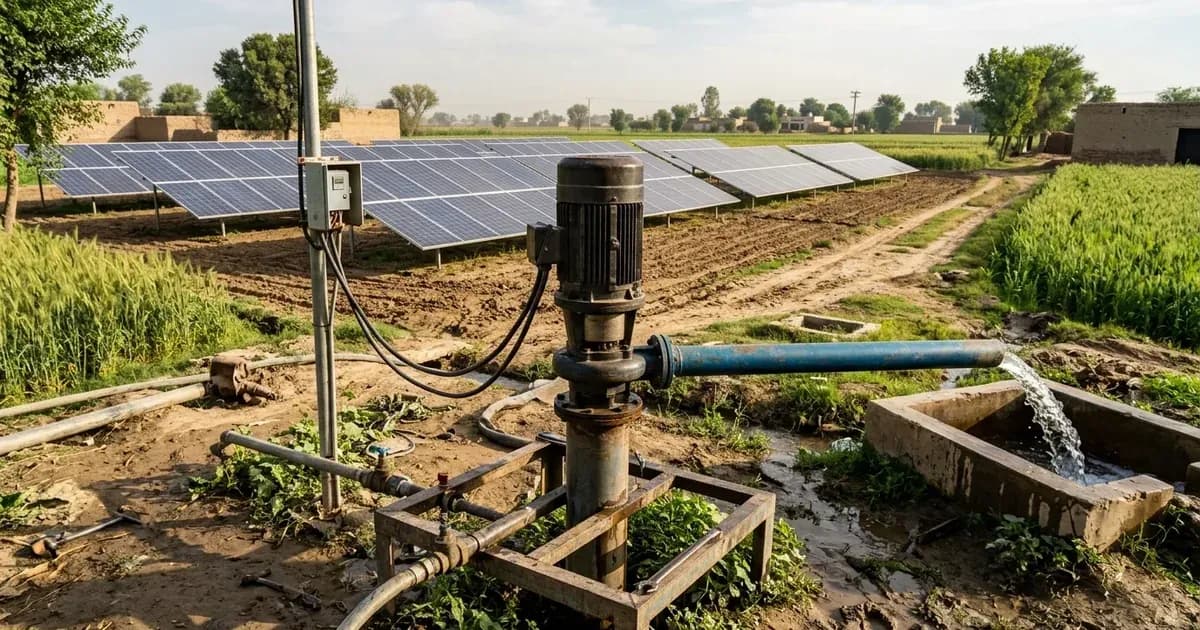
A deep-well turbine, in KSB's words, is a borehole pump whose pump shaft extends up to ground level, where it is coupled to a dry installed motor. Goulds sells both kinds: deep well lineshaft turbines (DWT) and submersible turbine pumps (VIS) with the motor below. So a "turbine" does not always keep its motor above ground. When this guide says turbine it means lineshaft.
Which is better in a deep borehole?
The manufacturer statements we found are about cost and depth. KSB says that if the boreholes or wells are very deep, the drive shaft and intermediate bearings tend to push up the overall cost of the installation, and it becomes more advantageous to install borehole pumps with submersible motors instead. It names no depth and says nothing about efficiency. Xylem's listing calls multistage lineshaft vertical turbine pumps ideal for deep well pumping and also gives no depth.
On efficiency we found no neutral or manufacturer source. Dealer blogs give differing partial statements. A US dealer writing for municipal systems says vertical turbines tend to offer better efficiency at higher flows, while submersible turbines may cost less to operate at lower duty points. A US service company says line-shaft vertical turbine pumps are generally more effective than submersible motor vertical turbine pumps, though this isn't always the case. A third dealer, Hoover Pumping, says submersible pumps operate more energy efficiently than land-based centrifugal pumps, which is a comparison with surface pumps, not turbines. We found no source for a general claim that submersibles are more efficient.
IWMI's 2021 Pakistan report says that for depths greater than 100 feet the cost of solar tube wells increases significantly and becomes uneconomical. That is about solar tube wells in general, not about pump type.
What happens when the water level falls?
Submersible. Grundfos says the installation depth must always be at least 1 m below the maximum draw-down level of the well, and the bottom of the motor must never be lower than the top of the well screen or within 1.5 m of the well bottom. Franklin lists resetting the pump to a lower level as a remedy for a low well level, with the warning not to lower it if sand may clog the pump. DAB rates the immersion depth of its current S4 motors at 300 m and 250 m by motor type.
Lineshaft turbine. KSB says deep-well turbine pumps can be extended in modules, meaning shaft sections. UC Davis Extension says surging from a falling pumping level can be corrected by lowering the pump intake pipe, and adds that lowering a pump will not increase discharge if surging does not occur and may slightly decrease it through added friction in the column pipe.
We found no source that gives the cost, time or effort of lengthening a turbine, and none that calls it a significant modification. The World Bank notes that water level may vary considerably between seasons, affecting pumping head, which applies to either type.
How do sand and silt affect each type?
We found no source saying either type is immune, and sand limits belong to individual products.
- Grundfos SP submersibles: maximum sand content of 50, 100 or 150 ppm by range, and a larger content may reduce the life of the pump and increase the risk of blockage. The stainless steel construction makes the pump resistant to abrasion, but constant exposure to sandy water may cause damage.
- DAB S4: a maximum sand content of 120 g/m3 on the distributor-hosted datasheet and 150 g/m3 on the current UK technical sheet.
- GIZ/FAO: in very poorly constructed wells with high sediment content, the hydraulic part of the water pump may have to be replaced after 2 to 3 years, while in a drilled well with proper casing submersible pumps may last 7 to 10 years.
- Lineshaft turbines: Floway says its standard unit is not designed to pump large amounts of abrasives or debris. We found no numeric sand limit for a turbine, so there is no like-for-like comparison.
We also found no source saying in words that a sealed submersible motor is protected from silt.
Maintenance and pulling
Xylem says that on a lineshaft turbine the hydraulic components are submerged while the motor is above ground, making it easy to access electrical components. Floway says major repairs typically consist of removal of the unit and disassembly, while packing box and mechanical seal repairs can be done without removing the complete unit. Franklin's troubleshooting for submersibles lists pulling the pump and replacing worn parts, and a US dealer writing for municipal systems says a submersible turbine is harder to service because the entire pump has to be hoisted out for repair.
Alignment and installation
Lineshaft turbines carry alignment tolerances. Floway says alignment depends on the shaft ends butting squarely, and gives a driver shaft alignment of within 0.002 inch where the head or motor stand has jacking screws, noting that manual driver alignment is not required if jacking screws are not supplied. Goulds' industrial turbine manual sets a straightness limit on the lineshaft. Both manuals are for general or industrial vertical turbines, not tube-well pumps.
A submersible is not quite a single unit. Franklin shows the pump end and motor joined by a splined coupling assembled with grease, and its troubleshooting names misalignment between pump and motor as a check. DAB offers the pump body, with or without an oil-filled or water-filled motor, or a kit. A dealer says submersible-motor turbines have fewer alignment and coupling concerns, and that lineshaft installation requires skilled technicians.
Can either run from a solar VFD?
Manufacturers set limits for running a submersible on a VFD, but their manuals are not written for solar. Franklin's 50 Hz guidelines for its three-phase submersible motors say they run continuously between 30 Hz and rated frequency, with a one-second maximum ramp between stopped and 30 Hz, and that minimum cooling flow must be maintained in variable-flow service. It says its single-phase submersible motors are not recommended for variable speed operation. Grundfos says not to run asynchronous motors below 30 Hz and never to reduce speed until the flow of cooling liquid past the motor is no longer ensured. DAB states its S4 motor is suitable for use with inverters between 30 Hz and 50 Hz. The World Bank adds that centrifugal pumps do not produce any water below a threshold speed.
For lineshaft turbines we found no manufacturer or neutral source on solar VFD use. Goulds says its Aquavar controller pairs with its VIS or DWT pumps, which is not a solar statement. Goulds' industrial turbine manual says slow running of a new or rebuilt pump may not flush and cool the stuffing box bushing, and a US service company says shallow-set line-shaft turbines on a variable speed drive are much more prone to vibration than deep-set ones.
We found no source on the starting torque a VFD must provide for either type, so this guide does not state a torque rule. See the solar pump VFD selection guide for the drive manufacturers' own tables.
What do Pakistani tube wells and sellers use?
A 2003 IWMI working paper, drawing on a survey of about 2000 to 2001, says about 95 percent of the pumps are centrifugal with horizontal shaft suction lift, and submerged turbine pumps make up the remaining 5 percent. It does not say whether those are lineshaft or submersible-motor, and it describes private tube wells that were mostly diesel. The same paper puts the average bore depth of tube wells at 35 to 85 meters. IWMI's 2021 report describes PCRWR solar pilots in Pakistan that were meant to show PV submersible DC pumps can work reliably.
Of four Pakistani sellers we read, none lists a turbine. W11stop's solar submersible category lists 40 pumps. Solar Citizen's system price includes a submersible pump. Pakistan Solar Traders describes a submersible or monoblock pump. Alpha Solar's page names no pump type. These are four pages, not market data, and we found no Pakistani price for a turbine pump or a lineshaft solar system.
Solar submersible pump prices in Pakistan
W11stop lists these DAB S4 pumps as solar submersibles. DAB's own documents describe the S4 as a multistage, centrifugal, submerged motor-driven pump on mains power, single phase 230 V or three phase 400 V at 50 Hz, for clean water including irrigation. None of the five DAB documents we searched mentions solar, though a separate DAB S4SUN data sheet, hosted by a distributor, describes a solar motor coupled with an S4 pump. These are asking prices for the pump listed, seen on 28 October 2026.
Product as listed | Price | Rating on DAB's older datasheet | Stock status |
|---|---|---|---|
DAB S4 D 21 | Rs 75,000 | 2.2 kW (3 HP) | Coming Soon |
DAB S4 E 17 | Rs 75,000 | 2.2 kW (3 HP) | Coming Soon |
DAB S4 F7 | Rs 75,000 | 2.2 kW (3 HP) | Coming Soon |
DAB S4 F13 | Rs 115,000 | 4 kW (5.5 HP) | Coming Soon |
The same category lists a DAB S4 D 13 of 1.5 HP at Rs 60,000. The retailer labels the F13 as 5 HP where DAB's datasheet says 5.5 HP. The D, E and F names appear in older DAB datasheets (a distributor-hosted copy, and a sheet on DAB UK's site with a 2016 file path), not in DAB's current S4 sheet, and we assumed w11stop's pumps are those models.
Solar pump inverter (VFD) prices
These are the same retailer's asking prices for the drive listed, seen on 28 October 2026. Its "updated on" stamp equals the date of the request, so it is not evidence of when a price last changed.
Product as listed | Price | Stock status | Note |
|---|---|---|---|
Hyundai N700E-022HF, 2.2KW / 3HP (as listed) | Rs 285,000 | In Stock | Described as industrial and commercial; details block shows Rs 92,000 |
Hyundai N700E-037HF, 3.7KW / 5HP (as listed) | Rs 349,000 | In Stock | Same description; details block shows Rs 100,800 |
SAJ VFD Drive 4 kW | Rs 48,000 | Coming Soon |
|
SAJ VFD Drive 5.5 kW | Rs 58,000 | Coming Soon |
|
JFY 5.5 kW 400 V 3-phase | Rs 112,200 | Coming Soon | Details block shows Rs 100,000 |
Taifu 5 SM 14-13F, 5.5 HP / 4 kW | Rs 69,000 | Coming Soon |
|
Voltronic Power Aspire 2.2 kW | Rs 38,500 | Not stated | Category listing |
Voltronic Power Aspire 7.5 kW | Rs 54,000 | Not stated | Category listing |
INVT GD170-PV | Rs 52,000 | In Stock | The title says 5.5kWh, a unit that does not fit an inverter rating |
The Hyundai N700E description never mentions solar, so ask the seller for the drive's solar specification before buying it for a solar pump.
What do complete systems cost?
Alpha Solar's table, with columns headed Estimated, read on 28 October 2026 under a 2023 price heading on a page titled 2025:
System | L2 structure | Pole mounting | Contents listed |
|---|---|---|---|
3 HP | Rs 345,000 | Rs 515,000 | 6 panels of 500 W, a 5 kW VFD, supporting structure |
5 HP | Rs 540,000 | Rs 730,000 | 10 panels of 545 W, a 5 kW VFD, mounting structure |
A pump is not in either list, and the page does not use the word submersible. Our price tables show larger systems seller by seller.
Summary and Recommendations
- Ask the seller which pump type they are proposing and why, and ask for the pump's own datasheet, not the retailer's title. The DAB documents we searched describe the S4 on mains supply and do not mention solar.
- Give the seller your draw-down, depth and sand content. Setting depth follows draw-down and well depth (Grundfos), and sand limits are stated per product, so compare your water's sand with the datasheet limit.
- If you consider a lineshaft turbine, ask who aligns it, who services it, and for evidence it has run on a solar VFD. We found none.
- For a submersible on a drive, follow the motor maker's limits. Franklin's guidelines for its three-phase motors say 30 Hz minimum, a one-second ramp and cooling flow past the motor, and they are not solar-specific.
- Related guides: groundwater rules and agri-solar and solar tube well versus diesel.
Correction, 28 October 2026: earlier versions of this guide said submersibles are generally more efficient and generally preferred for deeper wells, that turbines need significant modifications, that starting torque is critical, and described DAB S4 pumps as solar pumps. Those statements could not be supported as written, and have been replaced or removed. KSB supports only a cost statement for very deep boreholes.
Solar tube-well quotes from installers who work in your district
Tell us pump size and district. We pass your number to installers who quote against the surveyed prices on this page.
How this pays for the site: installers pay SolarNevs a fixed introduction fee when we pass them a genuine enquiry. They cannot pay to appear higher, and our surveyed prices are published before any introduction. You can also take our dated price tables straight to any installer.
Frequently asked questions
What is the main difference between a submersible and a turbine pump for solar tube wells?
A submersible puts the motor and pump below the water: GIZ and FAO define it as a motor and pump combination designed to be placed entirely below the water surface. A lineshaft turbine keeps a dry motor at ground level with a shaft down to the pump, as KSB describes it. Goulds also sells turbines with a submersible motor, so turbine can mean either. We found no source that compares them for a solar tube well.
How much does a solar submersible pump cost in Pakistan?
On 28 October 2026 w11stop listed three DAB S4 models of 3 HP at Rs 75,000 each and the F13 at Rs 115,000, with stock marked Coming Soon. DAB's older S4 datasheet puts the 3 HP models at 2.2 kW and the F13 at 4 kW. None of the five DAB documents we searched mentions solar, and they describe the S4 on mains supply; a separate DAB S4SUN data sheet describes a solar motor coupled with an S4 pump. These are one retailer's asking prices for the pump listed.
What components are included in a solar tube well system?
It depends on the seller. Solar Citizen says its price includes solar panels, VFD, submersible pump, mounting structure, wiring and installation. Alpha Solar's 3 HP system, in a table with columns headed Estimated, lists 6 panels of 500 W, a 5 kW VFD and the supporting structure, and a pump is not on that list.
What factors determine the choice between submersible and turbine pumps?
Grundfos says to determine the maximum depth of the well and the draw-down at the pump's maximum capacity, and wants a submersible set at least 1 m below the maximum draw-down level. Sand limits are stated per product: for its SP pumps Grundfos gives 50, 100 or 150 ppm by range and says a larger content may reduce pump life, and DAB gives 120 g/m3 on a distributor-hosted datasheet and 150 g/m3 on its current UK sheet for the S4. Access matters too: a lineshaft turbine's motor is above ground, Franklin lists pulling a submersible pump to replace worn parts, and Floway says major turbine repairs typically mean removing the unit. No source we found gives a depth at which one type becomes the better choice.
Where can I find prices for solar pump inverters in Pakistan?
On 28 October 2026 w11stop listed a SAJ 4 kW drive at Rs 48,000 and a SAJ 5.5 kW drive at Rs 58,000. Its Hyundai N700E drives at Rs 285,000 and Rs 349,000 (the same pages' details blocks show Rs 92,000 and Rs 100,800) are described as industrial and commercial, and the description does not mention solar. These are one retailer's asking prices for the drive listed, not quotes.
References
- GIZ/FAO, Solar Powered Irrigation Systems Toolbox, Module 1 — accessed 28 October 2026
- World Bank/ESMAP, Solar Pumping: The Basics (2018), SuSanA library copy — accessed 28 October 2026
- FAO and GIZ, solar powered irrigation systems technology brief — accessed 28 October 2026
- KSB centrifugal pump lexicon, deep-well turbine pump — accessed 28 October 2026
- Goulds Water Technology vertical turbine brochure for agriculture and irrigation (2017) — accessed 28 October 2026
- Goulds model VIC vertical industrial turbine pump manual — accessed 28 October 2026
- Weir Floway vertical turbine pump installation, operation and maintenance manual — accessed 28 October 2026
- Xylem deep well turbine pumps (Water Online listing) — accessed 28 October 2026
- Grundfos SP/SPE submersible pump installation manual — accessed 28 October 2026
- Franklin Electric AIM manual, 60 Hz 2026 edition — accessed 28 October 2026
- Franklin Electric AIM manual, 50 Hz 2016 edition — accessed 28 October 2026
- DAB Pumps S4 4-inch submersible pump datasheet (distributor-hosted) — accessed 28 October 2026
- DAB Pumps UK, S4 AMEIRA technical sheet — accessed 28 October 2026
- UC Davis Cooperative Extension, Coping with Declining Groundwater Levels — accessed 28 October 2026
- Kinetiflo Group, vertical turbine vs submersible turbine (dealer blog) — accessed 28 October 2026
- Pump Repair Services, submersible and line-shaft vertical turbine pumps (service company blog) — accessed 28 October 2026
- IWMI Working Paper 64, The Groundwater Economy of Pakistan (2003) — accessed 28 October 2026
- IWMI SoLAR, Solar Irrigation in Pakistan: A Situation Analysis Report (2021) — accessed 28 October 2026
- w11stop - solar submersible pump listings — accessed 28 October 2026
- w11stop - solar pump inverter listings — accessed 28 October 2026
- Solar Citizen - solar tubewell system price guide — accessed 28 October 2026
- Pakistan Solar Traders - solar tubewell price list — accessed 28 October 2026
- Hoover Pumping Systems - irrigation pump types (US dealer blog) — accessed 28 October 2026
- DAB S4SUN solar data sheet (distributor-hosted copy) — accessed 28 October 2026
- Alpha Solar - solar tubewell price list — accessed 28 October 2026
Related guides
More from sizing, net billing & installation.