Victron VE.Smart Networking: Wireless Sync & Setup
Updated 16 September 2026 · By SolarNevs Research Desk, Dealer surveys + verified sources · 1 source · Method ↗
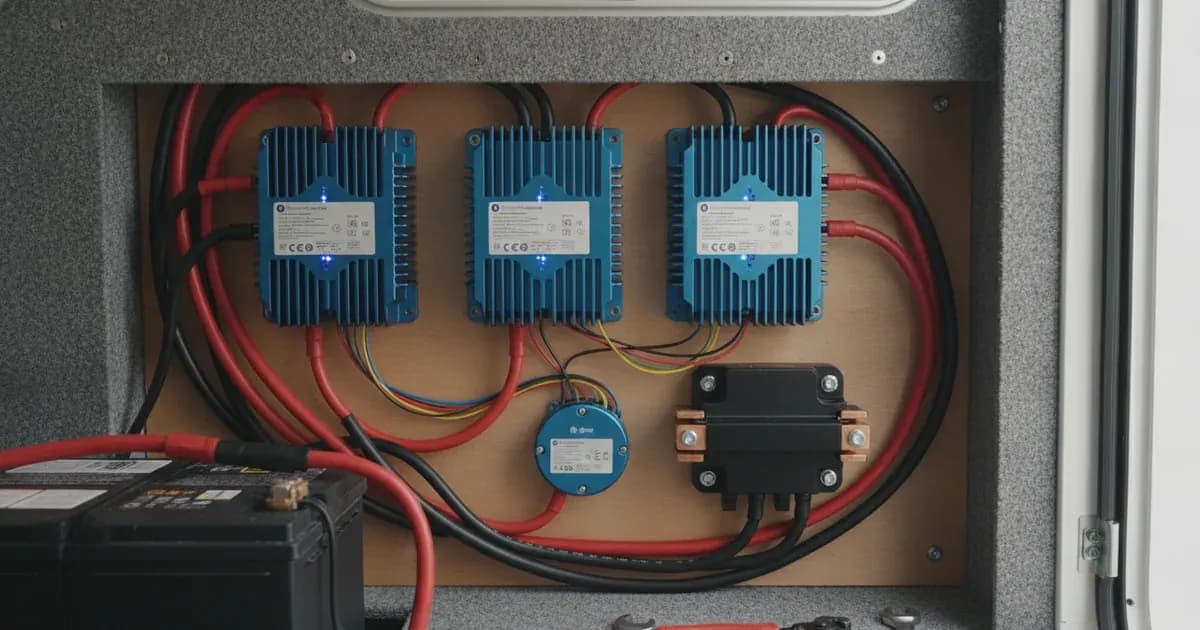
Key Takeaways
- The system operates where VE.Smart Networking is a wireless communication network between Victron products called Bluetooth Smart.
- Maintains a stable wireless mesh with The maximum number of devices that can be connected to one network is 10.
- Facilitates unified solar charging: Connect multiple SmartSolar charge controllers together in a VE.Smart network to make them charge the battery as if they were one large charger.
- Ensures coordinated charge state transitions: They will simultaneously switch from one charge state to another, for example from bulk to absorption.
- Provides accurate remote voltage telemetry: Remote Voltage reading - Vsense.
- Broadcasts battery temperature for thermal compensation: Temperature sensing - Tsense.
- Enables precision tail-current charge termination: Current sensing - Isense.
- Coordinates unified charging logic through Synchronised charging.
- Optimized for compact off-grid applications: VE.Smart Networking is designed for small systems that do not have a GX device.
- Incorporates clear hierarchy rules: if, for some reason, the same information (i.e. voltage sense) is being received by the charger over BLE and VE.Can/VE.Direct, the information coming over BLE (through VE.Smart Networking) will be ignored.
- Improves battery performance and longevity: These chargers use the battery's available information to optimise charging parameters.
Wireless Mesh Architecture & Shared Sensor Telemetry
VE.Smart Networking eliminates the need for physical data wiring or expensive GX central hubs in compact mobile, marine, and off-grid installations. By utilizing low-power Bluetooth Smart broadcasts, sensing devices transmit live battery data directly to charging devices.
The VE.Smart Networking mesh operates as a Bluetooth Smart wireless network connecting up to 10 devices, designed for autonomous systems without a central GX controller:
- Transmitters (Sensors): Smart Battery Sense, SmartShunt Monitor, BMV-712 Smart, Vsense, Tsense, Isense.
- Receivers (Chargers): SmartSolar MPPTs, Orion XS DC-DC, Smart IP43 Units, Auto Parameter.
- Wireless Sync: Multi-MPPT, Simultaneous, Bulk-to-Abs, Wired Priority.
Sensor Broadcasting & Charge Optimization
- Voltage Sensing (Vsense): Transmitting Remote Voltage reading - Vsense allows chargers to compensate for cable voltage drops between controller terminals and battery posts.
- Temperature Sensing (Tsense): Transmitting Temperature sensing - Tsense enables temperature-compensated lead-acid charging or prevents lithium charging below freezing.
- Current Sensing (Isense): Transmitting Current sensing - Isense from a SmartShunt allows MPPTs to terminate the absorption cycle when battery tail current falls below threshold.
- Overall Optimization: Through these telemetry streams, These chargers use the battery's available information to optimise charging parameters.
Synchronized Multi-Charger Operation & Priority Rules
In setups with multiple solar arrays or combined DC-DC and solar chargers, VE.Smart Networking coordinates the entire charging group:
- Synchronized Charging: When you Connect multiple SmartSolar charge controllers together in a VE.Smart network to make them charge the battery as if they were one large charger, individual controllers pool their charging phases through Synchronised charging.
- State Switching: Controllers maintain uniform charging algorithms: They will simultaneously switch from one charge state to another, for example from bulk to absorption, preventing one controller from prematurely entering float while another is in bulk.
- Network Capacity: Up to 10 nodes can communicate simultaneously: The maximum number of devices that can be connected to one network is 10.
- Target Scope: Ideal for modular compact setups: VE.Smart Networking is designed for small systems that do not have a GX device.
- Wired Hierarchy: If a GX device is subsequently added, **if, for some reason, the same information (i.e. voltage sense) is being received by the charger over BLE and VE.Can/VE.Direct, the information coming over BLE (through VE.Smart Networking) will be ignored**.
Technical Specifications & Networking Capabilities
Parameter | Engineering Rating | Design Significance |
|---|---|---|
Network Protocol | VE.Smart Networking is a wireless communication network between Victron products called Bluetooth Smart | Secure 2.4GHz wireless mesh communication |
Maximum Device Nodes | The maximum number of devices that can be connected to one network is 10 | Connects sensors and multiple charge controllers |
Voltage Telemetry | Remote Voltage reading - Vsense | Compensates for wiring voltage drop under load |
Temperature Telemetry | Temperature sensing - Tsense | Provides cold-weather protection and temperature compensation |
Current Telemetry | Current sensing - Isense | Precise tail-current detection for absorption completion |
Synchronized Charging | Synchronised charging | Coordinates multi-controller charging states |
Coordinated Switching | They will simultaneously switch from one charge state to another, for example from bulk to absorption | Eliminates charging conflicts across multiple PV arrays |
Target System Scale | VE.Smart Networking is designed for small systems that do not have a GX device | Cost-effective optimization for vans, boats, and off-grid cabins |
Hardwired Precedence | if, for some reason, the same information (i.e. voltage sense) is being received by the charger over BLE and VE.Can/VE.Direct, the information coming over BLE (through VE.Smart Networking) will be ignored | Avoids data collisions when wired GX networks are active |
Battery Health Benefit | These chargers use the battery's available information to optimise charging parameters | Maximizes battery capacity retention and service lifespan |
Add a battery at a surveyed price
Installers quote supply and fitting of the battery on this page for your existing or new system.
How this pays for the site: installers pay SolarNevs a fixed introduction fee when we pass them a genuine enquiry. They cannot pay to appear higher, and our surveyed prices are published before any introduction. You can also take our dated price tables straight to any installer.
Frequently asked questions
What is VE.Smart Networking and what is the maximum number of connected devices?
It is a system where **VE.Smart Networking is a wireless communication network between Victron products called Bluetooth Smart**, and **The maximum number of devices that can be connected to one network is 10** (August 2026).
What sensor telemetry functions are broadcast across the wireless network?
It broadcasts **Remote Voltage reading - Vsense**, **Temperature sensing - Tsense**, and **Current sensing - Isense** to connected chargers (August 2026).
How does synchronized multi-charger operation work?
Technicians can **Connect multiple SmartSolar charge controllers together in a VE.Smart network to make them charge the battery as if they were one large charger**, and **They will simultaneously switch from one charge state to another, for example from bulk to absorption** (August 2026).
What systems is VE.Smart Networking designed for and how are wired conflicts handled?
**VE.Smart Networking is designed for small systems that do not have a GX device**, and **if, for some reason, the same information (i.e. voltage sense) is being received by the charger over BLE and VE.Can/VE.Direct, the information coming over BLE (through VE.Smart Networking) will be ignored** (August 2026).
References
- Victron Energy: VE.Smart Networking Manual — accessed 31 August 2026
Related guides
More from what to buy — and how not to get cheated.