Commercial Solar in Saudi Arabia: Tariffs, Limits and the Business Case (August 2026)
Updated 15 September 2026 · By SolarNevs Research Desk, Dealer surveys + verified sources · 5 sources · Method ↗
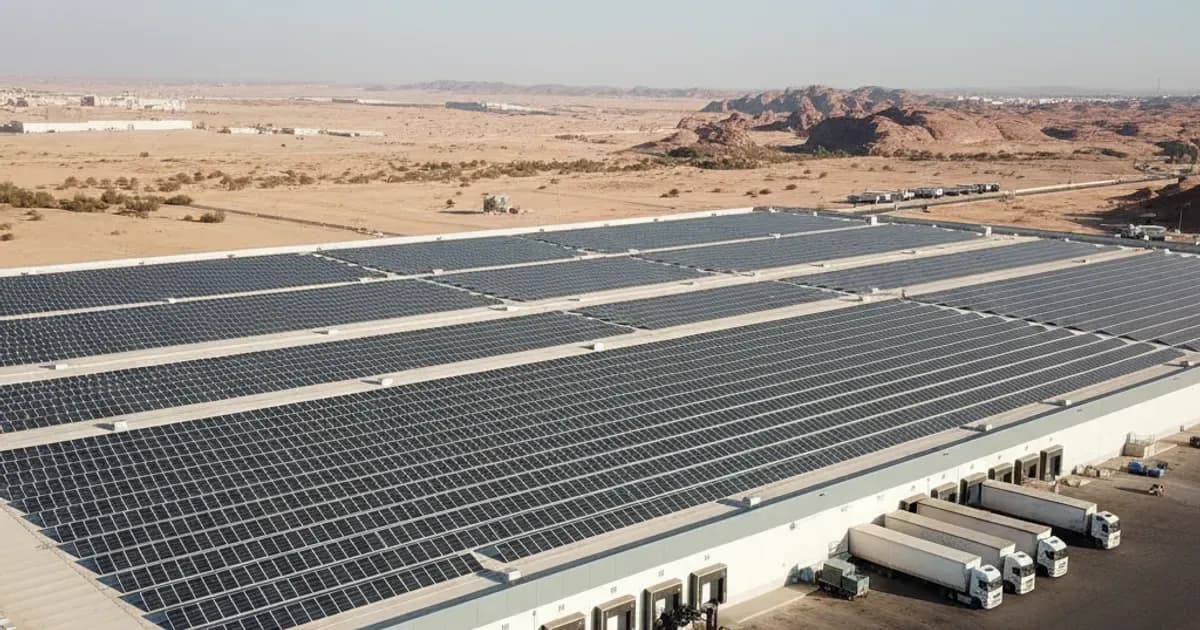
Key Takeaways
- The commercial advantage is not hardware — it is load shape. A business consumes in daylight, which is precisely when self-consumption is worth three to five times what export earns.
- Commercial tariffs are reported at 22 halalas up to 6,000 kWh and 32 above, with 15 percent VAT — though one source describes a flat 20 halalas, and we report the disagreement.
- The export credit is lower for non-residential customers: 5 halalas per kWh against 7 for residential. Exporting is a worse deal for a business, not a better one.
- Commercial connections meet constraints residential ones never do, including limits tied to transformer ratings and distribution-area demand.
What actually changes when the roof belongs to a business?
Four things, and only one of them is technical.
The tariff you displace changes. Commercial rates sit above residential ones, so each self-consumed kilowatt-hour is worth more.
The export credit changes, downward. Secondary sources consistently report 5 halalas per kWh for non-residential customers against 7 halalas for residential. The gap between self-consumption and export therefore widens for a business.
The connection constraints change. A villa array never comes near the grid limits a commercial project does.
And the load profile changes — which is the one that matters most. A warehouse, workshop, clinic or office consumes when the sun is up. A house often does not.
Everything else — the framework, the application route, the qualification requirement for contractors — is the same scheme covered in our guide to SEC net billing.
Why is load shape the whole argument?
Because Saudi Arabia runs net billing, and net billing pays you for matching, not for generating.
Under one-to-one net metering, timing barely matters: the grid banks your surplus at retail value and you draw it back later. Under net billing, a kilowatt-hour you generate and immediately use is worth the full tariff you avoided, while a kilowatt-hour you generate and export earns a small fixed credit. The ratio, worked through in our guide to rooftop solar payback in Saudi Arabia, is roughly three to one on the lower residential slab and around five to one on the upper.
Now apply that to a business. A commercial operation running from morning to evening — with lighting, cooling, refrigeration, compressors or process load through the middle of the day — naturally self-consumes a very high share of what its roof produces. It does not need behavioural change, load shifting or storage to get there. The building already does it.
That is why a commercial rooftop in Saudi Arabia frequently makes a cleaner case than a residential one on identical hardware. The equipment is not better. The match is.
What are the commercial tariff numbers?
Category | Up to 6,000 kWh/month | Above 6,000 kWh/month |
|---|---|---|
Commercial | 22 halalas/kWh | 32 halalas/kWh |
Industrial | tiered, reported up to ~20 halalas/kWh | — |
Agricultural | 16 halalas/kWh | 20 halalas/kWh |
Government | 32 halalas/kWh | 32 halalas/kWh |
Figures as of August 2026, from consistent secondary reporting. 15 percent VAT applies on top. The regulator's own tariff page was not reachable from our research session, so none of these are primary-verified.
Three caveats, stated rather than smoothed:
The commercial figures disagree between sources. The 22/32 slabs are most commonly reported; at least one source describes a flat 20 halalas per kWh. We are not choosing.
Secondary reporting also describes an additional 2 halalas per kWh for non-eligible customers in the industrial, commercial and agricultural categories under an intensive-consumption arrangement — a line worth checking on your own account.
And the independent cross-check helps only partly. GlobalPetrolPrices, collecting in December 2025, puts the all-in Saudi business electricity price at SAR 0.277 per kWh. That is consistent with a mix of customers around the reported commercial slabs once VAT is applied, but it does not settle the flat-versus-tiered question. The full slab picture is in our guide to the Saudi electricity tariff.
What size and connection limits apply?
Secondary reporting consistently describes the small-scale framework as covering grid-connected PV from 1 kW to 2 MW across consumer classes — which comfortably includes almost every commercial rooftop and stops well short of utility scale.
Beyond raw capacity, HAALA Energy's 2026 review of the Saudi regulatory landscape reports additional grid-connection constraints for larger systems, including caps tied to transformer ratings and to distribution-area demand. Those are the limits a villa never meets and a serious commercial project meets immediately.
The practical implication is sequencing. For a commercial building, the connection question should be asked before the roof is designed, not after. A layout that maximises panel count on the roof and then discovers a transformer constraint has wasted the design. Ask your contractor early what the connection point can accept, and what evidence they have for that answer.
We are relying on secondary reporting for these constraints, not the framework text — the regulator's own framework page was not reachable when we researched this series, and we would rather say so than imply we read it.
What is the business case built from?
The same verified hardware layer as everything else in this series, scaled up.
Panels at roughly 1.19 to 1.44 SAR per watt (August 2026) for in-stock brand-name large-format modules, from our guide to the solar panel price in KSA. Three-phase inverter hardware anchored at SAR 3,471 for an 11kW unit from a Riyadh specialty retailer — a genuinely relevant benchmark, because commercial premises are three-phase. Storage priced in our guide to the solar battery price in KSA, though a business with a daytime load often needs far less of it than a household.
At commercial volumes you should expect better hardware pricing than these retail figures, not worse. That is exactly why publishing them matters: retail is the ceiling a commercial buyer negotiates down from, and without a published ceiling there is nothing to negotiate against. The build-up and everything it excludes is in our guide to the solar system cost in Saudi Arabia.
What should a business buyer check that a homeowner does not?
Who owns the roof and for how long. A twenty-five-year asset on a five-year lease needs a landlord agreement before it needs a quote.
Structural capacity. Commercial roofs vary enormously, and ballasted arrays add real load. Get an engineering opinion, not a salesperson's reassurance.
The connection point. Ask what the transformer and distribution area can accept, and get the basis for the answer.
Contractor qualification at project scale. Saudi contractor and consultant qualification is governed through the official Shamsi platform per secondary reporting, and the vetting sequence in our guide to Shamsi and qualified solar installers in Saudi Arabia applies with more force to a commercial project, not less.
Metering and billing category. Confirm which tariff category your account sits in and whether the intensive-consumption surcharge applies, because that determines what every displaced kilowatt-hour is actually worth to you.
And apply the same quote discipline as everyone else: itemised lines, model codes, a named warranty party inside Saudi Arabia, a stated VAT convention and a validity date, as set out in our guide to reading a Saudi solar quote. Our method page explains which of the figures above are verified and which are corroborated secondary.
Frequently asked questions
Is commercial solar a better deal than residential in Saudi Arabia?
Usually yes, for one structural reason: a business consumes during daylight, which is exactly when a rooftop array generates. Under net billing, self-consumption is worth three to five times what export earns, so a load profile that matches generation is worth more than any hardware choice.
What is the commercial electricity tariff in Saudi Arabia?
Most reporting puts it at 22 halalas per kWh up to 6,000 kWh a month and 32 halalas above, with 15 percent VAT on top. At least one source describes a flat 20 halalas instead. We report the disagreement rather than resolving it — your own bill is authoritative.
What size systems does the Saudi framework cover?
Secondary reporting consistently describes the small-scale framework as covering grid-connected systems from 1 kW to 2 MW across consumer classes. Above that scope, a project is no longer a small-scale connection.
Do commercial customers get the same export credit?
No. Secondary sources report 5 halalas per kWh for non-residential customers against 7 halalas for residential — so export is worth even less to a business, which sharpens the self-consumption argument further.
References
- HAALA Energy — Saudi C&I solar regulatory landscape, including grid-connection limits tied to transformer ratings and distribution-area demand (2026-03-12) — accessed 4 August 2026
- pv magazine — Saudi rooftop PV provisions: 1kW-2MW scope, net billing, 7 halalas residential and 5 halalas non-residential export credit — accessed 4 August 2026
- SEC (Saudi Energy) — small-scale solar PV service page, citing SERA Administrative Decision 2/47/41 of 29/04/1441H — accessed 4 August 2026
- GlobalPetrolPrices — Saudi Arabia business electricity SAR 0.277/kWh all-in, December 2025 collection — accessed 5 August 2026
- SolarNevs own price survey — Saudi index, 5 August 2026 — accessed 5 August 2026
Related guides
More from schemes, subsidies & financing.