UK Agri-PV and Polytunnel Solar Integration Guide
Updated 6 September 2026 · By SolarNevs Research Desk, Dealer surveys + verified sources · 3 sources · Method ↗
Key Takeaways
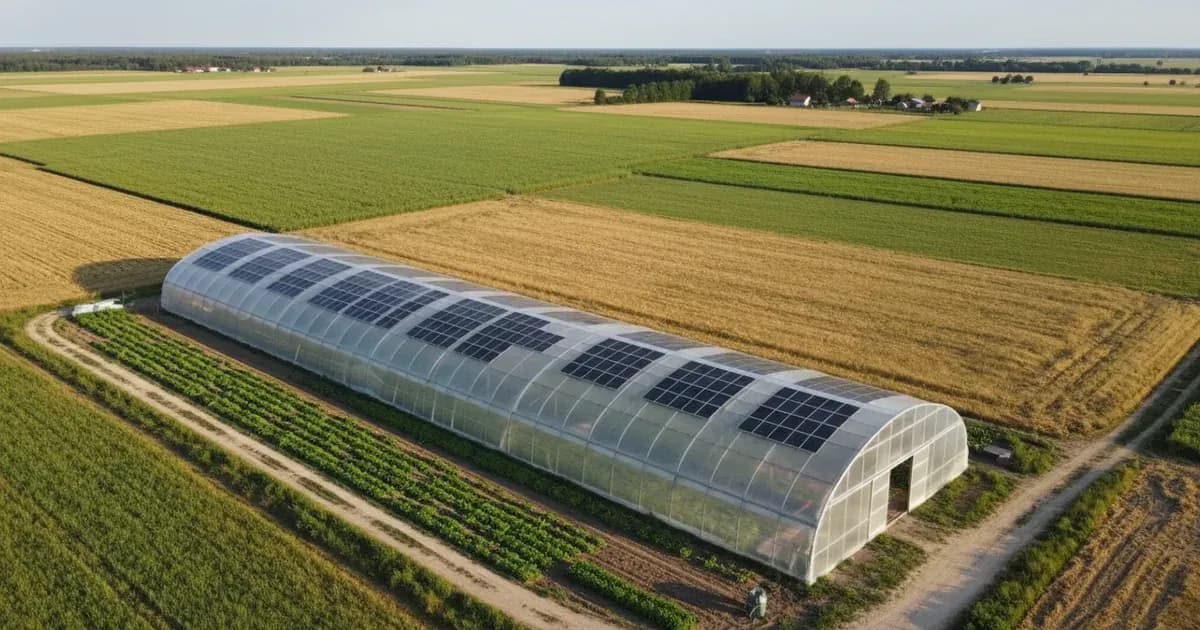
- Agrivoltaics (Agri-PV) combines food production with clean power generation across horticultural polytunnels and agricultural buildings.
- Under Defra's Farming Investment Fund, the Improving Farm Productivity grant provides 25% capital support for on-farm solar equipment.
- Grant funding ranges from a minimum of £15,000 to a maximum of £100,000 per farm business.
- Eligible solar systems must be designed primarily for farm power and paired with battery storage.
- Panels may be mounted onto existing farm buildings or installed across irrigation reservoirs on floating cradles.
- Agricultural permitted development under Class A applies to agricultural units of 5 hectares or more in area.
Siting and Farm Permitted Development: Part 6 Class A
Integrating solar technology across horticultural land requires understanding agricultural planning rules:
- Scale Threshold: Statutory rules under Class A govern agricultural development on units of 5 hectares or more.
- Permitted Operations: Authorises the carrying out on agricultural land comprised in an agricultural unit of 5 hectares or more in area of works for the erection, extension or alteration of a building, or any excavation or engineering operations, which are reasonably necessary for the purposes of agriculture within that unit.
- Where elevated Agri-PV structures or polytunnels with integrated solar glazing are erected, works must serve agricultural functions such as protecting soft fruit crops or powering cold storage fans.
Defra Farming Investment Fund: Solar Support
The Department for Environment, Food and Rural Affairs (Defra) supports agricultural energy resilience through competitive capital grants:
- Strategic Purpose: Aims at the installation of solar equipment to increase both energy resilience and the take-up of renewable energy generation on farms.
- Funding Percentage: The offer for solar equipment provides grant funding covering up to 25% of eligible project costs.
- Grant Boundaries: For solar equipment, the minimum grant available is £15,000 and the maximum grant available is £100,000.
- Sector Eligibility: The grant is open to horticultural and farm businesses. Contractors from those sectors are eligible to apply for robotic equipment, but not solar equipment.
Technical Requirements for Agricultural Solar
To secure grant certification and comply with Defra standards, farm solar designs must satisfy precise technical criteria:
- Farm Power Priority: An eligible solar PV system should be mainly for farm power and installed on farm buildings, not on a residential property.
- Storage and Export: The solar energy is stored in a battery or batteries. The systems can be connected to export surplus power back to the National grid.
- Mounting Locations: Solar panels can be installed on an irrigation reservoir (including the supporting floating cradle), or on farm buildings that are able to support them.
- Structural Duty: It’s your responsibility to make sure that a roof intended to take solar panels, is able to support them.
Eligible and Excluded Capital Items
Defra establishes clear boundaries on funded hardware:
- Eligible Items: Solar PV panels, solar batteries, inverters, utility meter, electrical grid connection, and power diverters that redirect excess solar energy to power storage (for example heat stores).
- Ineligible Items: Ground base solar panels, replacement or reinforcement of roofs, construction of farm buildings, and upgrading of existing solar panels are explicitly excluded from grant funding.
Frequently asked questions
What grant funding is available for agricultural solar in England?
The Improving Farm Productivity grant offers a 25% contribution for solar equipment, ranging from £15,000 to £100,000 per business.
What planning threshold applies to agricultural permitted development?
Class A permits agricultural buildings and engineering operations on agricultural units of 5 hectares or more in area.
Must farm solar systems include battery storage under Defra rules?
Yes, grant-funded solar PV systems must store energy in a battery or batteries to maximize on-farm clean power utilization.
Can solar panels be installed on farm irrigation reservoirs?
Yes, solar panels can be installed on an irrigation reservoir including the supporting floating cradle, or on suitable farm buildings.
Are ground-mounted solar panels eligible for farm productivity grants?
No, ground-based solar panels, roof reinforcement, and upgrading existing panels are explicitly excluded from grant funding.
References
- Defra Improving Farm Productivity Grant Equipment Definitions — accessed 28 August 2026
- Defra Farming Blog Improving Farm Productivity Grant Round 2 — accessed 28 August 2026
- Town and Country Planning General Permitted Development Order 2015 Schedule 2 Part 6 — accessed 28 August 2026
Related guides
More from what to buy — and how not to get cheated.