UK Coastal and Marine Solar Corrosion Engineering Guide
Updated 6 September 2026 · By SolarNevs Research Desk, Dealer surveys + verified sources · 4 sources · Method ↗
Key Takeaways
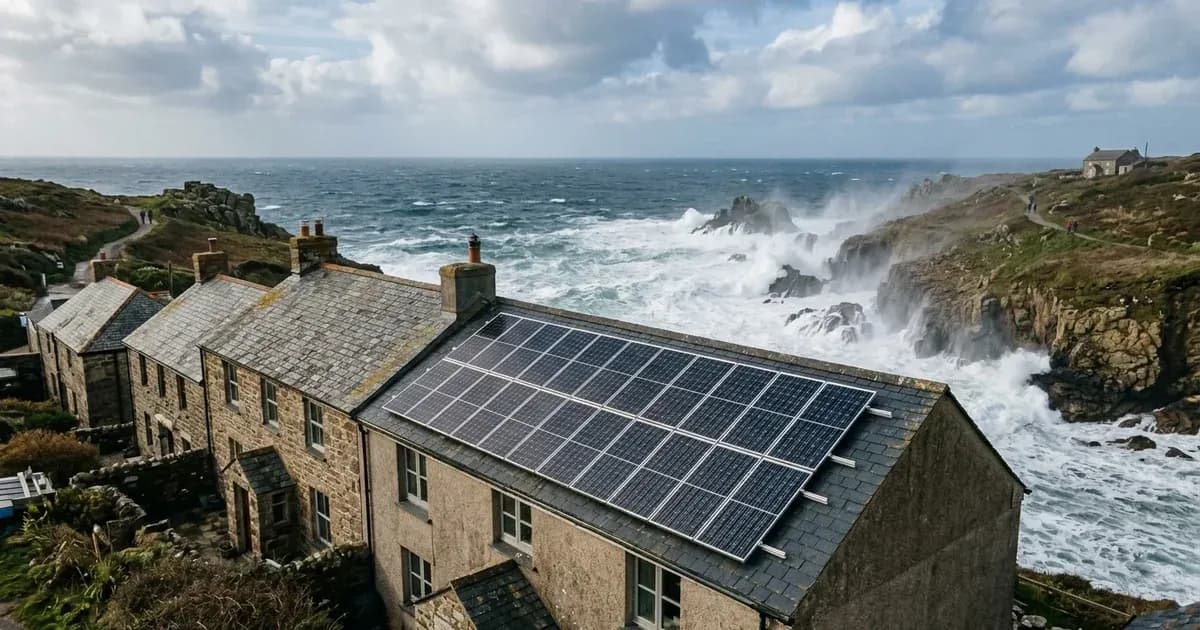
- Commercial solar arrays installed in UK coastal and offshore marine environments face accelerated degradation from salt mist, atmospheric moisture, and galvanic action.
- Statutory electrical compliance is governed by the 1989 Electricity at Work Regulations, mandating protective engineering in adverse environments.
- Equipment exposed to weather, temperature, moisture, and corrosive coastal atmosphere must be specifically protected to prevent danger.
- System electrical ratings must never be exceeded in a manner that gives rise to danger.
- Safe maintenance regimes require verified means of cutting off supply and physical electrical isolation.
- Routine inspection and maintenance ensure commercial plant and operating systems remain safe and without risks to health.
Marine Atmospheric Corrosion Mechanisms
Salt mist containing aerosolized sodium chloride accelerates electrochemical galvanic corrosion across exposed rooftop and ground mounts:
- Galvanic Dissimilar Metal Pitting: Contact between copper grounding lugs, stainless steel bolts, and anodized aluminum module frames creates aggressive galvanic cells in wet maritime air.
- Junction Box Ingress: Salt crust accumulation around cable glands can degrade elastomer seals, leading to DC arcing and insulation resistance breakdown.
- Marine Coating Specifications: Structural steel supports must feature heavy-duty hot-dip galvanizing (HDG) or proprietary zinc-aluminum-magnesium alloy coatings.
Adverse Environmental Protection: Statutory Framework
The 1989 Electricity at Work Regulations establish mandatory criteria for challenging deployment environments:
- Environmental Scope: Specifically targets Electrical equipment which may reasonably foreseeably be exposed to adverse hazards.
- Natural Hazards: Pertains directly to the effects of the weather, natural hazards, temperature or pressure.
- Corrosive Conditions: Explicitly covers the effects of wet, dirty, dusty or corrosive conditions; or.
- Preventative Duty: Mandates that equipment shall be of such construction or as necessary protected as to prevent, so far as is reasonably practicable, danger arising from such exposure.
- Capacity Integrity: Confirms that No electrical equipment shall be put into use where its strength and capability may be exceeded in such a way as may give rise to danger.
Circuit Isolation and Maintenance Work
Conducting maintenance on coastal assets requires robust physical disconnection infrastructure:
- Isolation Infrastructure: Directs that where necessary to prevent danger, suitable means (including, where appropriate, methods of identifying circuits) shall be available for.
- Supply De-energisation: Specifically mandates cutting off the supply of electrical energy to any electrical equipment.
- Disconnection Capability: Requires provision for the isolation of any electrical equipment.
- Legal Definition: Clarifies that isolation means the disconnection and separation of the electrical equipment from every source of electrical energy.
Competency and Health and Safety Duties
Personnel working on exposed coastal solar installations must satisfy rigorous safety standards:
- Staff Competency: Mandates that No person shall be engaged in any work activity where technical knowledge or experience is necessary to prevent danger or, where appropriate, injury, unless he possesses such knowledge or experience, or is under such degree of supervision as may be appropriate having regard to the nature of the work.
- Facilities Maintenance: Under the 2005 Fire Safety Order, facilities are subject to a suitable system of maintenance and are maintained in an efficient state, in efficient working order and in good repair.
- General Health and Safety Duty: The 1974 Health and Safety at Work Act requires the provision and maintenance of plant and systems of work that are, so far as is reasonably practicable, safe and without risks to health.
Frequently asked questions
What statutory requirement governs electrical equipment in corrosive marine environments?
Under Regulation 6 of the 1989 Electricity at Work Regulations, equipment exposed to wet or corrosive conditions must be constructed or protected to prevent danger.
How are electrical systems safely disconnected for coastal maintenance?
Suitable means must be available for cutting off the electrical supply and achieving isolation from every source of electrical energy.
What competency standards apply to marine solar maintenance engineers?
Personnel must possess technical knowledge or experience necessary to prevent danger or be under appropriate supervision.
What general duty do commercial asset owners have regarding plant safety?
Under the 1974 Health and Safety at Work Act, employers must provide and maintain plant and systems of work that are safe and without risks to health.
What maintenance standards apply to commercial facilities?
Under the 2005 Fire Safety Order, facilities must be subject to a suitable system of maintenance in an efficient state and good repair.
References
- Electricity at Work Regulations 1989 Regulation 6 Adverse Environments — accessed 28 August 2026
- Electricity at Work Regulations 1989 Regulation 5 Strength and Capability — accessed 28 August 2026
- Electricity at Work Regulations 1989 Regulation 12 Isolation — accessed 28 August 2026
- Electricity at Work Regulations 1989 Regulation 16 Competency — accessed 28 August 2026
Related guides
More from what to buy — and how not to get cheated.