UK Commercial Solar EICR Periodic Inspection and Testing Guide
Updated 6 September 2026 · By SolarNevs Research Desk, Dealer surveys + verified sources · 4 sources · Method ↗
Key Takeaways
- Commercial solar photovoltaic installations in the UK require periodic Electrical Installation Condition Reports (EICR) to satisfy statutory health and safety legislation.
- Installations must be maintained in a safe condition to ensure system capability is not exceeded in a manner that gives rise to danger.
- Statutory regulations require suitable means of cutting off supply and verified isolation during test sequences.
- Testers must possess technical knowledge and experience to prevent electrical danger and personal injury.
- Outdoor electrical equipment exposed to weather, temperature swings, and dirty or corrosive conditions must feature robust physical protection.
- Facilities and equipment must be subject to systematic maintenance in an efficient state and good repair under fire safety law.
The Purpose and Scope of Commercial Solar EICRs
Commercial rooftop arrays experience continuous thermal expansion, DC voltage stress, and environmental exposure:
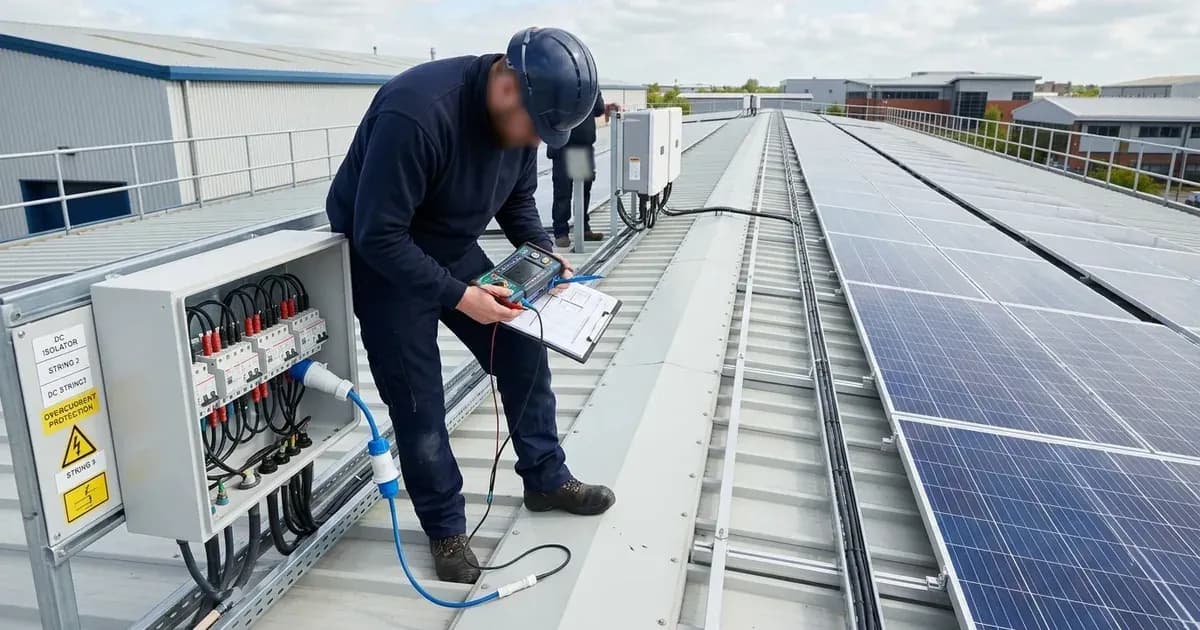
- Visual Inspection: Checking mechanical torque on DC disconnect switchgear, cable tray integrity, and signs of water ingress.
- Insulation Resistance (Riso) Testing: Verifying conductor insulation resistance between active DC conductors and earth under elevated test voltages.
- String Voc and Isc Verification: Measuring open-circuit voltage and short-circuit current across strings to locate module anomalies.
- Earth Continuity Testing: Confirming equipotential bonding across mounting frames, inverter enclosures, and lightning protection systems.
Statutory Basis under the Electricity at Work Regulations 1989
Periodic testing enforces mandatory duties established by secondary safety legislation:
- Operating Limits: Section 5 confirms that No electrical equipment shall be put into use where its strength and capability may be exceeded in such a way as may give rise to danger.
- Isolation Provisions: Mandates that where necessary to prevent danger, suitable means (including, where appropriate, methods of identifying circuits) shall be available for.
- Cutting Off Supply: Specifically identifies cutting off the supply of electrical energy to any electrical equipment.
- Physical Isolation: Directs the isolation of any electrical equipment.
- Definition of Isolation: Explains that isolation means the disconnection and separation of the electrical equipment from every source of electrical energy.
Environmental Resilience and Testing Safety
Solar arrays operate in demanding outdoor environments that test electrical integrity:
- Hazardous Exposure: Covers Electrical equipment which may reasonably foreseeably be exposed to.
- Climatic Stresses: Applies to the effects of the weather, natural hazards, temperature or pressure.
- Contamination Risks: Encompasses the effects of wet, dirty, dusty or corrosive conditions; or.
- Protective Construction: Requires that equipment shall be of such construction or as necessary protected as to prevent, so far as is reasonably practicable, danger arising from such exposure.
Inspector Competency and General Safety Duties
Executing high-voltage DC solar testing requires verified technical qualification:
- Statutory Competency: Mandates that No person shall be engaged in any work activity where technical knowledge or experience is necessary to prevent danger or, where appropriate, injury, unless he possesses such knowledge or experience, or is under such degree of supervision as may be appropriate having regard to the nature of the work.
- Maintenance System: Fire safety legislation requires that facilities are subject to a suitable system of maintenance and are maintained in an efficient state, in efficient working order and in good repair.
- Employer Obligations: Under the 1974 Health and Safety at Work Act, dutyholders must maintain the provision and maintenance of plant and systems of work that are, so far as is reasonably practicable, safe and without risks to health.
Frequently asked questions
What is an Electrical Installation Condition Report (EICR) for commercial solar?
An EICR is a formal inspection and testing procedure assessing the safety, degradation, and compliance of an existing electrical installation.
What statutory duty mandates periodic maintenance of commercial solar installations?
Under the 1989 Electricity at Work Regulations, all systems must be maintained so as to prevent danger, supported by regular testing.
What isolation requirements apply during electrical inspection works?
Suitable means must be available for cutting off the supply and isolating equipment from every source of electrical energy.
Who is legally qualified to carry out commercial solar EICR testing?
Personnel must possess technical knowledge or experience necessary to prevent danger or injury, or be under appropriate supervision.
What standard of facility maintenance is required under UK fire safety law?
Under the 2005 Fire Safety Order, equipment must be subject to a suitable system of maintenance in an efficient state and good repair.
References
- Electricity at Work Regulations 1989 Regulation 5 Strength and Capability — accessed 28 August 2026
- Electricity at Work Regulations 1989 Regulation 12 Isolation — accessed 28 August 2026
- Electricity at Work Regulations 1989 Regulation 16 Competency — accessed 28 August 2026
- Electricity at Work Regulations 1989 Regulation 6 Adverse Environments — accessed 28 August 2026
Related guides
More from what to buy — and how not to get cheated.