UK Commercial BESS Fire Suppression and Aerosol Guide
Updated 15 September 2026 · By SolarNevs Research Desk, Dealer surveys + verified sources · 6 sources · Method ↗
Key Takeaways
- Commercial and industrial Battery Energy Storage Systems (BESS) require specialized active fire protection due to thermal runaway hazards.
- Condensed aerosol fire suppression systems release ultra-fine potassium compounds that interrupt chemical flame combustion radicals without depleting oxygen or causing thermal shock.
- Under Article 9 of the Regulatory Reform (Fire Safety) Order 2005, the responsible person must conduct a suitable and sufficient fire risk assessment.
- Article 8 mandates taking general fire precautions to safeguard employees and relevant persons within the premises.
- Under statutory the 1989 Electricity at Work Regulations Regulation 4, all electrical systems must be constructed and maintained to prevent danger so far as is reasonably practicable.
- Regulation 5 dictates that equipment capability must not be exceeded in a way that gives rise to danger.
Fire Hazards in Commercial Containerized BESS
Commercial battery energy storage systems (BESS) installed at factories, logistics depots, and solar farms house high energy densities in enclosed modular containers. When an internal cell fault occurs—triggered by manufacturing defects, mechanical penetration, or overcharging—it can initiate thermal runaway.
During thermal runaway, volatile flammable gases (including hydrogen, methane, and carbon monoxide) are vented into the enclosure. If ignition occurs, temperatures escalate rapidly, threatening adjacent battery racks.
Condensed Aerosol Suppression Systems
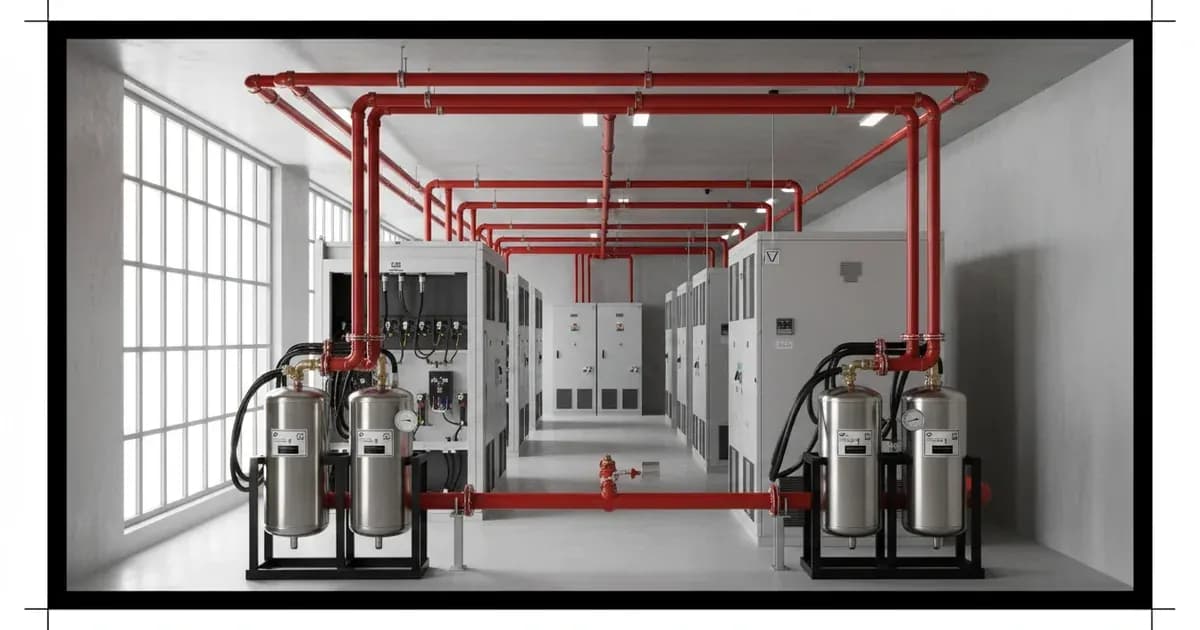
Traditional water sprinkler systems require massive water storage volumes and introduce electrical short-circuit hazards, while gaseous clean-agent systems require high-pressure piping and room air-tightness. Consequently, condensed aerosol fire suppression has emerged as an industry benchmark for containerized BESS.
Mechanism of Aerosol Action
- Solid aerosol compound generators are electrically or thermally activated by multi-stage detection systems.
- When triggered, a thermo-chemical reaction generates micron-sized potassium carbonate particles suspended in inert gas.
- The potassium particles bond with combustion-propagating free radicals (OH and H), terminating the flame chain reaction chemically rather than by oxygen suffocation.
Fail-to-Safe Control and Multi-Stage Detection
In alignment with modern fire engineering standards such as PAS 63100:2024, systems must integrate fault management and fail-to-safe operation of all control and monitoring functions. Early off-gas detection triggers ventilation shutdown and de-energisation before open flaming occurs.
Statutory Fire Legislation: Fire Safety Order 2005
Commercial BESS installations are strictly regulated under the Regulatory Reform (Fire Safety) Order 2005:
Article 9: Statutory Fire Risk Assessment
Under Article 9(1):
- The responsible person must make a suitable and sufficient assessment of the risks to which relevant persons are exposed for the purpose of identifying the general fire precautions he needs to take to comply with the requirements and prohibitions imposed on him by or under this Order.
- For BESS installations, the assessment must evaluate thermal runaway risks, explosion venting provisions, water runoff containment, and separation distances from occupied buildings.
Article 8: General Fire Precautions Duty
The responsible person must:
- Take such general fire precautions as will ensure, so far as is reasonably practicable, the safety of any of his employees.
- In relation to relevant persons who are not his employees, take such general fire precautions as may reasonably be required in the circumstances of the case to ensure that the premises are safe.
Electrical Safety and Capability Under the 1989 Electricity at Work Regulations
In addition to fire regulations, the electrical infrastructure of commercial BESS must comply with primary workplace safety statutes:
System Construction and Maintenance (Regulation 4)
- All systems shall at all times be of such construction as to prevent, so far as is reasonably practicable, danger.
- As may be necessary to prevent danger, all systems shall be maintained so as to prevent, so far as is reasonably practicable, such danger.
- Every work activity, including operation, use and maintenance of a system and work near a system, shall be carried out in such a manner as not to give rise, so far as is reasonably practicable, to danger.
- Any protective equipment provided shall be suitable for its use, maintained in suitable condition, and properly used.
Strength and Capability (Regulation 5)
Under Regulation 5:
- No electrical equipment shall be put into use where its strength and capability may be exceeded in such a way as may give rise to danger.
- In a commercial BESS, DC busbars, contactors, and switchgear must be engineered to withstand maximum prospective short-circuit currents without mechanical rupture.
Furthermore, national heritage guidance from Historic England confirms that official energy advice has been updated to include measures for mitigating the risk of fire.
Frequently asked questions
What fire suppression technologies are used in commercial BESS?
Commercial containerized BESS frequently deploy condensed potassium aerosol generators paired with early off-gas detection to extinguish fires and cool enclosures.
What statutory fire legislation governs commercial battery installations?
Commercial BESS installations are governed by the Regulatory Reform (Fire Safety) Order 2005, requiring risk assessments under Article 9.
What duties are imposed under Article 8 of the Fire Safety Order?
Article 8 requires the responsible person to implement general fire precautions to ensure the safety of employees and relevant persons on the premises.
How does the Electricity at Work Regulations 1989 apply to BESS?
Regulation 4 requires systems to be constructed and maintained to prevent danger, while Regulation 5 prohibits exceeding equipment strength and capability.
What is fail-to-safe control monitoring in BESS?
Fail-to-safe monitoring ensures that any internal fault, sensor failure, or communication loss automatically places the battery system into a safe, de-energised state.
References
- Regulatory Reform Fire Safety Order 2005 Article 9 — accessed 28 August 2026
- Regulatory Reform Fire Safety Order 2005 Article 8 — accessed 28 August 2026
- Electricity at Work Regulations 1989 Regulation 4 — accessed 28 August 2026
- Electricity at Work Regulations 1989 Regulation 5 — accessed 28 August 2026
- BSI PAS 63100:2024 Electrical Installations Fire Protection Specification — accessed 28 August 2026
- GOV.UK Review of Adapting Historic Homes for Energy Efficiency — accessed 28 August 2026
Related guides
More from what to buy — and how not to get cheated.