UK Commercial Solar Planning Permission and Permitted Development Class J Guide
Updated 6 September 2026 · By SolarNevs Research Desk, Dealer surveys + verified sources · 2 sources · Method ↗
Key Takeaways
- Commercial solar PV on non-domestic buildings is permitted development under Schedule 2, Part 14, Class J of the the 2015 General Permitted Development Order.
- Statutory amendments under Statutory Instrument No. 1279 of 2023 formally repealed the former 1 megawatt (1MW) capacity cap on non-domestic rooftop arrays.
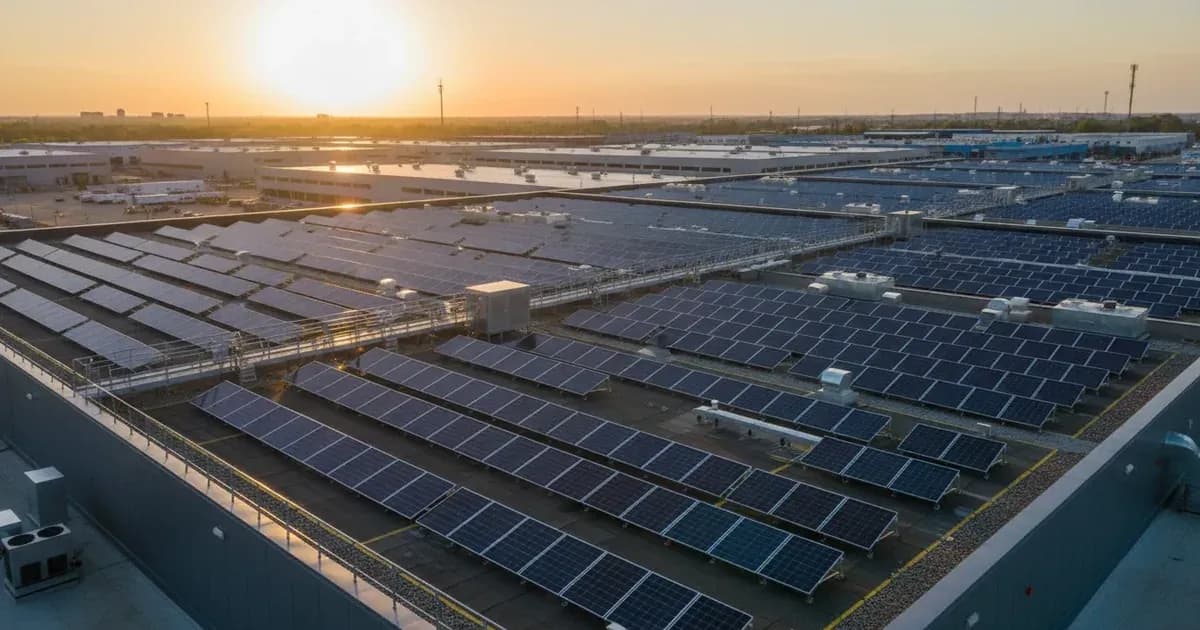
- On commercial flat roofs, equipment must not rise higher than 1 metre above the roof and must be set back at least 1 metre from the roof edge.
- On pitched roofs, panels must not protrude more than 0.2 metres beyond the roof slope plane.
- Commercial wall-mounted systems must project no more than 0.2 metres and remain at least 1 metre from junctions with other walls or roofs.
- Class J rights do not apply to listed buildings or buildings within the curtilage of a listed building.
The Scope of Class J Permitted Development
Commercial solar installations in England operate under Schedule 2, Part 14, Class J of the Town and Country Planning (General Permitted Development) (England) Order 2015.
Class J permits the installation, alteration or replacement of microgeneration solar thermal equipment, microgeneration solar PV equipment, or other solar PV equipment on the roof or walls of a building, explicitly applying to non-domestic premises other than a dwellinghouse or a block of flats. This framework covers industrial manufacturing plants, logistics warehouses, agricultural barns, commercial offices, and retail parks.
Repeal of the 1 Megawatt (1MW) Capacity Cap
Historically, commercial rooftop solar installations exceeding 1 megawatt required a full planning application. This threshold created unnecessary delays for large commercial and industrial rooftops capable of supporting multi-megawatt generation.
Under the Town and Country Planning (General Permitted Development etc.) (England) (Amendment) (No. 2) Order 2023 (Statutory Instrument No. 1279 of 2023):
- Paragraph J.3 of Class J, which restricted capacity to 1 megawatt, was formally omitted.
- Commercial rooftop arrays can now exceed 1MW under permitted development rights, subject to relevant prior approval considerations.
- The statutory amendment also omitted paragraph J.1(d), removing previous highway frontage restrictions on article 2(3) land for non-domestic roof slopes.
Technical Setback and Dimensional Constraints
To qualify for permitted development under Class J, commercial solar arrays must respect strict geometric setbacks:
Pitched Roof Installations
- Equipment installed on a pitched roof must not protrude more than 0.2 metres beyond the plane of the roof slope when measured perpendicular from the external surface.
Flat Roof Installations
- Maximum Height: Where equipment is installed on a flat roof, the highest part of the solar PV equipment must not be higher than 1 metre above the highest part of the roof (excluding any chimney).
- Perimeter Safety Setback: Equipment must not be installed within 1 metre of the external edge of that roof. This 1-metre perimeter buffer ensures visual containment from ground level and safe maintenance access.
Wall-Mounted Installations
Where solar PV is mounted onto commercial building elevations:
- Panels must not protrude more than 0.2 metres from the wall surface.
- Panels must not be installed within 1 metre of a junction of that wall with another wall or with the roof of the building.
Heritage and Conservation Exclusions
Commercial permitted development rights under Class J do not apply across protected heritage assets:
- Development is strictly not permitted if equipment would be installed on a listed building or on a building within the curtilage of a listed building.
- Installations on sites designated as scheduled monuments are excluded from Class J rights.
- For stand-alone non-domestic solar under Class K, installations on article 2(3) land closer to a bounding highway than the nearest part of the building are restricted to 2 metres in height.
Statutory Conditions and Decommissioning Obligations
All commercial Class J developments are governed by mandatory statutory conditions:
- Appearance Minimisation: Solar PV equipment must, so far as practicable, be sited so as to minimise its effect on the external appearance of the building.
- Removal Obligation: Solar equipment must be removed as soon as reasonably practicable when no longer needed for electricity generation.
Frequently asked questions
What permitted development rights apply to commercial rooftop solar in the UK?
Commercial rooftop solar is governed by Class J of Schedule 2, Part 14 of the GPDO, covering non-domestic buildings including warehouses, factories, and offices.
Does the 1 Megawatt (1MW) capacity cap still apply to commercial solar?
No, the 1MW capacity limit was repealed under statutory amendments (Statutory Instrument No. 1279 of 2023), allowing larger rooftop solar systems under permitted development.
What setbacks apply to commercial flat roof solar panels?
Panels on flat roofs must not exceed 1 metre in height above the highest point of the roof and must be set back at least 1 metre from any external roof edge.
What protrusion limit applies to commercial pitched roof solar?
Solar equipment on pitched commercial roofs must not protrude more than 0.2 metres beyond the plane of the roof slope.
Can commercial solar be installed on listed buildings under Class J?
Class J development is not permitted on listed buildings or on buildings situated within the curtilage of a listed building.
References
- Town and Country Planning General Permitted Development Order 2015 Part 14 — accessed 28 August 2026
- Town and Country Planning General Permitted Development Amendment Order 2023 2023/1279 — accessed 28 August 2026
Related guides
More from what to buy — and how not to get cheated.