UK Warehouse Solar Fire Barriers and Clearances Guide
Updated 15 September 2026 · By SolarNevs Research Desk, Dealer surveys + verified sources · 4 sources · Method ↗
Key Takeaways
- Commercial logistics warehouses installing extensive rooftop solar PV arrays must maintain perimeter clearances and roof compartmentation barriers.
- Dedicated rooftop walkways allow emergency fire service personnel to navigate roof areas safely during smoke or fire conditions.
- Installations must adhere to statutory fire design requirements set out in Approved Document B Volume 1 for Dwellings.
- Warehouse building owners are legally bound to implement general fire precautions to guarantee worker safety and premises security.
- Co-located ground fleet charging facilities benefit from permitted development rights with a 1.6-metre upstand height limit.
- Public or commercial fleet charging points are governed by statutory maintenance and payment reliability standards.
Rooftop Fire Barrier and Walkway Design Principles
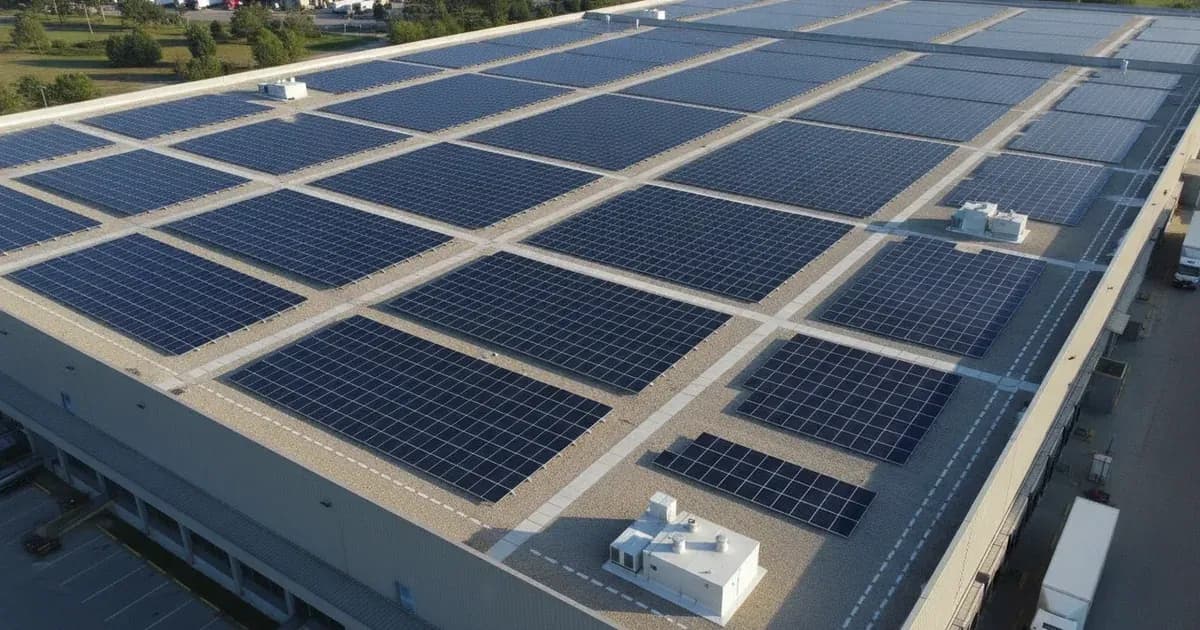
Large warehouse roofs spanning tens of thousands of square meters require systematic solar array separation:
Roof Feature / Zone | Clearance Requirement | Fire Safety & Access Function |
|---|---|---|
Internal Compartment Walls | 1.5 to 2.5 metres | Prevents fire spread across building compartment dividing lines |
Perimeter & Parapet Strips | 1.0 to 1.5 metres | Continuous unobstructed walkway for emergency fire personnel |
Smoke Vents (SHEVS) | Dedicated clearance buffer | Facilitates natural venting and prevents heat/smoke trapping |
- Compartment Wall Clearances: Solar modules must not bridge internal fire compartment walls, maintaining at least 1.5 to 2.5 metres of clear roof space directly above compartment dividing lines.
- Perimeter Firefighter Walkways: A continuous perimeter strip of at least 1.0 to 1.5 metres must remain unobstructed along parapet walls, roof edges, and rooflight smoke vents.
- Smoke and Heat Exhaust Ventilation (SHEVS): Clearances around automatic roof smoke vents prevent heat and smoke trapping, facilitating natural firefighter venting.
Statutory Fire Safety Framework
Warehouse solar layouts must fulfill primary fire safety duties:
- Building Regulations: Meets technical guidance under Approved Document B (fire safety) volume 1 Dwellings, 2019 edition incorporating 2020, 2022 and 2025 amendments.
- Employee Safety: Under the 2005 Fire Safety Order, dutyholders must take such general fire precautions as will ensure, so far as is reasonably practicable, the safety of any of his employees; and.
- Premises Security: Obligates dutyholders to take such general fire precautions as may reasonably be required in the circumstances of the case to ensure that the premises are safe.
Ground EV Fleet Charging and Permitted Development
Warehouse logistics facilities frequently combine rooftop solar with fleet charging bays:
- Wall Recharging Outlets: Protects The installation, alteration or replacement, within an area lawfully used for off-street parking, of an electrical outlet mounted on a wall for recharging electric vehicles.
- Highway Setback: Outlets must not face onto and be within 2 metres of a highway.
- Upstand Permitted Development: Authorizes The installation, alteration or replacement, within an area lawfully used for off-street parking, of an upstand with an electrical outlet mounted on it for recharging electric vehicles.
- Maximum Height Limit: Confirms that upstands must not exceed 1.6 metres in height from the level of the surface used for the parking of vehicles;.
- Single Upstand Rule: Mandates that works do not result in more than 1 upstand being provided for each parking space.
- Decommissioning Duty: Requires conditions that the development is removed as soon as reasonably practicable; when decommissioned.
Automated and Electric Vehicles Act 2018 Governance
Commercial fleet and public charging infrastructure operates under statutory service standards:
- Statutory Powers: Enforces that Regulations may impose requirements on operators of public charging or refuelling points in connection with.
- Transparent Access: Regulates the method of payment or other way by which access to the use of public charging or refuelling points may be obtained;.
- Operational Uptime: Governs the performance, maintenance and availability of public charging or refuelling points;.
Frequently asked questions
Why are perimeter fire clearances required on commercial solar warehouse roofs?
Clearances provide dedicated access walkways for emergency fire service personnel and prevent flames spreading across roof compartment walls.
What statutory guidance establishes building fire safety standards?
Fire safety design requirements are outlined in Approved Document B (fire safety) volume 1 Dwellings and Volume 2 for commercial buildings.
What statutory duty obligates commercial warehouse operators to maintain fire safety?
Dutyholders must take general fire precautions ensuring employee safety and keeping the premises safe under the 2005 Fire Safety Order.
What height restrictions apply to vehicle charging upstands on commercial grounds?
Under Class E of the 2015 GPDO, electrical upstands in off-street parking areas must not exceed 1.6 metres in height.
What regulations govern public vehicle charging facilities co-located at logistics hubs?
Regulations impose requirements regarding payment methods, performance, maintenance, and availability under the 2018 AEV Act.
References
- Building Regulations Approved Document B Volume 1 Dwellings — accessed 28 August 2026
- Regulatory Reform (Fire Safety) Order 2005 Article 8 Fire Precautions — accessed 28 August 2026
- Town and Country Planning (General Permitted Development) Order 2015 Part 2 — accessed 28 August 2026
- Automated and Electric Vehicles Act 2018 Section 10 — accessed 28 August 2026
Related guides
More from what to buy — and how not to get cheated.