Solar PV Immersion Diverters and Hot Water Guide UK
Updated 18 September 2026 · By SolarNevs Research Desk, Dealer surveys + verified sources · 3 sources · Method ↗
Key Takeaways
- Solar PV immersion diverters automatically redirect self-generated surplus electricity to hot water cylinders rather than exporting it to the grid.
- The myenergi eddi modulates power to any resistive load up to 3.68kW, drawing only 3W in standby mode.
- The Marlec Solar iBoost+ operates with up to two 3kW immersion heaters in a cascading sequence, with a default cut-in threshold of 100W.
- Diverters rely on current transformer (CT) clamps to measure real-time net export at the main incoming utility meter.
- Immersion heaters must be equipped with mechanical capillary thermostats; electronic smart thermostats must not be placed between diverter and element.
Principles of Solar Immersion Power Diversion
In typical UK domestic solar installations, household electricity consumption peaks in the early morning and evening, while solar generation reaches its zenith around solar noon. Research suggests that most homeowners use less than 50% of renewable energy at the point of generation, with the remainder simply exported to the grid.
A solar power diverter resolves this mismatch by continuously monitoring net power flow at the incoming grid supply. Rather than exporting self-generated electricity to the grid at modest export tariffs, the diverter rapidly adjusts output to an electric immersion element, storing surplus solar energy as clean domestic hot water.
Specification / Feature | myenergi eddi | Marlec Solar iBoost+ |
|---|---|---|
Maximum Resistive Load | Up to 3.68kW | Up to 2 x 3kW immersion heaters |
Minimum Cut-In Threshold | 100W operating load | 100W export default (adjustable to 500W in 50W steps) |
Standby Power Draw | 3W | Low baseline with 15-minute standstill cycle |
Multi-Heater Support | Single-phase (eddi) / 3-phase (eddi+) | Cascading dual-element switching (15-min re-check) |
CT Sensor Connectivity | 5m wired CT clamp (optional harvi wireless) | Wireless sender (868MHz, 30m indoor / 50m line of sight) |
Thermostat Compatibility | Mechanical thermostat required | Mechanical thermostat with manual thermal cut-out |
Technical Analysis: myenergi eddi Power Diverter
The myenergi eddi is an advanced microprocessor-controlled energy diverter engineered for domestic and commercial microgeneration systems.
Electrical Capacity and Standby Efficiency
- Maximum Resistive Load: The eddi can quickly and simply redirect surplus power to any electrical resistive load up to 3.68kW with a mechanical thermostat.
- Operational Range: The unit operates with a maximum heater load of 3.68kW and a minimum operating load of 100W.
- Standby Consumption: In standby mode, the eddi solar power diverter uses just 3W of power, ensuring minimal baseline grid drain.
- Phase Configurations: The platform is available in single-phase (eddi) and three-phase (eddi+) model variants.
Sensor Hardware and Connectivity
- Included Hardware: Supplied with a current transformer (CT) clamp with a 5m cable, alongside a wall mounting bracket.
- Wireless Extension: If the distance between the eddi and the consumer unit exceeds four metres, the CT clamp can be connected wirelessly using the myenergi harvi wireless transmitter.
Technical Analysis: Marlec Solar iBoost+ PV Controller
The Marlec Solar iBoost+ is another widely installed domestic immersion controller in Great Britain, utilising high-speed electronic pulse-width power modulation.
Load Management and Cascading Control
- Immersion Capacity: The Solar iBoost+ is designed for use with up to 2 immersion heaters each rated up to 3kW for water heating in the home.
- Cascading Operation: The system features a cascading priority cycle: power is directed to the primary immersion until its mechanical thermostat opens. Once satisfied, surplus transfers to the second immersion. The controller checks the condition of the first immersion every 15 minutes, reverting heating if water temperature drops.
- Standstill Period: Once both immersion thermostats are satisfied, the unit displays "Water Tank Hot" and enters a standstill period of 15 minutes before re-checking thermal status.
Export Thresholds and Adjustment
- Default Cut-In: The Solar iBoost+ has a 100W export threshold before it starts to divert energy to the immersion, preventing erratic cycling on minor generation fluctuations.
- Threshold Adjustment: The cut-in threshold can be adjusted in 50W increments up to 500W maximum, allowing seamless coordination with domestic battery storage systems.
Wireless Sensor and Manual Boost
- Wireless Sender: A battery-powered wireless sender transmits current clamp readings at 868MHz (868mHz) with a range of approximately 50m line of sight or up to 30m within a building.
- Clamp Spacing: When dual clamps are fitted at the utility meter, installers must ensure the clamps are separated by at least 10cm (3 inches) to avoid inductive interference.
- Manual Boost Function: The unit features a manual Boost button; each press increases grid heating time by 15 minutes up to a maximum of 2 hours.
Installation and Electrical Safety Guidelines
Safe integration of immersion diverters requires strict adherence to British wiring standards (UK wiring regulations IET Wiring Regulations):
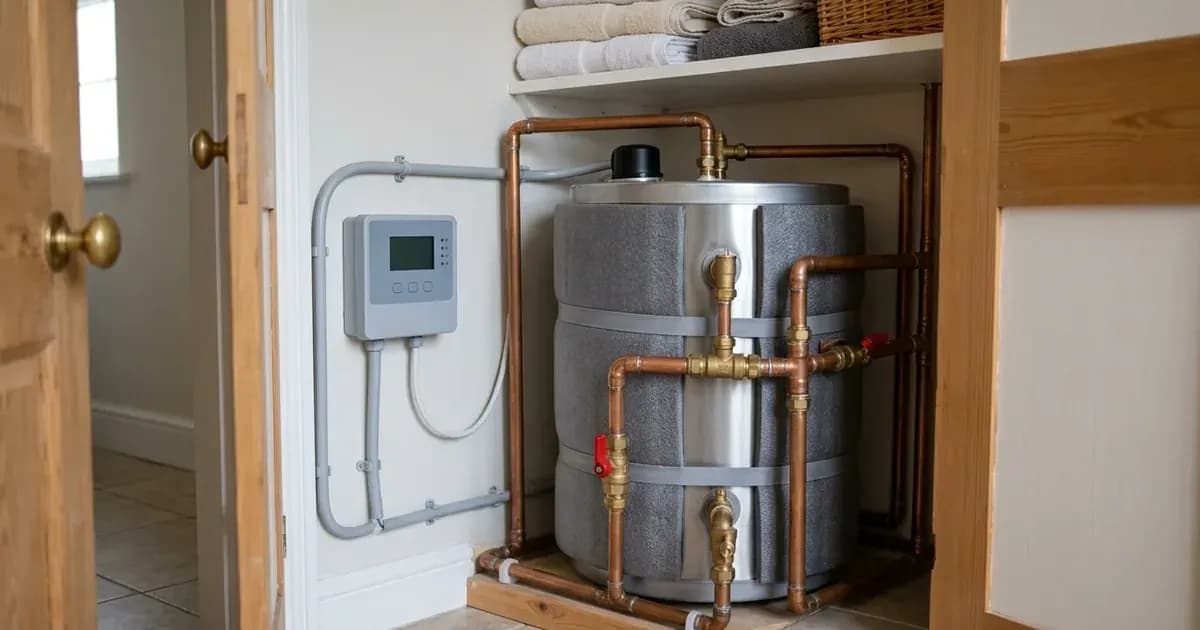
- Cable Sizing and Run Lengths: For the Solar iBoost+, installation should be arranged so that the cable from the controller output to the immersion heater is no more than 3m long, typically positioned in the airing cupboard adjacent to the cylinder.
- Dedicated Immersion Circuit: The output from the diverter to the immersion heater must not be interrupted by mechanical time switches, relays, or smart plugs.
- Thermostat Compatibility: The immersion element must have an independent mechanical safety thermostat with an integrated manual thermal cut-out. Electronic controllers must never be connected between the diverter and the resistive heating element.
Frequently asked questions
What is a solar PV immersion diverter?
A solar PV immersion diverter monitors household electricity generation and automatically redirects surplus power to an immersion heater in your hot water cylinder.
What is the maximum load capacity of the myenergi eddi?
The myenergi eddi diverter can redirect surplus electricity to any electrical resistive load up to 3.68kW with a mechanical thermostat.
How much standby power does the myenergi eddi consume?
In standby mode, the eddi solar power diverter consumes just 3W of power, maintaining high efficiency while monitoring generation.
What load capacity and cut-in threshold does the Solar iBoost+ have?
The Solar iBoost+ controls up to two 3kW immersion heaters with a factory default cut-in export threshold of 100W, adjustable in 50W increments up to 500W.
Can immersion diverters be used with electronic thermostats?
Immersion heaters must be fitted with mechanical thermostats; electronic smart controls between the diverter and element can cause component damage.
References
- myenergi eddi Technical Specifications — accessed 28 August 2026
- Marlec Solar iBoost+ Technical Specifications and FAQs — accessed 28 August 2026
- Marlec Solar iBoost Product Information — accessed 28 August 2026
Related guides
More from schemes, subsidies & financing.