Florida Net Metering Rules and Utility Interconnection Guide
Updated 18 September 2026 · By SolarNevs Research Desk, Dealer surveys + verified sources · 2 sources · Method ↗
Key Takeaways
- Florida Public Service Commission Rule 25-6.065 establishes 1:1 net metering for customer-owned renewable generation.
- Residential solar systems up to 10 kilowatts (10kW AC) qualify as Tier 1 with expedited interconnection.
- Systems between 10kW and 100kW AC are classified as Tier 2, requiring utility application fees and proof of personal liability insurance.
- Interconnection requires certified equipment and adherence to utility standards, including a visible break disconnect switch for Tier 2 and Tier 3 installations.
How does net metering work in Florida?
In Florida, net metering allows homeowners with solar panels to receive credit for the excess electricity their system generates and sends back to the grid. Florida Public Service Commission Rule 25-6.065 establishes 1:1 net metering for customer-owned renewable generation. This means that for every kilowatt-hour (kWh) of electricity you export to the grid, you receive a credit equal to the retail rate you pay for electricity imported from the grid.
This credit offsets electricity consumed from the grid at other times, such as at night or on cloudy days. The system is designed to help you reduce your electricity bills by maximizing the value of your solar production.
Understanding Florida's Net Metering Rule 25-6.065
The Florida Public Service Commission (FPSC) governs distributed renewable generation interconnected to investor-owned utility networks across the state of Florida. Rule 25-6.065 is the core regulation that outlines how net metering operates for customers of major utilities like Florida Power & Light (FPL), Duke Energy Florida, and Tampa Electric (TECO).
Under this rule, if your solar system produces more electricity than your home consumes in a given month, the excess generation rolls over monthly as a kilowatt-hour credit against future consumption within the annual billing cycle. This allows you to build up credits during sunnier months and use them during periods of lower solar production or higher consumption.
At the end of each calendar year, any remaining surplus generation credits are credited at the utility avoided-cost wholesale rate. This means that if you still have unused credits at the end of the year, the utility will compensate you for them at the wholesale rate they would pay to generate or purchase electricity themselves.
Interconnection Tiers: 10kW AC Thresholds and Requirements
Connecting your solar system to the grid in Florida involves an interconnection process, which varies based on the size of your system. The FPSC categorizes systems into different tiers, each with specific requirements.
Tier | System Size (AC) | Application Fee | Insurance Requirement | Interconnection Process |
|---|---|---|---|---|
Tier 1 | Up to 10 kilowatts (10kW AC) | No application fee | Not required | Expedited interconnection |
Tier 2 | Between 10kW and 100kW AC | Utility application fees | Proof of personal liability insurance | Standard interconnection process |
Residential solar systems up to 10 kilowatts (10kW AC) qualify as Tier 1 with expedited interconnection and no application fee. This streamlined process is designed for smaller residential installations.
Systems between 10kW and 100kW AC are classified as Tier 2. These larger residential or small commercial systems require utility application fees and proof of personal liability insurance. The insurance requirement is in place to cover potential liabilities associated with larger systems connected to the grid.
Tier 3 systems, which are larger than 100kW AC, have even more stringent requirements, including higher liability insurance and more complex interconnection studies.
Managing Excess Generation: Monthly Rollovers and Annual Cashouts
Florida's net metering policy provides a clear mechanism for handling electricity generated beyond your immediate consumption needs. The primary benefit is the monthly rollover of excess kilowatt-hour credits. This means that if your solar panels produce more electricity than you use in, for example, July, those surplus kilowatt-hours are banked as credits. You can then draw upon these credits in subsequent months, such as August or September, when your consumption might be higher or your solar production lower.
This monthly rollover continues throughout the annual billing cycle. The goal is to allow homeowners to effectively use all the electricity their system generates over the course of a year, matching periods of high production with periods of high demand.
At the end of each calendar year, remaining surplus generation credits are credited at the utility avoided-cost wholesale rate. This annual cashout ensures that any unused credits are not lost but are instead compensated financially, albeit at a wholesale rate rather than the retail rate. This mechanism encourages efficient system sizing and usage while providing a financial return for significant overproduction.
Federal Incentives: The Section 25D Tax Credit for Solar and Batteries
Beyond state-level net metering policies, homeowners in Florida can benefit from federal tax incentives that significantly reduce the cost of installing solar and battery storage systems. The primary incentive is the Section 25D tax credit.
Homeowners claiming qualifying residential solar and battery installations receive the 30% Section 25D credit on Form 5695. This credit applies to the cost of new, qualified clean energy property for your home. It is a direct reduction of your federal income tax liability, not just a deduction.
An important aspect of this credit is its applicability to battery storage. Residential battery energy storage systems qualify for the federal 30% Section 25D tax credit with no solar requirement. This means you can install a standalone battery system and still claim the tax credit, which is beneficial for homeowners looking to improve energy resilience or take advantage of time-of-use electricity rates.
Essential Equipment and Safety Standards for Florida Interconnection
Interconnecting a solar system to the grid in Florida requires specific equipment and adherence to established safety and performance standards. These requirements ensure the safety of homeowners, utility workers, and the stability of the electrical grid.
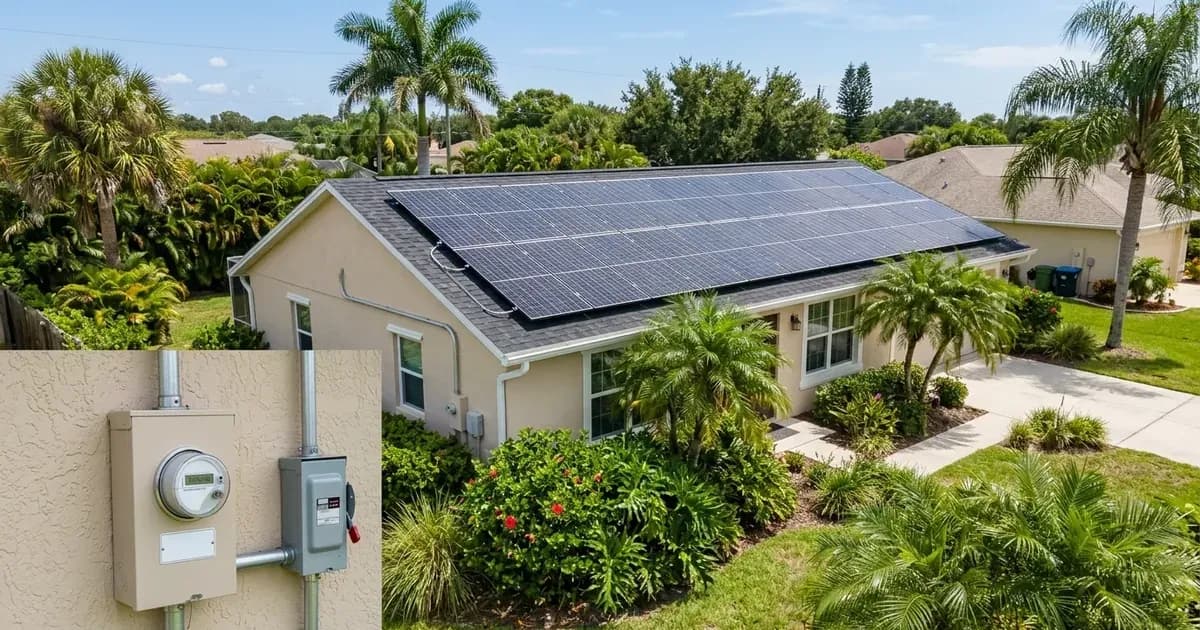
A dedicated bidirectional smart revenue meter is installed by the utility to accurately measure energy imported and exported. This meter is crucial for tracking your net electricity consumption and calculating your net metering credits.
Grid-tied inverters must be certified to UL 1741 and IEEE 1547 standards to automatically isolate during utility outages. This anti-islanding capability is a critical safety feature that prevents your solar system from feeding electricity into a de-energized grid, which could endanger utility workers performing repairs.
For larger installations, specifically Tier 2 and Tier 3, a visible break disconnect switch is required. Tier 2 and Tier 3 installations require an external, lockable, visible-break manual disconnect switch adjacent to the meter. This switch allows utility personnel to manually and visibly disconnect your solar system from the grid for maintenance or in emergency situations, ensuring their safety.
Contractors must follow OSHA lockout tagout safety procedures when making main electrical service connections. This practice ensures that electrical circuits are de-energized and locked out before work begins, preventing accidental re-energization and protecting workers from electrical hazards.
What the published sources do not tell you
While the Florida Public Service Commission (FPSC) Rule 25-6.065 provides a statewide framework for net metering, it's important to note that municipal electric utilities and rural electric cooperatives establish independent net metering policies outside FPSC jurisdiction. This means that if your electricity provider is not an investor-owned utility (like FPL, Duke, or TECO), their specific net metering rules may differ. The provided technical guidance does not detail these independent policies.
Additionally, while official scheme guidelines mentions utility application fees for Tier 2 systems, it does not specify the exact amounts of these fees, as they can vary by utility and may be subject to change. Similarly, the specific requirements for personal liability insurance for Tier 2 systems are not detailed, as these can depend on the utility and the insurance provider. The exact avoided-cost wholesale rate for annual cashouts is also not specified, as this rate fluctuates based on market conditions and utility-specific calculations.
Frequently asked questions
How does net metering work in Florida?
Florida Public Service Commission Rule 25-6.065 establishes 1:1 net metering for customer-owned renewable generation. Excess generation rolls over monthly as a kilowatt-hour credit against future consumption within the annual billing cycle.
What is the difference between Tier 1 and Tier 2 interconnection in Florida?
Residential solar systems up to 10 kilowatts (10kW AC) qualify as Tier 1 with expedited interconnection and no application fee. Systems between 10kW and 100kW AC are Tier 2, requiring utility application fees and proof of personal liability insurance.
Do I get paid for excess solar energy in Florida?
At the end of each calendar year, remaining surplus generation credits are credited at the utility avoided-cost wholesale rate. This means you receive a payment for any unused kilowatt-hour credits.
What federal tax credit is available for solar in Florida?
Homeowners claiming qualifying residential solar and battery installations receive the 30% Section 25D credit on Form 5695. Residential battery energy storage systems also qualify for this federal 30% Section 25D tax credit with no solar requirement.
What equipment standards are required for grid-tied solar in Florida?
Grid-tied inverters must be certified to UL 1741 and IEEE 1547 standards to automatically isolate during utility outages. A dedicated bidirectional smart revenue meter is installed by the utility to measure energy imported and exported.
References
- Florida Public Service Commission Rule 25-6.065 — accessed 27 August 2026
- FPL and Duke Energy Net Metering Interconnection — accessed 27 August 2026
Related guides
More from schemes, subsidies & financing.