Can Solar Run Your Air Conditioning? The Load That Decides
Updated 17 September 2026 · By SolarNevs Research Desk, Dealer surveys + verified sources · 2 sources · Method ↗
Key Takeaways
- Grid-tied: yes, gracefully — AC's appetite peaks precisely when panels produce, the happiest load-production alignment in home energy.
- The budget line: central AC adds commonly 900–1,500 kWh per hot month — call it 8–12 panels of summer production dedicated to cooling.
- Off-grid AC is a different sport: 3–5 kW continuous into the evening demands battery banks that dominate the whole design.
- Cooling-heavy homes are solar's best customers — the alignment is why Sun Belt worth-it math works at modest rates.
The happiest alignment in home energy
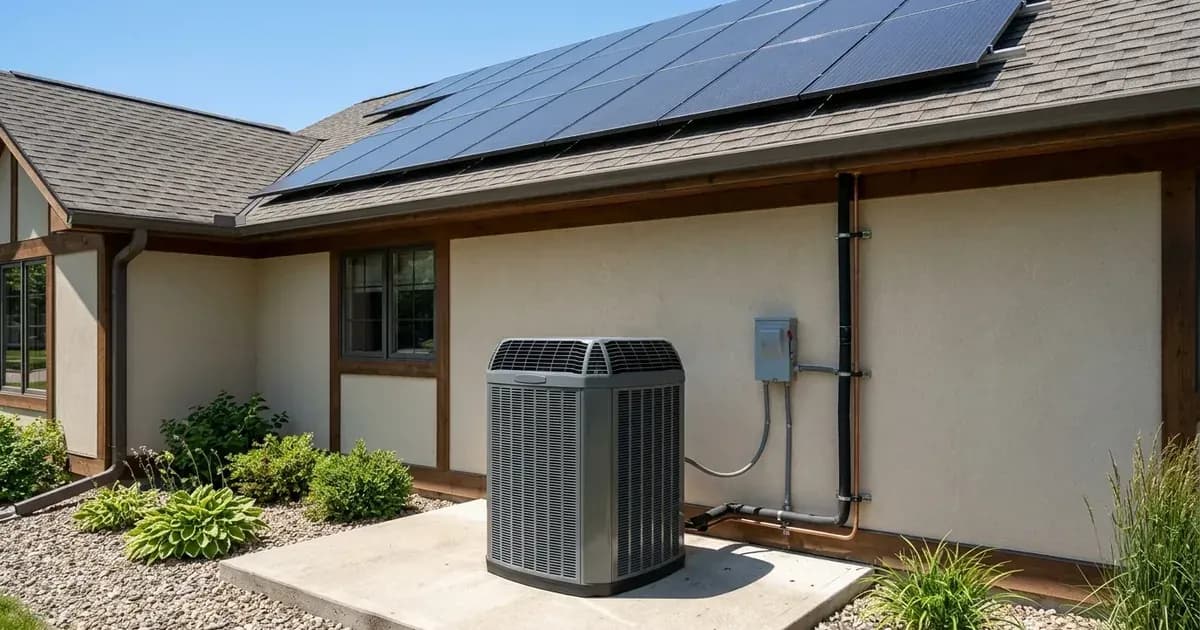
Most loads fight the sun — evening lights, night heating. Air conditioning is the exception that behaves: it runs hardest on the clear, blazing afternoons when your array peaks, which means a grid-tied solar home's cooling is substantially powered in real time, no storage or scheduling gymnastics required. EIA's residential data shows cooling as the dominant summer load across the South — and it's the reason summer bills double, which is precisely the doubling solar erases best.
The alignment isn't perfect — AC runs into the evening after production fades, which is where your export regime decides whether banked noon credits (full retail states) or a battery/pre-cooling strategy (net billing states) carries the 6-to-10pm shift.
Sizing the cooling line
Skip the wattage rabbit hole and budget by energy, as always:
Cooling profile | Added kWh, hot month | Panel-equivalent (summer) |
|---|---|---|
Window units, light use | 150–400 | 1–3 panels |
Central AC, moderate climate | 600–900 | 5–8 panels |
Central AC, Sun Belt summer | 900–1,500+ | 8–12+ panels |
The verification | Your July vs. April bills | The real number, free |
Bands per typical central systems (3–5 kW draw × runtime); the July-minus-April subtraction on your own bills beats every band. Panel-months at ~40 kWh summer yield per the production math.
That last row is the method this series trusts most: your utility bills already ran the experiment. Subtract a spring month's kWh from a peak-summer month's and the difference is your cooling load — hand it to the sizing arithmetic and the AC question dissolves into panel count.
The off-grid asterisk, honestly
Off-grid changes the verb from "offset" to "carry": a compressor drawing 3–5 kW continuously through evening hours is the load budget's final boss — hours of multi-kilowatt draw after sunset means battery banks sized in tens of kilowatt-hours for cooling alone, plus inverter surge headroom for compressor starts. The off-grid community's real answers: high-efficiency mini-splits (fractional draw, zone-by-zone), architectural cooling (shade, mass, ventilation — the desert's original AC), and honest acceptance that whole-house central air is the grid's flagship product. The same physics caps RV solar at "limited battery-hours" — scale changes, the boss fight doesn't.
The takeaway
For the grid-tied majority, AC isn't solar's problem — it's solar's case: the load that doubles summer bills is the one your roof attacks head-on, in real time, at peak production. Size the cooling line from your own bills, mind the evening shift per your export regime, and the hottest month becomes the one your system earns hardest. Panels were practically invented for July.
Frequently asked questions
Can solar panels run an air conditioner?
On a grid-tied system, easily — AC is just load, and its summer appetite aligns with peak production. A central system consuming 30–50 kWh on a hot day wants roughly 8–12 additional panels' worth of production.
How many solar panels does AC need?
Budget by energy: central AC adds commonly 900–1,500 kWh across a hot month. At ~40 kWh per panel-month in summer sun, that's 8–12 panels dedicated to cooling — the biggest single line in most sizing exercises.
Can off-grid solar run air conditioning?
This is the hard version: AC's continuous 3–5 kW draw through evening hours demands serious battery capacity. Off-grid AC means mini-splits, big banks, and honest budgets — or the desert-cabin answer, design that needs less cooling.
Does AC make solar more worth it?
Strongly — cooling-heavy households have the summer-peaked consumption that solar production mirrors, which is why the Sun Belt's worth-it math works even at modest electricity rates.
References
- EIA – Air conditioning in US homes (RECS) — accessed 5 August 2026
- NREL – PVWatts Calculator — accessed 5 August 2026
Related guides
More from schemes, subsidies & financing.