RV Solar Power: The Guide to Sun-Powered Boondocking
Updated 10 September 2026 · By SolarNevs Research Desk, Dealer surveys + verified sources · 1 source · Method ↗
Key Takeaways
- An RV solar setup is our off-grid guide shrunk onto a roof: panels → charge controller → house battery → (inverter), sized by a camp-day load budget.
- The tiers are honest: 100–200 W maintains, 400–600 W sustains, 800 W+ liberates — and rooftop air conditioning remains the boundary nobody's roof repeals.
- Lithium house batteries changed RV solar more than panels did — usable capacity and charge acceptance that lead-acid never offered.
- "Pre-wired for solar" frequently means a hole and a wire — audit before you count it.
The system, RV-sized
Everything from our off-grid systems guide applies, miniaturized: panels feed a charge controller (MPPT earns its keep here too, especially with panel voltages above the bank's 12/24 V), the controller feeds the house battery bank, and an inverter — optional in frugal rigs, central in fancy ones — serves AC appliances. The RV twist is that the vehicle already has an electrical civilization: house batteries, a converter/charger, shore-power inlet, maybe a generator. Solar joins that civilization as the boondocking fuel source, and the design question is simply how much of your camp life it should carry.
The load budget is the same discipline as always — appliance watts × hours — but denominated in camp days: what does 24 hours parked actually consume? Fridge (the big constant — propane-electric absorption vs 12 V compressor changes everything), lights, water pump, furnace fan (propane heats, but the fan drinks amps on cold nights), devices, and the inverter's own overhead. Weekenders discover they need less than feared; full-timers discover the fridge is a lifestyle decision.
The sizing tiers, without romance
Tier | Array + bank | What it honestly delivers |
|---|---|---|
Maintainer (100–200 W) | Modest bank, any chemistry | Batteries stay topped between hookups; weekend frugality |
Boondocker (400–600 W) | Lithium bank, proper controller | Sustained dry camping for compressor-fridge frugal rigs |
Liberator (800 W+) | Big lithium bank + real inverter | Residential-ish life off-grid — except AC |
The AC asterisk | Any of the above | Limited battery-hours at best; generator or humility |
Tiers reflect standard practice; your load budget adjudicates. Roof area caps most rigs near 400–800 W — see our panel size guide for the square-foot math.
The air-conditioning row deserves its own sentence because it anchors every disappointed forum thread: a rooftop AC unit draws on the order of a household circuit continuously, which is why "solar-powered AC" on an RV means "a large battery bank running it for limited hours, recharged over many sun-hours" — physics our charging-math guides let you verify, not a product gap awaiting one more purchase.
Roof versus portable, and the lithium footnote
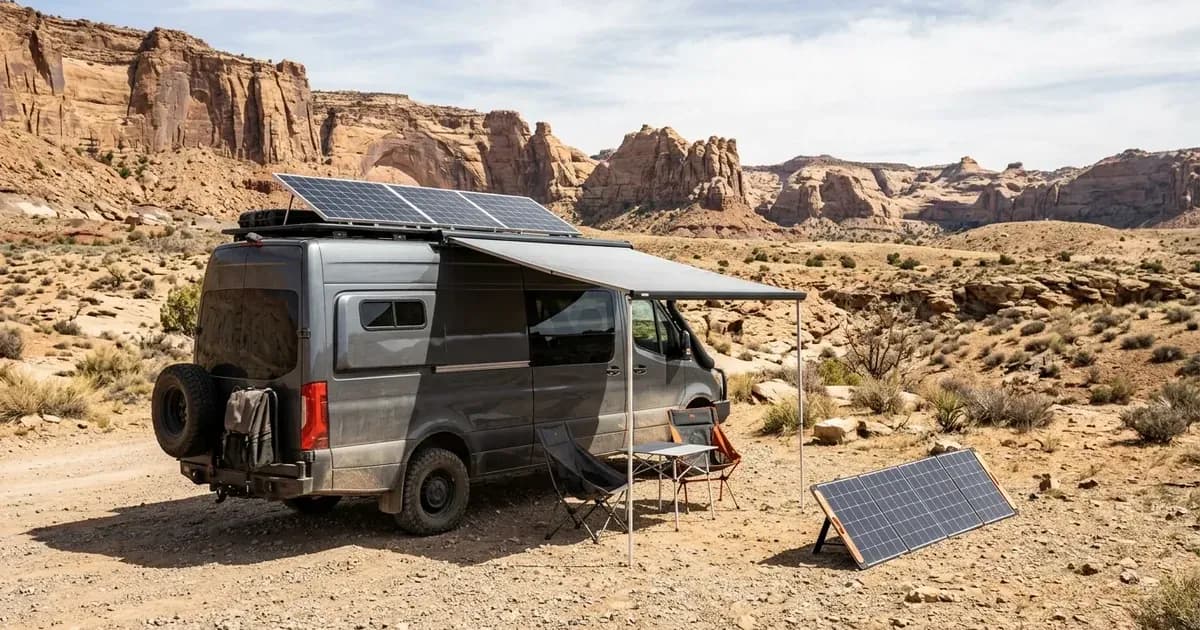
Roof panels harvest every daylight hour including driving days, survive weather, and cost roof real estate shared with vents and ACs. Portable panels chase sun while the rig parks in shade — the boondocker's classic move — at the price of setup ritual and theft-awareness. Veterans overwhelmingly land on both: a roof base for the constant, a folding supplement for the campsite. (Portable-panel quality math lives in our portable solar guide.)
The quieter revolution is chemistry: lithium house banks — deep usable capacity, fast charge acceptance, indifference to partial states — turned marginal solar systems into sufficient ones without adding a single panel. If your rig still runs lead-acid, the upgrade order is usually battery first, panels second.
Buying and rigging notes
- Audit "pre-wired." Frequently a roof gland and thin wire to a cabinet — no controller, marginal gauge. Budget as if bare until proven otherwise.
- Kits fit RVs unusually well — matched 12/24 V components are exactly the compatibility problem kits solve; see our kit guide's checklist.
- Mind the roof walk — panels, vents, and ACs compete for a small roof; lay it out on paper first.
- Fuse like an adult — mobile systems vibrate; protection and strain relief are where RV solar fires start and end.
- No incentives apply — the residential credit never fit vehicles and is gone regardless; RV solar has always been bought on usefulness alone, which is perhaps why its owners are the least disappointed people in solar.
Sized to the tier your camping actually matches, RV solar delivers the specific luxury it promises: mornings in places with no hookups, no generator drone, and no countdown — the sun refilling yesterday while you drink the coffee it heated.
Frequently asked questions
How much solar does an RV need?
By camp style: 100–200 W keeps batteries topped for weekenders; 400–600 W with a lithium bank runs sustained boondocking for a frugal rig; 800 W+ with a big bank approaches residential-style freedom minus air conditioning.
Can RV solar run the air conditioner?
This is the boundary question: rooftop AC draws more than most RV arrays produce. Big battery banks can run one for limited hours, recharged slowly — generous solar plus honest expectations, or a generator, remains the AC answer.
Roof-mounted or portable panels for an RV?
Roof for always-on charging and driving-day harvest; portable for chasing sun while parking in shade. The seasoned answer is both: modest roof base plus a portable supplement.
What does 'solar pre-wired' actually mean on an RV?
Often just a roof gland and wire run to a controller location — not a controller, panels, or adequate wire gauge. Verify what's actually installed before counting it as solar-ready.
What does "solar pre-wired" actually mean on an RV?
Often just a roof gland and wire run to a controller location — not a controller, panels, or adequate wire gauge. Verify what's actually installed before counting it as solar-ready.
References
- US DOE – Solar Photovoltaic Technology Basics — accessed 5 August 2026
Related guides
More from sizing, net billing & installation.