Portable Solar Panels: What They CAN and CAN't Do
Updated 17 September 2026 · By SolarNevs Research Desk, Dealer surveys + verified sources · 1 source · Method ↗
Key Takeaways
- The honest job description: recharging batteries away from outlets — power stations, RV banks, emergency reserves. Companion to storage, never substitute for a roof.
- Real output is a fraction of the label: angle, heat, haze, and cable losses all take their cut — plan with derated numbers and be pleasantly surprised.
- The buying spec that matters most is unlisted: the kickstand — because aim is output on a panel you position by hand.
- Where portable wins: multi-day stays. Where a bigger battery wins: overnights. Where the roof wins: everything stationary — our other guides cover that side.
The niche, drawn precisely
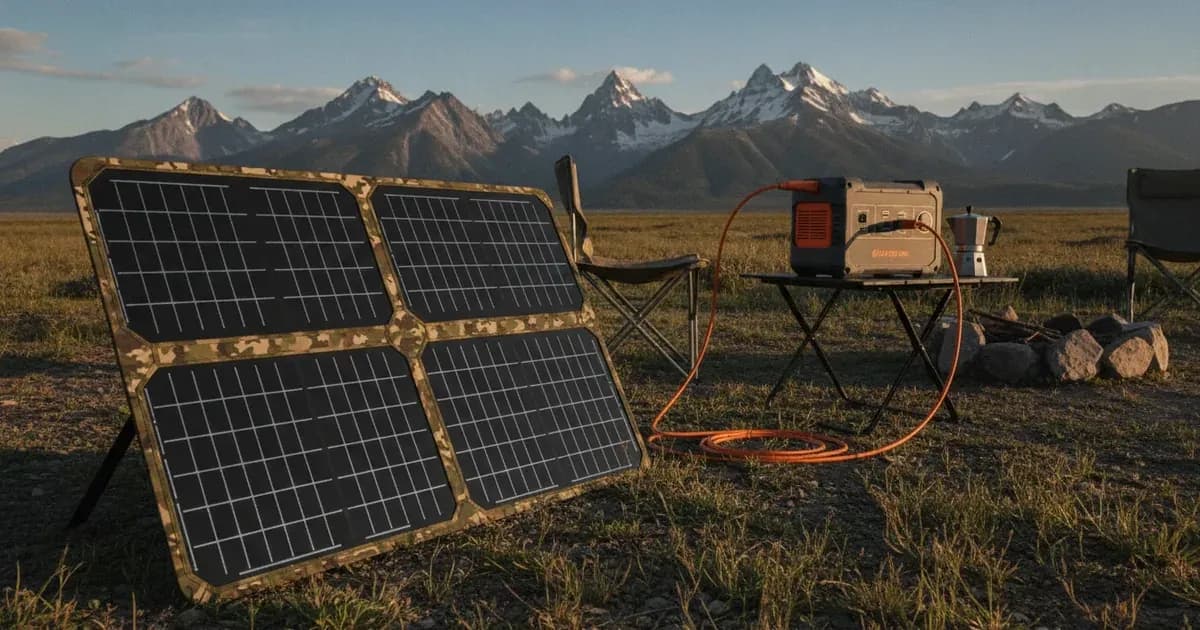
A portable panel is generation you carry to the energy need — which only makes sense when the need outlasts the battery you could have carried instead. That draws the map cleanly. Weekend car camp with a power station: charge it at home; the folder stays in the garage. Four days off-grid: now the battery is finite and the sun is the resupply — the folder earns its seat. RV parked under the one shady tree in Arizona: the portable chases sun the roof can't (the both-tools doctrine from our RV guide). Home outage kit: a folder plus power station is a quiet, gasless mini-resupply — modest, but genuinely useful (with the EV-charging exception our solar-generator article measures: cars are too big a bucket for this spigot).
What the niche excludes matters as much: portable panels are storage's companion, not competition for permanent mounting. Per watt, rooftop and even RV-roof installs beat folders on price, longevity, and the not-being-stolen dimension — the folder buys placement freedom, and that's the whole premium.
Label watts versus camp watts
Rated output assumes lab conditions; a campsite offers angle-by-kickstand, afternoon haze, panel heat (output sags as cells warm — the same physics from our winter guide, in reverse), and losses down the cable. The seasoned expectation: a healthy fraction of the label in good sun, less as conditions slide — enough that a 100 W folder aimed well across a decent day recharges a mid-size power station, which is precisely the pairing the category evolved around. Two habits recover most of what conditions steal: re-aim every hour or two (the kickstand is a sundial in reverse), and shorten cable runs where the kit allows.
Pairing | Verdict |
|---|---|
Folder + power station, multi-day camp | ✅ The category's home turf |
Folder + RV bank, shade-parked | ✅ The veteran move |
Folder + phone/devices direct | ✅ Small panels exist for exactly this |
Folder + EV | ❌ Thermos, swimming pool — see our scale math |
Folder instead of roof panels | ❌ Placement freedom is the only spec it wins |
Directional; the load-budget arithmetic from our sizing guides applies at every scale.
Buying: five specs, one of them secretly first
- The kickstand — sturdy, multi-angle, wind-tolerant. Aim is output; a floppy stand is a derating device.
- Real-world output reputation — reviews with measured numbers outrank labels; the gap between brands lives here.
- Connector compatibility — the folder must speak your power station's input dialect (and voltage window); adapters exist but verify first.
- Weight versus your actual life — the panel carried is the panel used; heroic wattage that stays in the trunk produces nothing.
- Fabric, glass, and hinge durability — folders live folded, dropped, and dusty; build quality is lifespan.
Priced against its real job — turning a finite battery into a renewable one for days at a time — the portable panel is one of the most honest products in consumer solar: modest promises, kept outdoors, no permits, no tariffs, no acronyms. Just remember which product it is: the resupply line, not the power plant. The power plant is the roof, and the rest of this site is about that.
Frequently asked questions
What are portable solar panels good for?
Recharging battery-shaped things away from outlets: power stations at camp, RV house banks when parked in shade, emergency top-ups. They're the mobile companion to storage, not a substitute for rooftop generation.
How much power does a portable panel actually make?
Expect a healthy fraction of the label under real conditions — angle, haze, and heat all trim rated watts. A 100 W folder in good sun commonly delivers enough to recharge a mid-size power station across a day.
Are portable panels worth it versus a bigger power station?
For multi-day off-grid stays, yes — panels turn a finite battery into a renewable one. For overnight trips, a bigger battery charged at home usually beats carrying generation.
What specs matter when buying a folding panel?
Real-world output ratio (reviews beat labels), the connector matching your power station, kickstand quality (angle is output), weight against your actual carrying, and durability of the fabric and glass.
References
- US DOE – Solar Photovoltaic Technology Basics — accessed 5 August 2026
Related guides
More from what to buy — and how not to get cheated.