Bifacial Solar Panels: When Two Faces Beat One
Updated 17 September 2026 · By SolarNevs Research Desk, Dealer surveys + verified sources · 2 sources · Method ↗
Key Takeaways
- Bifacial = glass both sides, cells that work from either — the rear face farms light bouncing off the ground.
- The gain is a function of albedo and air: near-zero flush on a dark roof, meaningful over concrete, dramatic over snow or white gravel with elevation.
- Roofs are monofacial territory; bifacial earns its premium on ground mounts, carports, and vertical installs.
- Utility-scale went bifacial for single-digit gains at massive volume; homeowners should demand the same arithmetic before paying the premium.
The physics of the second face
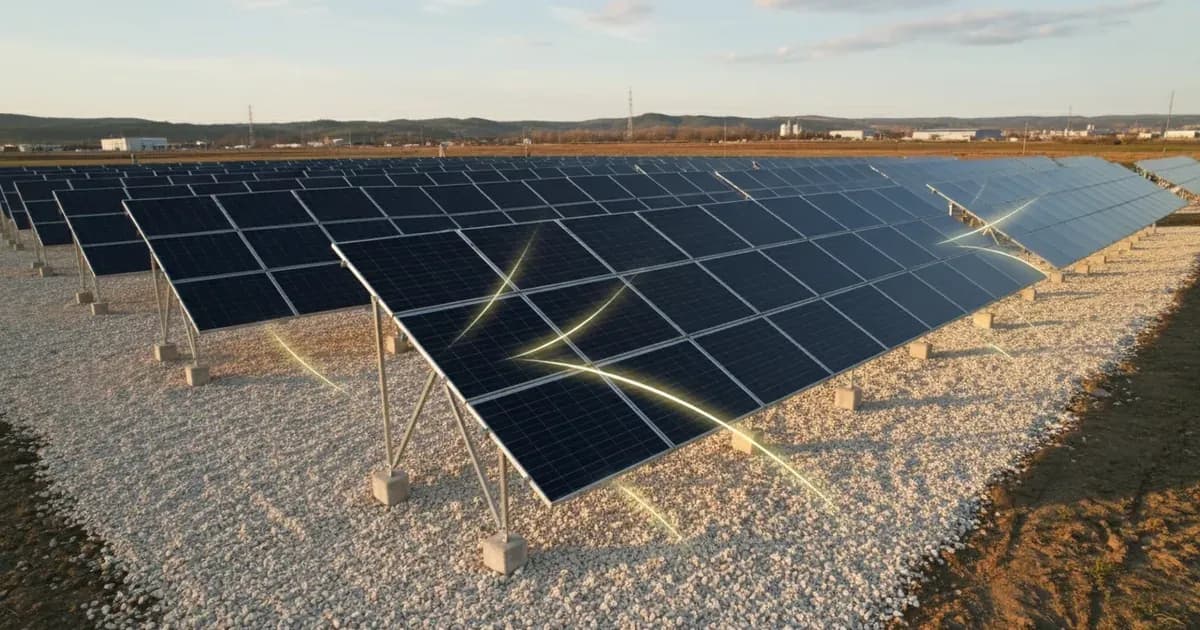
Sunlight that misses your panel doesn't vanish — it hits the ground and bounces, and a fraction of that bounce travels upward. A monofacial panel's opaque backsheet wastes it; bifacial construction replaces the backsheet with glass and leaves the cell's rear contact grid open, so the same photovoltaic effect runs on reflected photons. Rear output is always a minority share — the ground is a dimmer lamp than the sun — but it's additive output from panel area you already bought.
Two variables set the size of the gift. Albedo — the ground's reflectivity: dark shingles and soil bounce little, concrete a fair amount, white gravel and fresh snow a lot (snow country's second solar bonus after the cold-efficiency effect). And geometry — the rear face needs air and offset to see the bounce, which flush roof mounting denies almost entirely.
Where the second face earns its keep
Installation | Rear-face reality | Bifacial verdict |
|---|---|---|
Flush roof mount | Inches of dark shadow | Skip — pay for wattage instead |
Elevated ground mount, bright surface | Real bounce, real air | The home-turf case |
Open underside, reflective paving optional | Natural fit | |
Vertical (fence-style) east-west | Two faces, two peaks — morning and evening | The clever niche, snow-proof by geometry |
Utility farms | Engineered albedo at scale | Why the industry defaulted bifacial |
Gain ranges per NREL bifacial modeling: single digits typical, double over engineered or snowy surfaces.
The vertical case deserves its sentence: fence-like east-west bifacials produce a twin-peak curve — morning face, evening face — that maps neatly onto TOU rate windows and sheds snow by standing up, a combination turning European farm fences into a legitimate design pattern.
The buying arithmetic
Bifacial panels cost and weigh more (glass-glass construction — durability upside, the lifespan guide's glass-glass warranties often run longer), so the question is always gain versus premium. Flush-roof buyers: the gain rounds to zero — spend the premium on higher-wattage monofacial. Ground-mount, carport, and pergola builders: model it honestly (bright surface below? elevation? open back?) and bifacial frequently pencils — occasionally spectacularly where snow-months albedo aligns with winter's efficiency bonus. And everywhere, the kit checklist rule holds: the spec sheet's bifaciality factor is a lab ceiling; your ground supplies the real number.
Frequently asked questions
What are bifacial solar panels?
Panels with glass on both faces and cells that convert light from either side — the front works normally while the rear harvests light reflected off the surface below.
How much extra power do bifacial panels produce?
It depends almost entirely on what's underneath: low single digits over dark shingle roofs, high single digits over concrete, and double-digit gains over white gravel or snow with elevated ground mounts.
Are bifacial panels worth it on a house roof?
Rarely — flush-mounted panels see almost no rear light, so you pay bifacial's weight and cost for a rounding-error gain. Roofs are monofacial territory.
Where do bifacial panels shine?
Elevated ground mounts over reflective surfaces, carports and pergolas with open undersides, vertical fence-style installations, and snow-country arrays — anywhere the rear face actually sees sky-bounced light.
References
- US DOE – Solar Photovoltaic Technology Basics — accessed 5 August 2026
- NREL – Photovoltaic research (bifacial modeling) — accessed 5 August 2026
Related guides
More from what to buy — and how not to get cheated.