Solar Carports: Shade That Charges Your Car
Updated 10 September 2026 · By SolarNevs Research Desk, Dealer surveys + verified sources · 2 sources · Method ↗
Key Takeaways
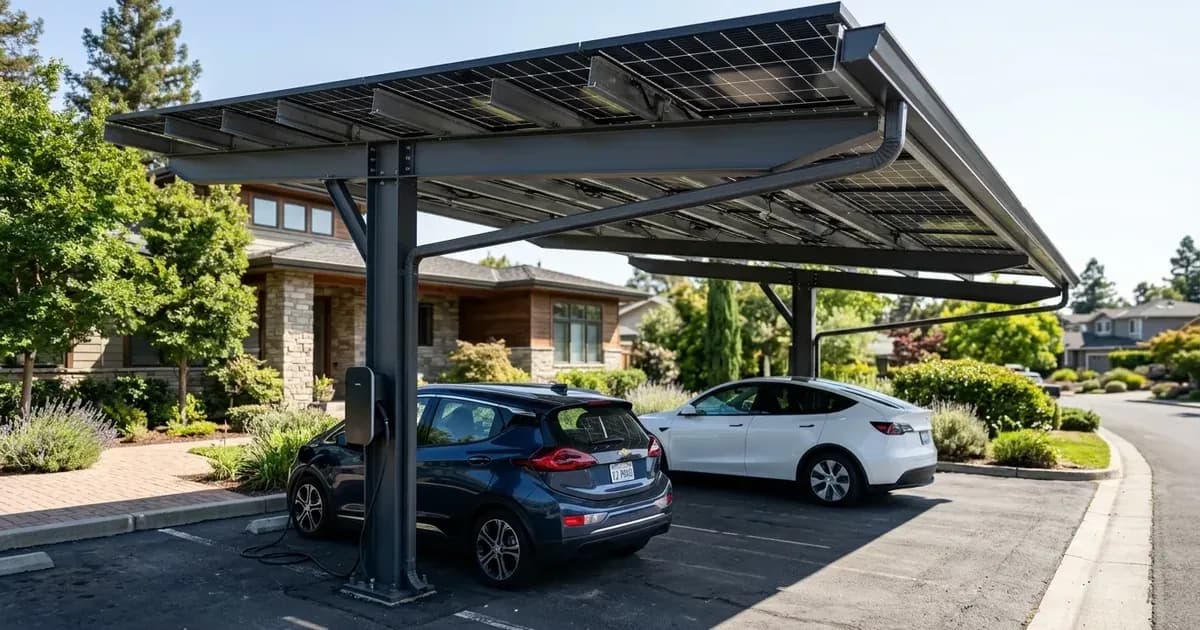
- A solar carport is a ground-mount with a job: panels form the canopy, cars get shade and weather cover, and EV charging wires in directly beneath.
- Its superpower is choice: you pick the orientation and tilt your roof never offered — and skip roof penetrations, roof-age dependencies, and future re-roofing conflicts entirely.
- Its handicap is structure: you're buying the steel your house would have provided free, so cost per watt runs meaningfully above rooftop.
- The sweet-spot buyer: an EV household with a compromised roof — shaded, north-facing, or due for replacement — or one that simply refuses to put holes in it.
What it is, and why the format works
Strip the branding and a solar carport is elegant plumbing: a canopy structure engineered to carry panels as its roof, parked things underneath. The format solves three problems in one pour of concrete. Generation — the canopy aims panels wherever you want them, unconstrained by your house's geometry. Protection — vehicles sit shaded from sun and hail, which EV batteries in hot climates genuinely appreciate. Charging logistics — the Level 2 charger mounts on the structure with the shortest possible run to the car it feeds, making the sun-to-wheels loop this site keeps mapping physically literal: the panels above the car charge the car below them.
Commercial America figured this out first — big-box lots and campuses turned parking acreage into power plants. The residential version is the same idea at driveway scale.
Carport versus rooftop: the honest ledger
Factor | Rooftop | Solar carport |
|---|---|---|
Structure cost | Free — the house exists | You buy every beam |
Orientation & tilt | Whatever the roof offers | Whatever PVWatts says is optimal |
Roof penetrations | Dozens | Zero |
Roof-age coupling | Re-roof forces panel removal | Independent of the house |
Shading | Inherited from trees/dormers | Sited where shade isn't |
Permitting | Standard solar | Solar + accessory structure |
Cost per watt | Baseline | Meaningfully higher |
Directional comparison; site specifics govern.
The structural premium is the whole argument against, and it's real — you're erecting a small building. The rebuttals are situational: a household already wanting covered parking splits the structure's cost across two purposes; one facing a five-figure re-roof-then-reinstall cycle on an aging roof escapes that tax permanently; and one with a hopeless roof (heavy shade, wrong azimuth) has no rooftop baseline to compare against — the carport is the only path to owning generation at all.
Sizing: what a driveway canopy actually yields
A two-car carport roof offers on the order of 200–350 usable square feet — hosting roughly 10–16 modern panels, or 4–6 kW. Run that through the arithmetic from our sizing guides: at typical US production, call it 5,500–8,500 kWh a year. Against the roughly 3,800 kWh a year an average commuter EV consumes (37 miles a day at ~3.5 mi/kWh including losses, per our EV-charging math), the canopy covers the car's entire appetite with room left over for the house. A carport alone rarely zeroes a home's bill — the average home wants ~20 panels — but "the car runs on sunshine and the house gets a discount" is a fair one-line summary of the format's output.
Orientation freedom sweetens the yield: canopies tilt panels at the textbook angle facing true south — or west, where time-of-use rates reward afternoon production — recovering the 10–20% that compromised roofs forfeit.
What to check before building one
- Permits wear two hats — solar rules plus accessory-structure rules (setbacks, height, sometimes HOA aesthetics review). Ask the installer who's handled both in your jurisdiction.
- Trenching is the hidden line item — power from a detached canopy reaches the house underground; distance and driveway crossings move the quote.
- Design for the charger now — conduit and panel capacity for a Level 2 unit cost little during construction and annoyingly more after.
- Snow country loves the format — steep canopy tilts shed snow better than most roofs, and the car underneath never needs scraping again.
- The federal credit is gone either way — carports and rooftops lost the 30% homeowner credit together at the end of 2025; state incentive stacks (see our state guides) apply to both equally.
The carport won't beat rooftop on a spreadsheet where a good roof exists. Where one doesn't — or where covered parking was already on the wishlist — it's the rare structure that shades your car, charges it, and pays rent while doing both.
Frequently asked questions
What is a solar carport?
A canopy structure whose roof is solar panels — shading and weather-protecting parked vehicles while generating power, with EV charging naturally wired beneath.
Is a solar carport better than rooftop solar?
Electrically it can be — you choose perfect orientation and tilt instead of inheriting your roof's. Financially it costs more per watt because you're building the structure the panels sit on, which rooftop gets free.
How many panels fit on a carport?
A two-car canopy typically hosts on the order of 10–16 modern panels — 4–6 kW, which is most of an average commuter EV's charging needs and a meaningful share of household consumption.
Do solar carports make sense for homes, or just parking lots?
Both, differently: commercial lots monetize acres of parking, while residential carports fit households with poor roofs (shade, orientation, age) or those wanting the EV-charging pairing without touching the house.
References
- NREL – PVWatts Calculator (custom-tilt production modeling) — accessed 5 August 2026
- US DOE – Solar Photovoltaic Technology Basics — accessed 5 August 2026
Related guides
More from sizing, net billing & installation.