Do Solar Panels Work at Night? What Actually Happens
Updated 17 September 2026 · By SolarNevs Research Desk, Dealer surveys + verified sources · 2 sources · Method ↗
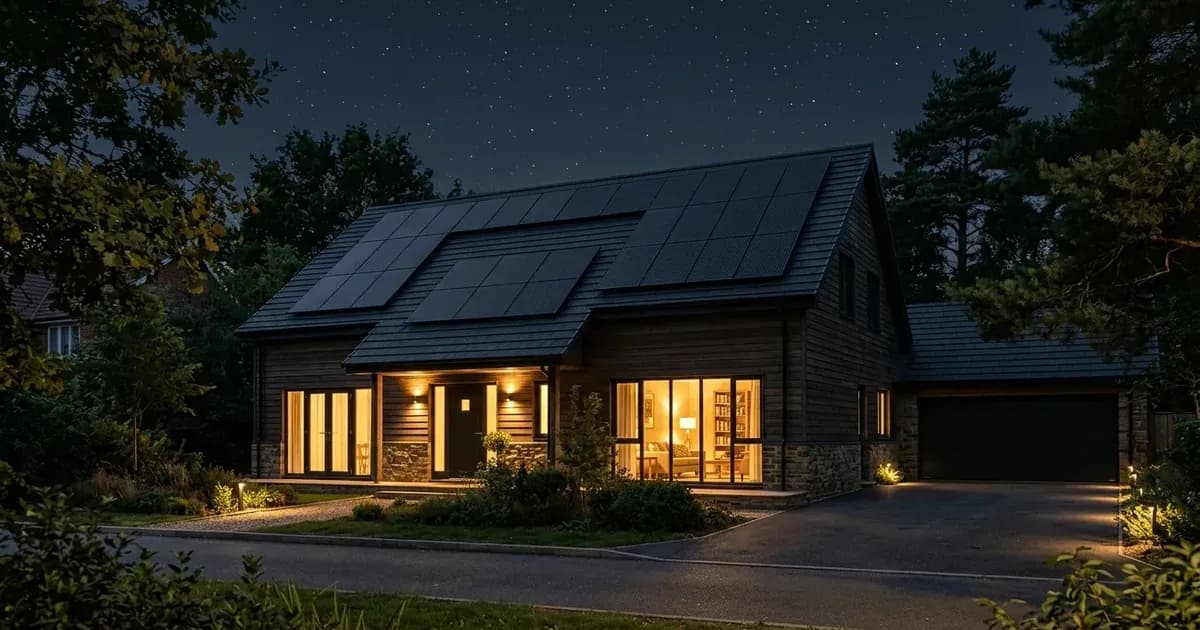
Key Takeaways
- No — the photovoltaic effect needs photons, and night sky delivers effectively none. Panels sit idle from dusk to dawn.
- Your lights stay on through one of three routes: grid power, banked export credits, or a home battery.
- Moonlight is real sunlight — reflected at roughly a millionth of the intensity. It produces trace output, not power.
- Nighttime is a billing question, not a hardware one — and your utility's export policy decides how expensive your nights are.
The short answer and the reason
Solar cells generate electricity when photons — light's energy packets — knock electrons loose in silicon, as the Department of Energy's primers describe. Remove the light and the process simply stops; there's no residual generation, no wind-down, no trickle worth metering. A panel at midnight is an inert pane of glass. This isn't a design flaw to be engineered away; it's the definition of the technology.
The interesting question — the one people are usually asking — is then how do solar homes work at night? And that answer is about plumbing, not panels.
The three night shifts
1. The grid (the default). A standard grid-tied home switches seamlessly to utility power when production stops. Nothing flickers; you just start buying electricity again like any other house. For most US solar households this is the entire nighttime story.
2. Banked credits (the accounting trick). Under net metering, your daytime surplus exported to the grid earns credits that offset your nighttime purchases. Where credits are full retail — as at Florida's investor-owned utilities — the grid works like a perfect battery: noon's excess pays for midnight's consumption one-for-one. Where exports earn less than retail (California's net billing being the sharpest example), each nighttime kilowatt-hour costs you the spread between retail and your export rate — which is precisely why…
3. The battery (the physical answer). A home battery charges on daytime surplus and discharges after dark, converting your own noon into your own evening. Where export credits are weak, this arbitrage is the economic heart of modern system design; where credits are strong, a battery is more about outage backup than nightly economics.
Night strategy | What powers 10pm | Cost of a nighttime kWh |
|---|---|---|
Grid only | Utility | Full retail rate |
Net metering credits | Utility, offset by day's exports | Retail minus export credit (zero where full-retail) |
Battery | Your stored solar | Roughly your solar's marginal cost |
Framework; export policies vary by utility.
But what about moonlight?
Moonlight is genuinely sunlight — reflected off the moon at roughly one-millionth of daytime intensity. Panels aimed at a full moon produce laboratory-detectable trace amounts, orders of magnitude short of running anything in your house. Streetlights and porch lights fare no better; you'd spend more powering the lamp than the panel returns. And the periodically viral "nighttime solar panel" research — devices harvesting the tiny thermal flow from a warm panel radiating heat to the cold night sky — is real science with outputs thousands of times below daytime PV: fascinating, and irrelevant to your roof for the foreseeable future.
What this means for system design
Because panels sleep at night, every solar decision is secretly a decision about the other 12 hours:
- Check your export policy first. It sets your nighttime electricity price. Full-retail credits make nights free (net of fixed charges); discounted exports make nights the leak in your savings.
- Size for your 24 hours, not your noon. Annual consumption is the target; the grid or battery time-shifts it.
- Shift what you can into daylight. Dishwasher, laundry, EV charging, pre-cooling — every load moved into production hours is a nighttime purchase avoided, whatever your tariff.
- Price the battery against your actual spread. Its nightly value is retail rate minus export credit; that number, times your evening consumption, is what the battery earns per day.
Night isn't solar's weakness so much as its bill: the technology hands you free daylight and lets your tariff decide what darkness costs. Choose the tariff — and the storage — accordingly.
Keep reading: how panels work · cloudy-day output · winter and snow.
Frequently asked questions
Do solar panels work at night?
No. Panels generate from light via the photovoltaic effect, and nighttime sky provides effectively none — moonlight is far too weak to produce meaningful power. Solar homes run on grid power, banked credits, or a battery after dark.
How does a solar house have power at night?
Three routes: buying from the grid as normal, drawing down net metering credits earned from daytime exports, or discharging a home battery charged with the day's surplus.
Do solar panels work with moonlight or streetlights?
Not usefully. Moonlight is reflected sunlight at roughly a millionth of daytime intensity — outputs are trace amounts, not usable household power.
Is there such a thing as a nighttime solar panel?
Researchers have demonstrated devices that harvest tiny amounts of energy from heat radiating to the night sky, but outputs are orders of magnitude below daytime PV — a laboratory curiosity, not a product.
References
- US DOE – How Does Solar Work? — accessed 5 August 2026
- US DOE – Solar Photovoltaic Technology Basics — accessed 5 August 2026
Related guides
More from sizing, net billing & installation.