Do Solar Panels Need Direct Sunlight? Shade, Explained
Updated 10 September 2026 · By SolarNevs Research Desk, Dealer surveys + verified sources · 2 sources · Method ↗
Key Takeaways
- Panels need light, not necessarily direct sun — diffuse sky and reflected light generate too, at lower intensity.
- The genuine villain is partial shade: series wiring means one shaded cell can throttle a whole string, costing far more than its share.
- Modern hardware — bypass diodes, micro-inverters, optimizers — turned shade from a dealbreaker into a design detail.
- The question isn't "is there any shade?" but "how many unshaded sun-hours does the roof bank per year?" — a measurable number, not a vibe.
Light versus direct light
A solar cell converts photons regardless of their travel history: straight from the sun, scattered by the sky (that's why a shaded courtyard isn't dark), or bounced off snow, water, or a light-colored wall. Direct beam is simply the densest delivery — which is why installers chase south-facing, unobstructed exposure — but panels on a bright overcast day, or facing east under a western sun, keep producing from the ambient light. If your panels can "see" open sky, they're working; the only question is at what fraction of their potential.
So "needs direct sunlight" is false as physics but true as economics: every hour of direct exposure is worth several hours of diffuse light, and system payback is built from those dense hours.
Why a little shade causes a lot of trouble
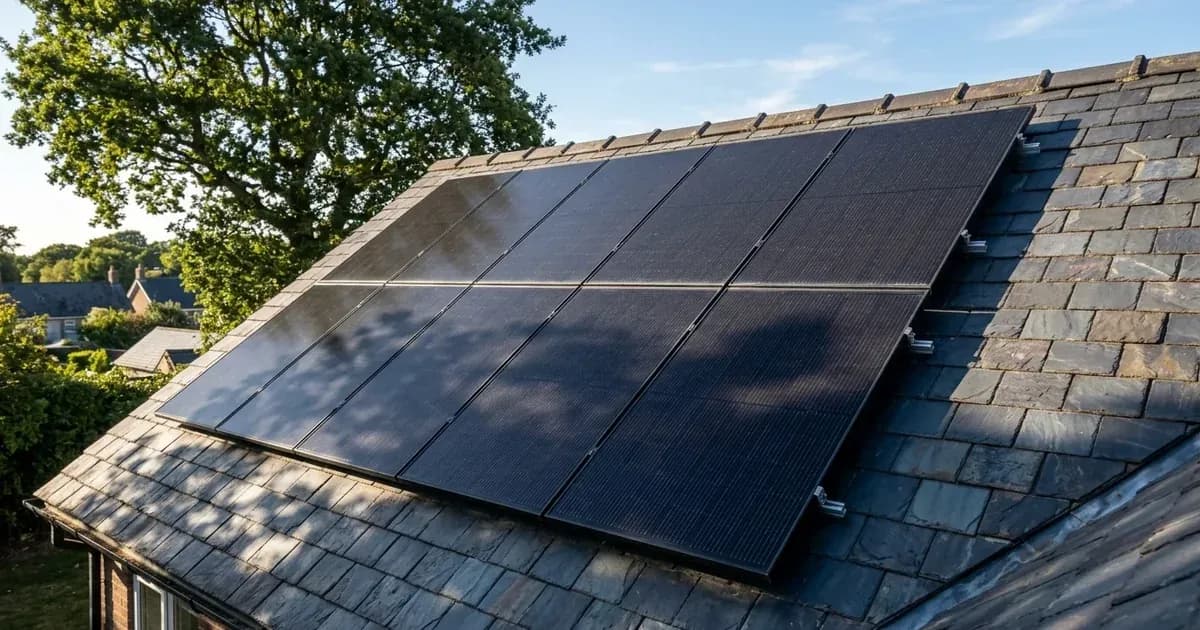
Here's the counterintuitive part that matters more than any of the above. Cells within a panel — and traditionally, panels within a string — are wired in series, meaning current flows through each in turn. Shade one cell and you've kinked the hose: the shaded cell's reduced current becomes the ceiling for everything downstream. A shadow covering a few percent of an array's area can, on legacy designs, cost a wildly disproportionate share of its output. A chimney's slow-moving shadow, one autumn-bare branch, even heavy leaf litter on a single panel — each punches above its area.
This is the real reason shade dominates solar site assessments. Not because indirect light fails, but because uneven light fights the electrical architecture.
The hardware that fixed it
Technology | What it does | Shade result |
|---|---|---|
Bypass diodes | Let current detour around a shaded cell-group within a panel | Limits one panel's internal loss |
Micro-inverters | Convert DC→AC at each panel independently | A shaded panel affects only itself |
Power optimizers | Per-panel DC conditioning feeding a central inverter | Same isolation, different topology |
String design | Routes strings to keep predictable shadows on one string | Old-school, still useful on simple roofs |
Standard equipment tiers; most modern residential quotes include per-panel electronics by default.
The practical upshot: a partially shaded roof that would have been rejected fifteen years ago is often a routine install today — the morning chimney shadow costs the morning chimney shadow's worth of light, and nothing more.
How to think about your own shade
- Get the number, not an opinion. Site assessments map your roof's solar access hour-by-hour across the seasons; NREL's PVWatts approximates production for your address before anyone visits. Shade shows up as arithmetic, not anecdote.
- Watch the winter angles. A tree that's irrelevant in June can shadow half the roof in December's low sun. Assessments model the whole year for exactly this reason.
- Trim before you engineer. A morning's pruning is cheaper than a lifetime of optimizer-rescued output; some shade problems are landscaping problems wearing an electrical costume.
- Skip the mythology. Panels don't need to "warm up," don't stop under glass-diffused light, and don't require a cloudless climate — they require photons and a design matched to where the shadows fall.
Direct sunlight is solar's best fuel, not its only fuel. The systems that disappoint aren't the ones built under occasional shadows — they're the ones designed as if shadows didn't exist.
Keep reading: how panels work · solar at night · cloudy-day output.
Frequently asked questions
Do solar panels need direct sunlight to work?
No — they need light, and direct sun simply delivers the most of it. Panels generate from diffuse and reflected light too, at reduced output. What genuinely hurts is partial shade on part of an array.
Why is partial shade worse than an overcast sky?
Cells in a panel are wired in series, so one shaded cell can throttle the current of its whole string — like a kink in a hose. Even light shade on one corner can cost disproportionate output on older designs.
What fixes shade problems?
Hardware: bypass diodes limit the damage within a panel, and micro-inverters or power optimizers make each panel independent, so one shaded panel no longer drags down its neighbors.
Is my roof too shaded for solar?
Only a site assessment answers that — shade analysis tools map your roof's sun hour by hour across the year. A morning chimney shadow is routine; a towering oak over the whole southern exposure is a different conversation.
References
- US DOE – Solar Photovoltaic Technology Basics — accessed 5 August 2026
- NREL – PVWatts Calculator — accessed 5 August 2026
Related guides
More from sizing, net billing & installation.