Monocrystalline Solar Panels: Why They Won the Market
Updated 17 September 2026 · By SolarNevs Research Desk, Dealer surveys + verified sources · 2 sources · Method ↗
Key Takeaways
- Mono means one crystal per cell — an orderly lattice that converts more light per square foot, which is the whole victory.
- The mono-vs-poly debate is over: residential offerings are essentially all-mono, making the word a description, not a decision.
- The label's remaining value is as a junk filter — anything sold as poly or thin-film for rooftops today deserves questions.
- Real 2026 differentiation lives inside mono: cell architecture, wattage-per-area, bifacial glass, warranty curves.
What the crystal actually does
The Czochralski process from our manufacturing tour pulls one continuous silicon crystal, and cells sliced from it inherit a defect-free atomic lattice — freed electrons (the photovoltaic effect's working currency) travel it with fewer collisions and losses. Polycrystalline's cast-block alternative froze into many grains whose boundaries scatter and trap; cheaper to make, measurably worse at the only job. That efficiency gap — a few points that compound across every square foot of a constrained roof — is why mono's manufacturing-cost disadvantage eroded, then inverted, then ended the argument.
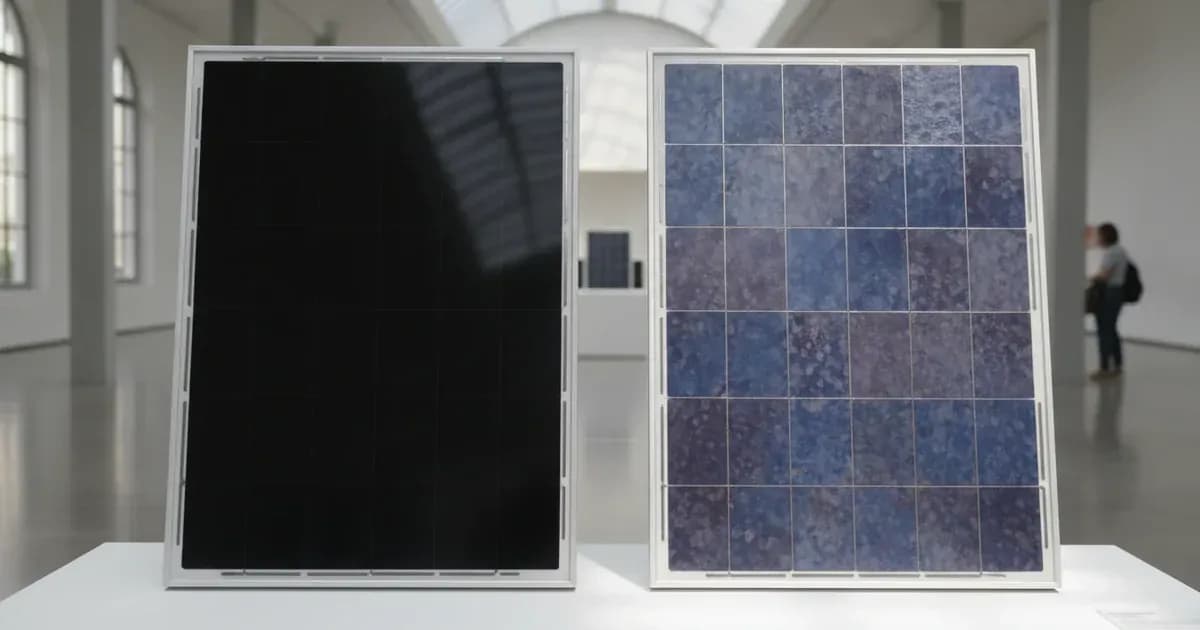
The visual tell became a brand: mono's uniform light absorption reads deep black, poly's grain mosaic shimmered blue, and curb appeal cast its vote with the spreadsheets.
The market verdict, and what it means for buyers
Era question | 2026 answer |
|---|---|
Mono or poly? | Mono — the shelves decided |
Is "mono" a premium label? | No — it's the baseline |
Does the word filter anything? | Junk: rooftop poly/thin-film offers warrant scrutiny |
Where's the real choice now? | Within mono: architecture, wattage, warranty |
Market state per prevailing US residential offerings.
For a buyer this is liberating: one historical anxiety deleted. The panels in every kit, every quote, every sizing exercise on this site are mono by default, and the label on the datasheet confirms rather than differentiates.
The choices that replaced it
Inside the mono family, the differentiators that actually move your outcome:
- Cell architecture — newer designs (TOPCon-class and successors) squeeze extra points of efficiency from the same crystal; this is where "premium" now lives.
- Wattage per panel — the same-footprint power growth our size guide tracks; tight roofs pay for density.
- Bifacial construction — glass backs that harvest reflected light, a genuine variable with its own guide in this series.
- The warranty curve — degradation floors and terms separate brands more meaningfully than crystal marketing ever did.
- Provenance — supply-chain origin, which FEOC rules turned into a compliance line for commercial buyers.
"Monocrystalline" earned its victory lap; read it on the spec sheet as the price of entry, then spend your attention where the differences still are.
Frequently asked questions
What are monocrystalline solar panels?
Panels whose cells are sliced from a single continuous silicon crystal — the orderly atomic lattice converts light more efficiently than the multi-grain (polycrystalline) alternative it displaced. Visually: uniform black cells, not blue mosaic.
Are monocrystalline panels better than polycrystalline?
Yes, and the market already voted: mono's higher efficiency per square foot won so completely that poly has nearly vanished from residential offerings. The mono-vs-poly question is settled history.
Is 'monocrystalline' still a useful buying filter?
Barely — nearly everything sold is mono now. The differentiators that matter today live inside the mono family: cell architectures like TOPCon, half-cut designs, bifacial glass, wattage, and warranty terms.
Why are monocrystalline panels black?
The single-crystal cell absorbs light uniformly, reading as deep black — one reason mono also won on aesthetics over poly's shimmering blue fragments.
Is "monocrystalline" still a useful buying filter?
Barely — nearly everything sold is mono now. The differentiators that matter today live inside the mono family: cell architectures like TOPCon, half-cut designs, bifacial glass, wattage, and warranty terms.
References
- US DOE – Solar Photovoltaic Technology Basics — accessed 5 August 2026
- US DOE – Photovoltaics — accessed 5 August 2026
Related guides
More from what to buy — and how not to get cheated.