How Are Solar Panels Made? From Sand to Rooftop
Updated 16 September 2026 · By SolarNevs Research Desk, Dealer surveys + verified sources · 3 sources · Method ↗
Key Takeaways
- The chain runs quartz → polysilicon → ingot → wafer → cell → module: rock to rooftop in six industrial acts.
- The working wafer is sliced thinner than a few human hairs, then layered into a glass-polymer-aluminum sandwich built to survive 25+ years of weather.
- The supply chain's China concentration is now a US tax matter: FEOC rules tie commercial credit eligibility to component provenance.
- Panels are recyclable — glass, aluminum, copper, and silicon all recover — and a US recycling industry is scaling as the first generation retires.
Act one: from quartz to polysilicon
Every mainstream panel begins as quartz — silicon dioxide, among the most common materials in the Earth's crust. Furnaces reduce it to metallurgical silicon, and further chemical refining pushes purity to the astonishing levels photovoltaics demand: the polysilicon feedstock is refined to well beyond 99.999% pure, because stray atoms interfere with the electron traffic the whole enterprise depends on. This refining is energy-hungry, which is why polysilicon plants cluster near cheap electricity worldwide.
Act two: growing the crystal
Purity isn't enough; the silicon's atomic lattice must be orderly. In the dominant monocrystalline process, polysilicon is melted in a crucible and a seed crystal is dipped and slowly withdrawn, rotating, pulling up a single continuous crystal — a gleaming cylindrical ingot. The slower, cheaper multicrystalline route (casting blocks with many crystal grains) has largely lost the market to mono's higher efficiency, which is why nearly every modern panel quote reads "monocrystalline."
Act three: wafers, thinner than hairs
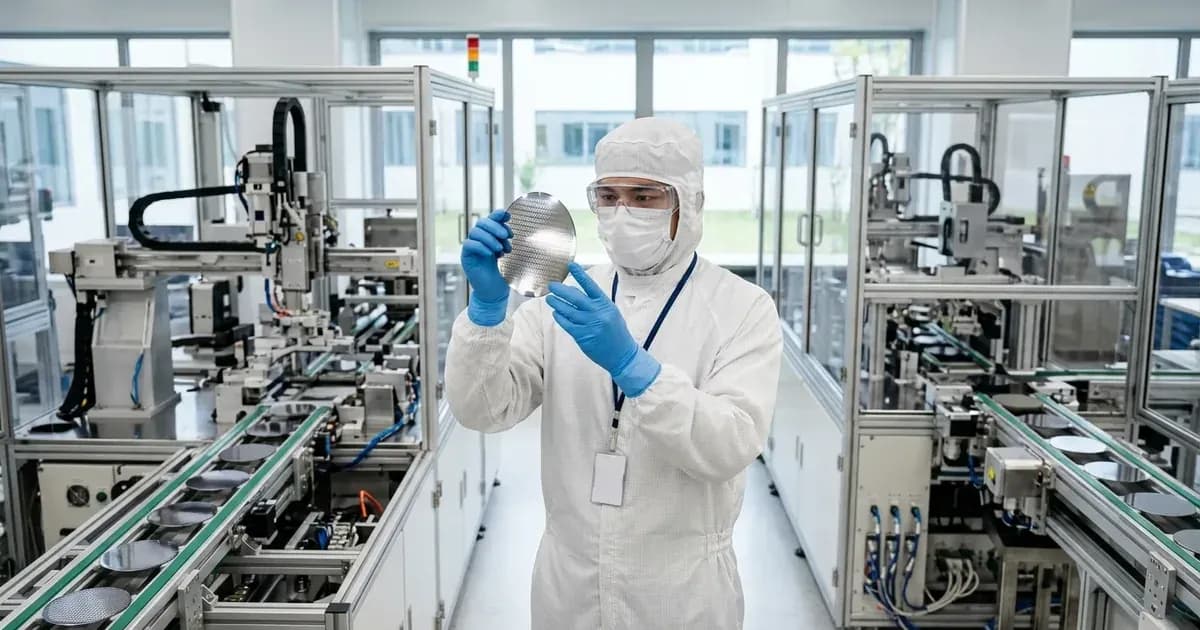
Diamond-wire saws slice the ingot into square-ish wafers thinner than a few human hairs — the Department of Energy notes finished cells are "often less than the thickness of four human hairs." Sawing waste (kerf) once claimed a large share of each ingot; thinner wires and recycling have clawed much of it back. The fragile wafers then head to the cell line.
Act four: turning a wafer into a cell
This is where physics is installed. The wafer is chemically textured to trap light, doped to create the positive-negative junction that gives electrons their one-way street, coated with an anti-reflective layer (the classic deep blue-black), and screen-printed with silver contact lines that harvest the current. Each finished cell is flash-tested and binned by performance — the cells in one panel are matched siblings, because a weak cell throttles its series-wired neighbors.
Act five: the sandwich
Layer | Material | Job |
|---|---|---|
Front | Tempered glass | Weather, hail, decades of UV |
Encapsulant | Polymer (EVA or similar) | Seals cells from moisture |
Working layer | ~60–72 wired cells | The generator |
Backsheet / rear glass | Polymer or glass | Rear protection (glass-glass for bifacial) |
Frame | Aluminum | Rigidity and mounting |
Junction box | Wiring + bypass diodes | Power out, shade protection |
Standard module construction per DOE materials overviews.
Lamination ovens fuse the stack; a frame, junction box, and final flash test finish it. The product is rated for decades outdoors — the same fragile wafer that would shatter in your fingers, now armored for hail.
The geography — and why it's suddenly a tax question
Manufacturing at every stage of this chain concentrated heavily in China over the past two decades, with US and Southeast Asian capacity meaningful and growing. Since 2026 that concentration carries direct financial consequences for American commercial projects: FEOC (foreign entity of concern) rules under the One Big Beautiful Bill Act tie business tax-credit eligibility to how much of a project's cost traces to prohibited foreign entities — making "where was this made?" a compliance document rather than trivia. Homeowners face no such test, but the origin question now shapes which panels US distributors stock.
The afterlife
A panel that spends 25–30 years on a roof doesn't become landfill by necessity: the glass, aluminum frame, copper wiring, and silicon are all recoverable, and dedicated US recyclers are scaling alongside the first big retirement wave. Recycling economics still trail the value recovered — common for young waste streams — but the direction is set, and several states have begun folding panels into e-waste frameworks. The rock-to-rooftop chain, in other words, is slowly closing into a loop.
Keep reading: how panels work · solar at night · cloudy-day output.
Frequently asked questions
What are solar panels made of?
Mostly silicon (refined from quartz), tempered glass, aluminum framing, copper wiring, and polymer encapsulants — with silver in the cell contacts. The working layer is a silicon wafer thinner than a few human hairs.
How is a solar cell manufactured?
Quartz is refined into high-purity polysilicon, melted and drawn into a single crystal ingot, sliced into thin wafers, chemically treated to form the electric junction, printed with metal contacts, and tested.
Where are most solar panels made?
The supply chain is heavily concentrated in China at every stage, with meaningful and growing manufacturing in the US and Southeast Asia — a concentration that now carries tax-credit consequences for US commercial projects under FEOC rules.
Can solar panels be recycled?
Yes — the glass, aluminum, copper, and silicon are all recoverable, and a US recycling industry is scaling up as early installations retire.
References
- US DOE – Solar Photovoltaic Technology Basics — accessed 5 August 2026
- US DOE – Photovoltaics — accessed 5 August 2026
- Baker Tilly – FEOC provisions in the OBBBA (supply-chain context) — accessed 5 August 2026
Related guides
More from sizing, net billing & installation.