Solar Panel Size and Weight: What Fits on Your Roof
Updated 17 September 2026 · By SolarNevs Research Desk, Dealer surveys + verified sources · 2 sources · Method ↗
Key Takeaways
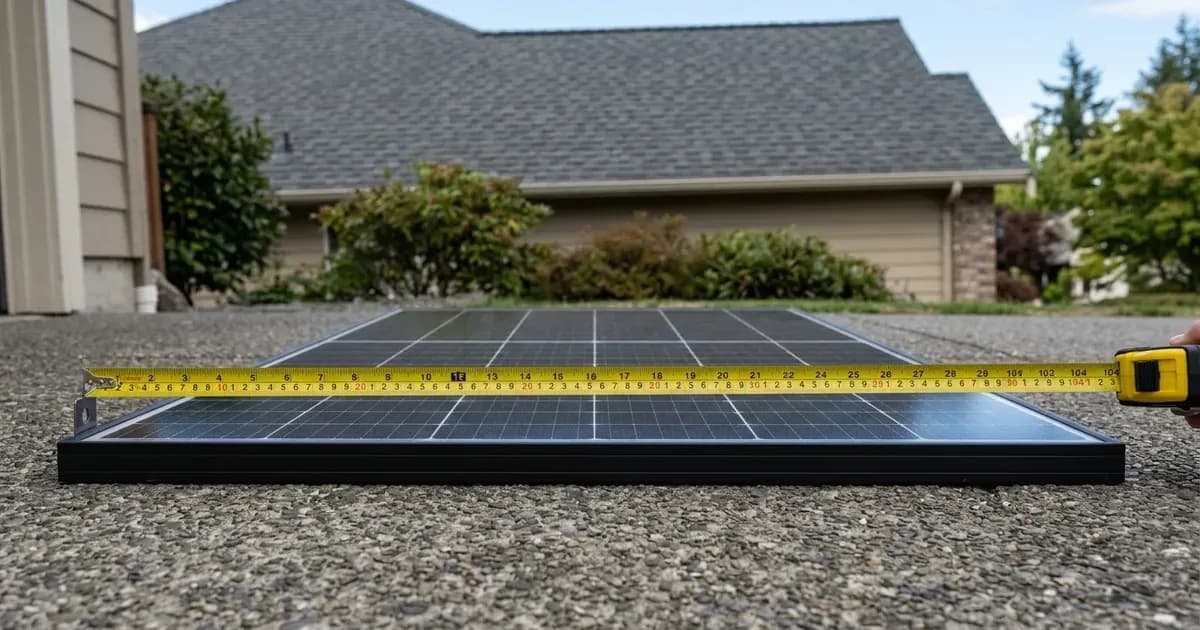
- A residential panel: about 5.5–6.5 ft × 3.5 ft, 40–50 lb — a door-sized slab two people carry comfortably.
- Installed arrays load roofs at roughly 3–4 lb per square foot including racking — modest against what code-built roofs carry.
- Budget ~21 sq ft of roof per panel: a 20-panel system wants 400–450 usable square feet after fire-code setbacks.
- Roof condition disqualifies far more projects than roof strength — the pre-install structural check is about age, not capacity.
The panel itself
Residential modules have converged on a familiar format: roughly 5.5 to 6.5 feet long, about 3.5 feet wide, an inch-and-change thick — think "exterior door, but glass." Weight runs 40 to 50 pounds for most current models: a two-person carry up a ladder, which is precisely why installation crews exist. Commercial-format panels (the 72-cell-and-up class) stretch longer and heavier, buying fewer mounting points per watt on big flat roofs — the reason warehouse arrays use bigger slabs than bungalows.
Wattage grew inside this stable footprint: the same-sized panel that shipped at 300 W a decade ago ships at 400+ today because cells got better, not bigger. For a space-limited roof, that history matters — each panel generation packs more system into the same square footage, and premium high-efficiency models exist specifically for tight roofs.
What an array asks of a roof
Question | The number | Context |
|---|---|---|
Area per panel, installed | ≈21 sq ft | Panel plus inter-row spacing |
12-panel starter (≈4.8 kW) | ≈250 sq ft | Townhouse-scale roofs |
20-panel average-home (≈8 kW) | ≈400–450 sq ft | The EIA-average-consumption system |
30-panel large-home (≈12 kW) | ≈650 sq ft | Big roofs or split across faces |
Load, panels + racking | ≈3–4 lb/sq ft | Distributed across many anchors |
Rounded planning figures; module spec sheets and structural review govern.
The load figure deserves emphasis because it's where homeowner intuition runs hottest and reality runs coolest: three to four pounds per square foot, spread across dozens of anchor points into rafters, on structures engineered for snow, wind, workers, and decades of weather. Structurally sound roofs — which is to say, nearly all of them — carry solar without drama, and the installer's engineering review exists to certify the exceptions.
What actually kills projects is the other roof question: remaining life. Shingles with five years left mean a mid-life panel removal and reinstallation nobody enjoys paying for. Re-roof first is the standing advice in every guide this site publishes, and it's a scheduling nuisance precisely because it's so rarely wrong.
Fitting the system to the space you have
Usable roof is smaller than actual roof. Fire codes reserve setbacks — access pathways along ridges and edges — and vents, chimneys, and skylights carve their own exclusions. The planning sequence that avoids disappointment:
- Measure the candidate faces — south-ish and west-ish planes first (our orientation guide explains when west outranks south), minus obvious obstructions.
- Divide by ~21 sq ft for a realistic panel ceiling.
- Compare against your target count from consumption math (the panels-to-power-a-house guide).
- Close gaps with wattage, not wishful shading tolerance — premium panels squeeze 10–15% more capacity into the same area, worth real money on constrained roofs; panels forced into shade squeeze out disappointment.
And if the roof genuinely can't host the target: partial systems pay partial-but-proportional returns, and ground mounts turn yard into capacity for those with the acreage. The panel's dimensions are fixed; the design around them rarely is.
Keep reading: per-panel daily output · sizing for 1,000 kWh · kW vs kWh.
Frequently asked questions
How big is a standard residential solar panel?
Roughly 5.5 to 6.5 feet long by about 3.5 feet wide — on the order of 18–22 square feet per panel — with commercial-format panels somewhat larger.
How much do solar panels weigh?
Typically 40–50 pounds per residential panel. Spread across its area with racking included, an installed array loads a roof at roughly 3–4 pounds per square foot — well within what code-compliant roofs are built to carry.
How much roof space does a full system need?
Around 21 square feet per panel installed: a 20-panel, 8 kW system wants on the order of 400–450 square feet of usable, well-oriented roof after setbacks.
Can my roof support solar panels?
Almost all structurally sound roofs can — a few pounds per square foot is modest loading. The real disqualifiers are age and condition: installers assess the roof, and re-roofing first beats removing panels later.
References
- US DOE – Solar Photovoltaic Technology Basics — accessed 5 August 2026
- NREL – PVWatts Calculator (system sizing) — accessed 5 August 2026
Related guides
More from sizing, net billing & installation.