Can Solar Run a Well Pump? Surge Is the Whole Story
Updated 17 September 2026 · By SolarNevs Research Desk, Dealer surveys + verified sources · 1 source · Method ↗
Key Takeaways
- The pump's energy is a rounding error — 1–3 kWh a day; its starting surge (2–3× running watts, instantly) is the entire engineering problem.
- Grid-tied homes: your well is already solar-powered and nobody noticed — the grid absorbs surges invisibly.
- Off-grid: the pump sizes your inverter, not your array — surge headroom or a soft-start kit is the design decision.
- The elegant third path: DC solar pumps filling a storage tank all day, no inverter, no surge, no batteries — gravity does the pressure.
The two numbers, and why they mislead
A typical residential well pump — 1 to 2 horsepower, 750–1,500 running watts — moves a family's water in minutes per hour, totaling perhaps 1–3 kWh a day: one panel's worth of production by the daily math. By energy, the well is among your cheapest appliances.
Then it starts. Induction motors driving pumps demand a surge of double or triple running watts for the moment of spin-up — 3,000+ watts appearing instantly from a pump that averages a few hundred. Energy: trivial. Power: the spikiest thing in a rural home — the kW-versus-kWh distinction with a pressure tank attached.
Grid-tied: the non-problem
If your home has utility service, this article is reassurance: the grid eats motor surges without blinking, your grid-tied array offsets the pump's modest energy along with everything else, and the well adds maybe one panel to any sizing exercise. Wells only become a solar topic when the grid leaves the story.
Off-grid: the pump sizes the inverter
Off-grid, that surge lands on your inverter — and inverters that can't source it simply fault, leaving tanks dry behind a mostly-charged battery. The design rules the off-grid guide sets:
Design lever | The move |
|---|---|
Inverter surge rating | Spec against pump start (2–3× running), not the daily average |
Soft-start kit | Ramps the motor; slashes surge; the cheap fix that shrinks the inverter |
Pump choice | Modern variable-speed/soft-start pumps design the problem away |
Scheduling | Pump to a pressure/storage tank midday, when the array can help |
Portable stations mostly can't start big pumps — check surge specs |
Surge multiples per standard induction-motor behavior; your pump's plate and manual carry the real numbers.
The soft-starter deserves its fame: a modest device that converts the brutal instant demand into a polite ramp, frequently the difference between needing a big inverter or the one you already own.
The homestead classic: skip AC entirely
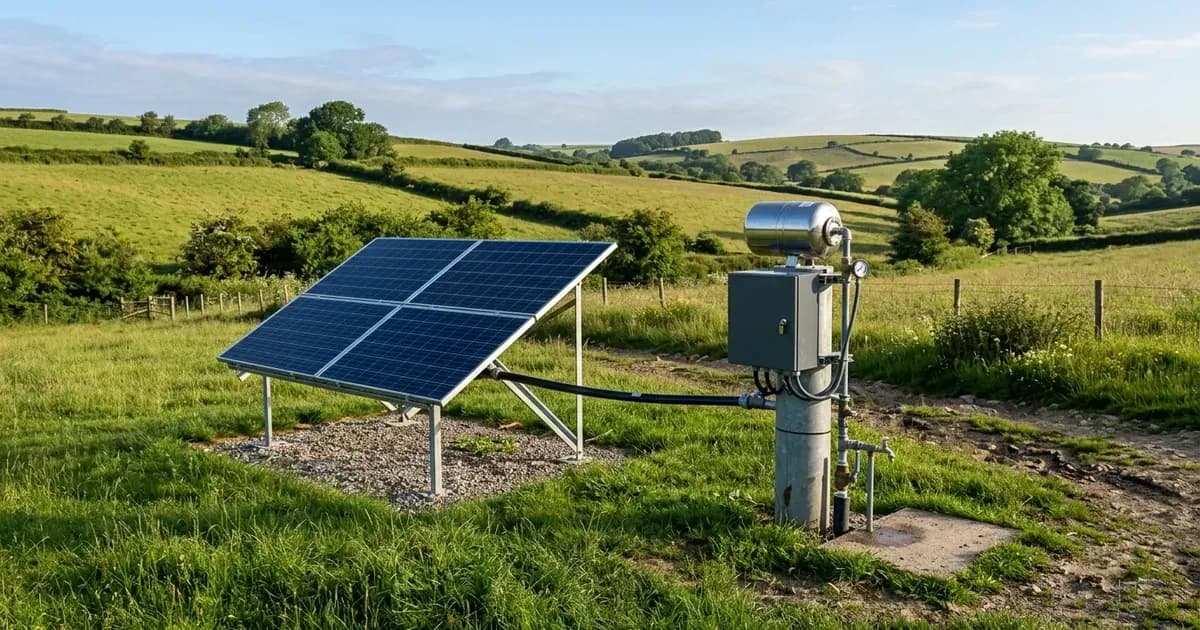
The oldest solution predates the problem: DC solar well pumps wire directly to a few panels — no inverter, no battery, no surge — and pump slowly all day into an elevated storage tank; gravity or a small pressure pump serves the house. Output tracks sunshine (cloudy days pump less; the tank buffers), which suits livestock, irrigation, and patient homesteads perfectly. It trades convenience for radical simplicity — and remains, decades on, the purest expression of solar's oldest promise: sun in, water up.
The verdict: solar runs well pumps everywhere from suburbs to homesteads — the question was never if but how the start gets handled, and every path above handles it. Just never let a spec sheet's running watts write an off-grid design the starting surge will veto.
Frequently asked questions
Can solar power a well pump?
Grid-tied: trivially — a pump's daily energy use is small against any home array. Off-grid: yes with design — the pump's starting surge (often 2–3× running watts) sets your inverter size, and soft-start kits tame it.
How much power does a well pump use?
Common residential pumps run 750–1,500 W (1–2 hp) but only minutes per hour — typically just 1–3 kWh a day. The catch is the start: induction motors briefly demand double or triple their running draw.
What is a soft starter for a well pump?
A device that ramps the motor up instead of slamming it on, cutting the starting surge dramatically — often the cheapest fix that lets a modest inverter or generator start a big pump.
What about dedicated solar well pumps?
DC solar pumps run directly off panels without inverters or batteries — slower, steady pumping into a storage tank while the sun shines. The livestock-and-homestead classic that sidesteps the surge problem entirely.
References
- US DOE – Energy Saver: water pumping — accessed 5 August 2026
Related guides
More from schemes, subsidies & financing.