Sunsynk Inverter Range Compared: Choosing a Single-Phase Model
Updated 17 September 2026 · By SolarNevs Research Desk, Dealer surveys + verified sources · 11 sources · Method ↗
Key Takeaways
- The maximum continuous AC passthrough current determines the total household load an inverter can support from the grid or a generator.
- Most Sunsynk single-phase inverters are rated IP65 for outdoor use, but Lynks models are IP41 and require indoor installation.
- Many Sunsynk models explicitly list NRS 097-2-1 compliance in their datasheets, but Elite HYB 1P and Lynks models do not.
- A datasheet listing a standard is not a guarantee of approval by your local municipality; always verify local requirements.
Choosing a Sunsynk Single-Phase Inverter for Your South African Home
Selecting the correct Sunsynk single-phase inverter for your South African home involves more than just its rated output power. A critical specification to consider is the maximum continuous AC passthrough current. This figure, measured in Amperes, indicates the total load the inverter can carry from the grid or a generator, regardless of its own power generation capacity. This is particularly important for managing high-demand appliances during load-shedding or when relying on grid power.
Sunsynk offers a range of single-phase hybrid inverters designed to integrate solar PV, battery storage, and grid power. These models vary in their power capabilities, MPPT configurations, environmental protection ratings, and grid compliance.
Understanding Inverter Specifications: What Matters for Your Home
When evaluating Sunsynk single-phase inverters, several specifications directly impact their suitability for your home's energy needs and installation environment:
- Rated AC Output Power (W): This is the maximum power the inverter can supply to your home from all sources (PV, battery, grid). It indicates the inverter's capacity to run your appliances.
- Max Continuous AC Passthrough (A): This is the maximum current the inverter can continuously draw from the grid or a generator to supply your loads.That 35A passthrough limit is a current ceiling on everything the inverter carries from the grid to your loads, and it is independent of the inverter's own output rating — so it, not the headline kW, is what decides whether a geyser and a kettle can run together on a grid-fed circuit. Check it against the total current of the loads on your essential-loads board rather than against their kilowatt sum. If your household demand exceeds this, the inverter may trip or bypass the load.
- Max DC Input Power (W): This specifies the maximum solar PV array size the inverter can support.
- MPPT Range (V) and Number of MPPTs/Strings: Multiple Maximum Power Point Trackers (MPPTs) allow for more flexible solar array designs, especially if your roof has different orientations or shading. The MPPT voltage range indicates the optimal operating voltage for your solar panels.
- IP Rating: The Ingress Protection (IP) rating indicates how well the inverter is protected against dust and water. An IP65 rating means the unit is dust-tight and protected against water jets, making it suitable for outdoor installation. An IP41 rating offers protection against solid objects larger than 1mm and vertically falling water drops, making it suitable only for indoor use.
- Operating Temperature Range and Derating Temperature: These figures specify the ambient temperatures within which the inverter can operate. Above the derating temperature, the inverter will reduce its power output to protect itself from overheating.
Sunsynk Single-Phase Inverter Models: A Comparison
The table below compares key specifications for Sunsynk's single-phase hybrid inverters. Note the differences in AC passthrough, IP rating, and grid compliance.
Model | Rated AC Output Power (W) | Max Continuous AC Passthrough (A) | Max DC Input Power (W) | No. of MPPT / Strings per MPPT | IP Rating | Derating Temperature (°C) | NRS 097-2-1 Listed |
|---|---|---|---|---|---|---|---|
SYNK-3.6K-SG04LP1 | 3600 | 35 | 7000 | 2/1+1 | IP65 | >45 | Yes |
SYNK-5K-SG04LP1 | 5000 | 35 | 6500 | 2/1+1 | IP65 | >45 | Yes |
SYNK-8K-SG05LP1 | 8000 | 50 | 10400 | 2/2+2 | IP65 | >45 | Yes |
SYNK-7K-SG05LP1 | 7000 | 50 | 10000 | 2/2+2 | IP65 | >45 | Yes |
SYNK-7K-SG05LP1-SM2 | 7000 | 50 | 11200 | 2/2+2 | IP65 | >45 | Yes |
SYNK-7.6K-SG05LP1-SM2 | 7600 | 50 | 12160 | 2/2+2 | IP65 | >45 | Yes |
SYNK-8K-SG05LP1-SM2 | 8000 | 50 | 12800 | 2/2+2 | IP65 | >45 | Yes |
SYNK-5K-SG04LP1-SM2 | 5000 | 35 | 8000 | 2/1+1 | IP65 | >45 | Yes |
SUNSYNK-10K-SG02LP1 | 10000 | 60 | 15000 | 3/2+2+2 | IP65 | >45 | Yes |
SUNSYNK-12K-SG02LP1 | 12000 | 60 | 18000 | 3/2+2+2 | IP65 | >45 | Yes |
SYNK-16K-SG01LP1 | 16000 | 100 | 20800 | 3/2+2+2 | IP65 | >45 | Yes |
SunC1-3.6LV01(W/B) | 3600 | 35 | 5760 | 2/1+1 | IP65 | >45 | Yes |
SunC1-5.0LV01(W/B) | 5000 | 40 | 8000 | 2/1+1 | IP65 | >45 | Yes |
SunC1-6.0LV01(W/B) | 6000 | 40 | 9600 | 2/1+1 | IP65 | >45 | Yes |
SunC2-3.6LV01(W/B) | 3600 | 35 | 5760 | 2/1+1 | IP65 | >45 | Yes |
SunC2-5.0LV01(W/B) | 5000 | 40 | 8000 | 2/1+1 | IP65 | >45 | Yes |
SunC2-6.0LV01(W/B) | 6000 | 50 | 9600 | 2/2+2 | IP65 | >45 | Yes |
SunC2-7.0LV01(W/B) | 7000 | 50 | 11200 | 2/2+2 | IP65 | >45 | Yes |
SunC2-8.0LV01(W/B) | 8000 | 50 | 12800 | 2/2+2 | IP65 | >45 | Yes |
SS-3.6kW-ELITE-HYB-1P-IP65-00 | 3600 | 35 | 5760 | 2/1+1 | IP65 | >45 | No |
SS-5kW-ELITE-HYB-1P-IP65-00 | 5000 | 50 | 8000 | 2/2+2 | IP65 | >45 | No |
SS-7kW-ELITE-HYB-1P-IP65-00 | 7000 | 50 | 11200 | 2/2+2 | IP65 | >45 | No |
SM(3.6)kWLLL / SM(3.6)kWPLL | 3600 | 40 | 5000 | 1/1 | IP41 | >35 | No |
SM(6.0)kWLLL / SM(6.0)kWPLL | 6000 | 42 | 8000 | 2/1+1 | IP41 | >35 | No |
SM(8.0)kWLLL / SM(8.0)kWPLL | 8000 | 42 | 10000 | 2/1+1 | IP41 | >35 | No |
Grid Compliance in South Africa: NRS 097-2-1 and Local Approvals
For grid-tied or hybrid solar installations in South Africa, compliance with NRS 097-2-1 is a mandatory requirement. This standard sets the technical specifications for connecting small-scale embedded generation (SSEG) to the grid.
Many Sunsynk datasheets explicitly list "NRS 097-2-1" under their "Grid Connection Standard" or "Grid Regulation" sections, indicating the manufacturer's declared compliance. However, some models, specifically the Elite HYB 1P series and the Lynks IP41 series, do not explicitly list NRS 097-2-1 in their datasheets. For the Elite HYB 1P models, the datasheet states that "Approvals and certifications are subject to change without prior notice. Please confirm the current status with Sunsynk before placing an order." The Lynks models list "EMC/Safety Regulation" standards but not grid connection standards.
It is important to understand that a manufacturer's datasheet listing a standard is not the same as an inverter appearing on your local municipality's approved equipment list. Municipalities and Eskom often maintain their own lists of approved inverters. Before purchasing and installing any inverter, you must confirm its acceptance by your specific local authority. For more information on approved inverters, you can refer to our guide on NRS 097-approved inverters in South Africa.
Installation Considerations: Siting and Temperature
The physical installation environment for your inverter is crucial for its performance and longevity.
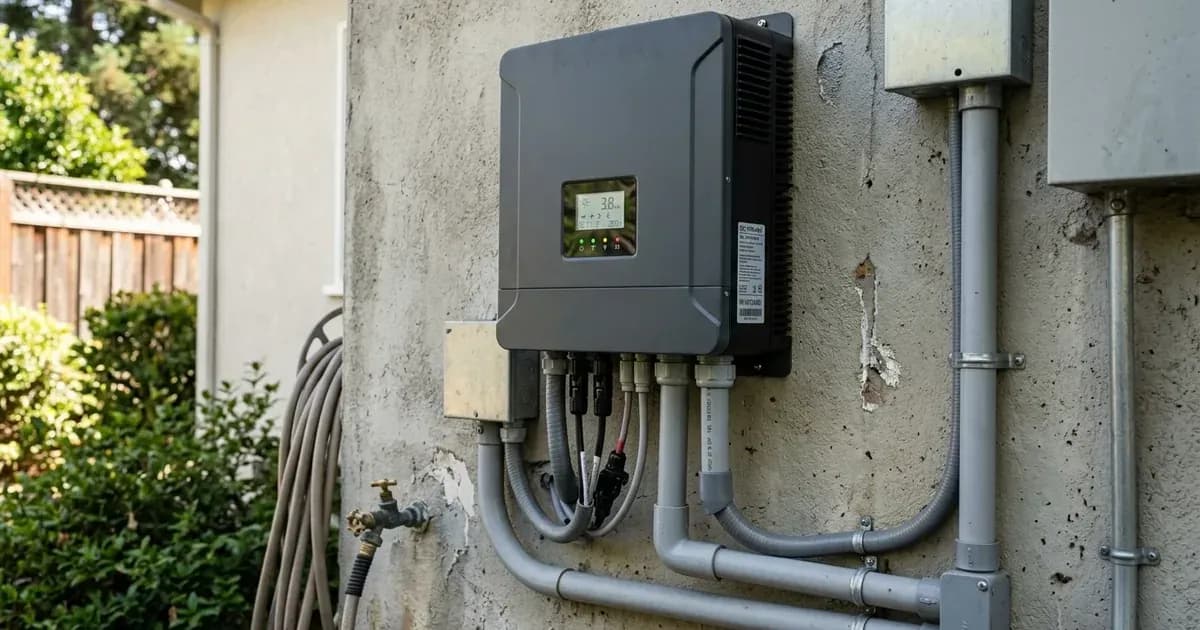
Most Sunsynk single-phase inverters (SG04LP1, SG05LP1, SG05LP1-SM2, SG02LP1, SG01LP1, Acure C1/C2, Elite HYB 1P) have an IP65 rating. This means they are dust-tight and protected against water jets, making them suitable for outdoor installation, even in exposed locations. These models also typically have an operating temperature range of -40°C to +60°C and begin to derate above 45°C.
In contrast, the Sunsynk Lynks models (SM(3.6)kWLLL, SM(6.0)kWLLL, SM(8.0)kWLLL and their PPL variants) have an IP41 rating. This rating indicates protection against solid objects larger than 1mm and vertically falling water drops, but not against water jets or heavy rain. Therefore, Lynks models are suitable only for indoor installation or within a well-protected enclosure. Additionally, Lynks models have a derating temperature of >35°C, which is lower than other Sunsynk models. Given South Africa's climate, where ambient temperatures can frequently exceed 35°C, careful consideration of the installation location is necessary to prevent premature derating and reduced performance. The common local practice of mounting inverters on exterior garage walls may not be suitable for IP41-rated units.
What the published sources do not tell you
Sunsynk's datasheets provide comprehensive technical specifications, but there are nuances important for the South African market. While many datasheets list NRS 097-2-1 alongside other international standards like EN 50549-1, AS-NZS 4777.2, and G98/G99, it is important to remember that only NRS 097-2-1 is relevant for South African grid connection. The other standards apply to different markets, such as the UK or Australia.
Furthermore, the datasheets for the Elite HYB 1P and Lynks models do not explicitly list NRS 097-2-1. For the Elite HYB 1P, the manufacturer states that "Approvals and certifications are subject to change without prior notice. Please confirm the current status with Sunsynk before placing an order." For the Lynks models, only general EMC/Safety regulations (e.g., IEC standards) are listed, not specific grid connection standards. This means that while these inverters may be technically capable, their official grid-tie approval status in South Africa is not attested by these specific datasheets.
Finally, a manufacturer's declaration of compliance with NRS 097-2-1 in a datasheet does not automatically mean the inverter is approved by your specific municipality or Eskom. Local authorities often maintain their own lists of approved equipment, and these lists can vary. Always verify the inverter's acceptance with your local supply authority before making a purchase or commencing installation.
Frequently asked questions
What is the most important specification when choosing a Sunsynk inverter?
The maximum continuous AC passthrough current is critical. This figure, measured in Amperes, determines the total household load the inverter can carry from the grid or generator, regardless of its rated output power.
Which Sunsynk single-phase inverters are listed with NRS 097-2-1 compliance?
Many Sunsynk single-phase models, including the SG04LP1, SG05LP1, SG05LP1-SM2, SG02LP1, SG01LP1, and Acure C1/C2 series, list NRS 097-2-1 in their datasheets. The Elite HYB 1P and Lynks models do not explicitly list this standard.
Can all Sunsynk inverters be installed outdoors in South Africa?
Most Sunsynk single-phase inverters have an IP65 rating, suitable for outdoor installation. However, Lynks models have an IP41 rating, meaning they are not protected against water ingress and should only be installed indoors.
At what temperature do Sunsynk inverters start to derate?
Most Sunsynk single-phase inverters begin to derate, reducing their output, when the ambient operating temperature exceeds 45°C. Lynks models derate at a lower temperature, above 35°C.
Is a datasheet listing NRS 097-2-1 enough for grid connection in South Africa?
No. While a datasheet may list NRS 097-2-1, this is not the same as appearing on your local municipality's approved equipment list. Always confirm with your specific municipality or Eskom before installation.
References
- Sunsynk Single Phase 3.6-5kW SG04LP1 Datasheet — accessed 27 August 2026
- Sunsynk Single Phase 8kW SG05LP1 Datasheet — accessed 27 August 2026
- Sunsynk Single Phase 7kW SG05LP1 Datasheet — accessed 27 August 2026
- Sunsynk Single Phase 7-7.6-8kW SG05LP1-SM2 Compact Datasheet — accessed 27 August 2026
- Sunsynk Single Phase 5kW SG04LP1-SM2 Compact Datasheet — accessed 27 August 2026
- Sunsynk Single Phase 10-12kW SG02LP1 Datasheet — accessed 27 August 2026
- Sunsynk Single Phase 16kW SG01LP1 Datasheet — accessed 27 August 2026
- Sunsynk Single Phase 3.6-5-6kW LV01 C1 Acure Datasheets — accessed 27 August 2026
- Sunsynk Single Phase 3.6-5-6-7-8kW LV01 C2 Acure Datasheets — accessed 27 August 2026
- Sunsynk Single Phase 3.6-5-7kW Elite HYB 1P Datasheet — accessed 27 August 2026
- Sunsynk Single Phase 3.6-6-8kW Lynks IP41 Datasheet — accessed 27 August 2026
Related guides
More from what to buy — and how not to get cheated.