Single-Phase vs Three-Phase Solar Australia: Inverters, Limits, and Metering
Updated 19 September 2026 · By SolarNevs Research Desk, Dealer surveys + verified sources · 2 sources · Method ↗
Key Takeaways
- Most Australian homes have single-phase electricity, but larger properties with ducted air conditioning or workshop equipment often have three-phase supply.
- For three-phase connections, installing a dedicated three-phase inverter distributes solar generation evenly and minimizes phase voltage rise issues.
- Australian digital smart meters net out consumption and generation across all three phases, ensuring solar export on one phase offsets usage on other phases.
- Network service providers impose tighter system capacity limits on single-phase supplies (for example, 10kW in South Australia) compared to 30kW on three-phase lines.
Single-Phase vs Three-Phase Power in Australian Homes
Depending on where you live and how much electricity you consume, your home will be fitted out with either a single-phase grid connection or a 3-phase solar grid connection. (Most homes have single-phase connections.)
Regardless of whether you have a single-phase or 3-phase connection, the appliances in your home all (almost certainly) run on a single phase. In a single-phase connection, electricity flows into your premises through one active conductor and returns through the neutral wire.
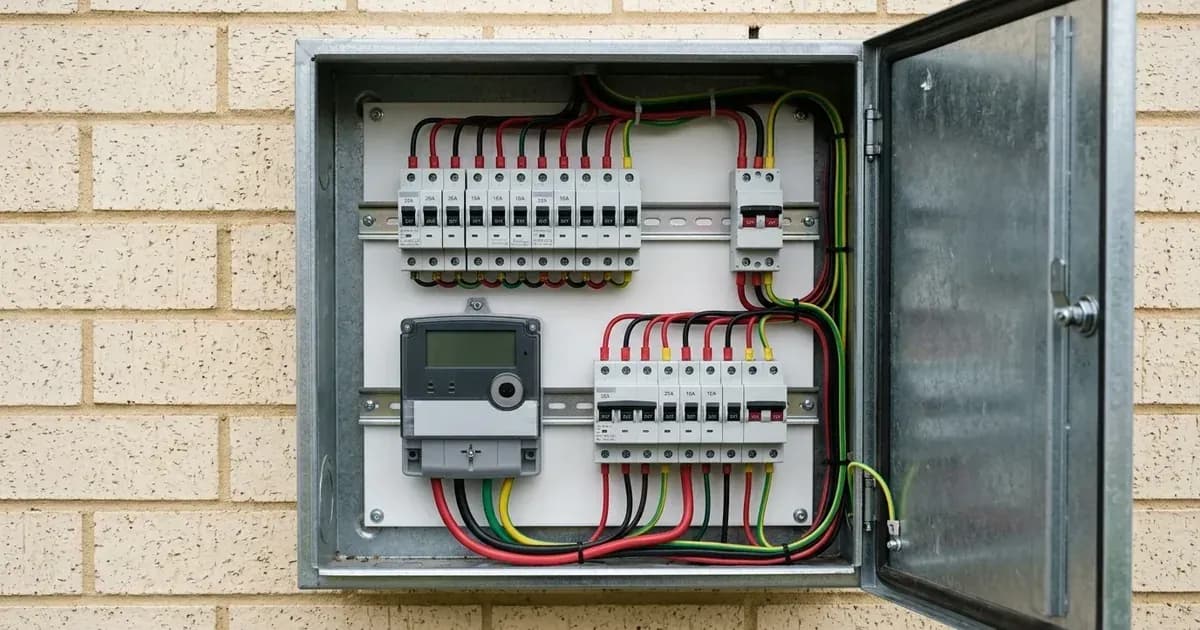
If you have a 3-phase solar inverter connection, on the other hand, the electricity entering your home is divided into three separate phases (imagine three cables/circuits). Different devices in your home will be powered by these different phases. For example, lighting circuits may operate on Phase A, refrigeration and kitchen appliances on Phase B, and laundry equipment or air conditioning on Phase C.
Understanding your supply type is crucial when selecting solar system capacity. Compare hardware configurations in our residential solar sizing guide and our three-phase 10kW solar system guide.
Inverter Topology Options on Three-Phase Connections
If your home has a single-phase supply, inverter selection is straightforward: for a single-phase connection, a single-phase solar inverter should be installed – fairly straightforward.
However, if your property is connected to a three-phase electricity supply, you have three distinct design options:
Inverter Configuration | Operating Characteristics | System Trade-offs |
|---|---|---|
Option 1: Dedicated Three-Phase Inverter | Distributes solar generation evenly across all three phases simultaneously | Best and simplest option; provides balanced grid injection and lowest voltage rise |
Option 2: Single-Phase Inverter on One Phase | Connects the entire solar array to a single designated active phase conductor | Risks phase overvoltage tripping if solar output is large; potential phase unbalance |
Option 3: Multiple Single-Phase Inverters | Installs up to three separate single-phase inverters, each allocated to a distinct phase | Higher equipment and installation cost than a single three-phase inverter |
For a 3-phase connection, in most cases the best and simplest option is to get a 3-phase inverter , which will distribute the solar power evenly across all three phases.
Another option for a 3-phase connection is to install one single-phase inverter on one of the phases in the home (preferably the one that uses the most electricity/has the heaviest loads). The downsides of this approach are that 1) if the solar system is too large, the inverter could ‘trip out’ if the voltage for that phase goes to high, and 2) the solar energy may not flow to the phase where it is needed most.
The third option is to install multiple (up to three) single-phase inverters , each one on its own phase. This could prove to be a more expensive option than simply using a 3-phase solar inverter.
If an inverter shuts down during bright sunshine, learn how grid voltage thresholds cause automatic shutdowns in our guide to inverter shutting down on sunny days due to grid voltage.
How Polyphase Net Metering Works in Australia
A common concern among homeowners with three-phase power is whether solar generation on Phase A will be wasted if heavy appliances are running on Phase B or Phase C.
Under Australian metering rules, digital interval smart meters perform net metering across all phases:
- Technically that is correct – the load and generation is netted out across all of the phases. So, if its all generated on 1 phase, and only consumed on the other 2 that’s ok.
- Simplest way to think of it is that the bill aggregates all phases, so you can expect generation and consumption to also be aggregated.
- For example, if your solar system exports power on one phase while your oven and air conditioner draw equivalent power across the other two phases during the same metering interval, the meter registers zero net import. You are not penalized for phase divergence during billing.
DNSP System Sizing Limits: Single-Phase vs Three-Phase
Distribution Network Service Providers (DNSPs) manage local electricity networks and enforce strict generation capacity limits to maintain grid stability and prevent localized overvoltage:
- Single-phase constraints: Generally speaking, tighter solar system size limits are placed on homes with single-phase connections than those with 3-phase connections. In urban zones, single-phase connections are frequently capped at 5kW or 10kW inverter capacity.
- Three-phase allowance: In South Australia , for example, solar PV system size is limited to 10kW in buildings serviced by single-phase connections, whereas homes and businesses with a 3-phase connection may install systems as large as 30kW.
- Rural SWER networks: Approval from utilities for grid-connection of large solar PV systems in remote areas (which are sometimes serviced by ‘single wire earth return’ or SWER lines) is more common than in areas with high population densities, as SWER lines have high impedance and low capacity.
Under federal Small-scale Renewable Energy Scheme (SRES) rules, residential solar PV installations must have a capacity less than 100 kW and generate a total annual electricity output less than 250 MWh to qualify for upfront STC discounts.
AC vs DC Electricity Conversion
To understand how single and three-phase systems interface with rooftop solar and storage, keep basic conversion principles in mind:
- AC (alternating current) electricity. AC electricity is what most household electrical appliances require to operate.
- The other type of electricity, DC (direct current), is what solar panels and batteries produce.
- The inverter bridges these domains, synchronizing DC solar power into either single-phase or three-phase alternating current that matches Australian grid frequency and voltage tolerances.
All grid-connected inverters must meet Australian and New Zealand standards and list its panels and inverter on the Clean Energy Council list of approved products. Learn how regulatory standards govern backup circuits in our backup power standards guide.
Safety and Switchboard Compliance
Modifying or upgrading electrical switchboards to accommodate solar inverters involves significant electrical risks.
[!WARNING]Three-phase electrical switchboards operate at 400V phase-to-phase and carry dangerous fault current levels. Never remove switchboard escutcheon panels, touch live busbars, or attempt to alter circuit breakers yourself. All phase balancing, solar inverter connections, isolation switchgear, and metering upgrades must be carried out by a licensed electrician.
Ensure your electrician tests neutral-earth integrity, balances single-phase loads across the three phases as evenly as practicable, verifies main service fuse ratings, and issues an official Certificate of Electrical Safety.
References
- Solar Choice - Solar power and single-phase vs 3-phase power connections — accessed 16 September 2026
- Clean Energy Regulator - Rooftop Solar Small-scale Renewable Energy Scheme — accessed 16 September 2026
Related guides
More from sizing, net billing & installation.