Heated LiFePO4 Batteries for Canadian Winter Cabins: Cold-Weather Storage
Updated 19 September 2026 · By SolarNevs Research Desk, Dealer surveys + verified sources · 2 sources · Method ↗
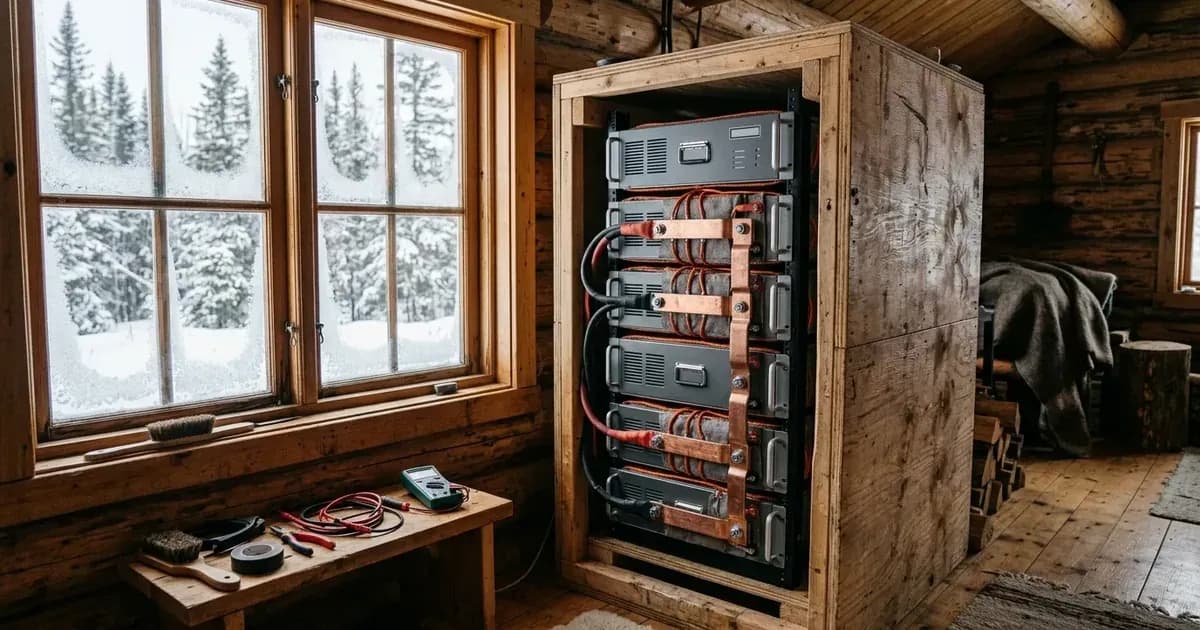
Off-grid cabins and rural retreats across Canada experience severe sub-zero temperatures throughout winter. When temperatures fall below freezing, standard lithium iron phosphate (LiFePO4) batteries cannot be charged without causing permanent internal damage. Installing self-heated LiFePO4 batteries solves this cold-weather bottleneck by integrating automatic heating elements directly into the battery pack, ensuring seamless winter solar and generator charging.
Key Takeaways
- Charging standard LiFePO4 batteries below freezing causes irreversible lithium plating on the graphite anode, permanently ruining storage capacity.
- Self-heated batteries like the Maple Leaf Beaver feature intelligent heating that activates in -25℃ to 5℃ to protect cell health.
- Incoming charging current from solar panels or a backup generator powers the internal thermal pads before the BMS opens the charge gate.
- Heated batteries designed for cold climates carry rigorous safety testing certified to ANSI/CAN/UL 9540A:2025 standards for fire propagation safety.
The Cold-Weather Charging Problem Explained
Lithium iron phosphate has become the premier battery chemistry for residential and off-grid solar due to its high round-trip efficiency, deep depth of discharge, and exceptional cycle life. However, its chemical properties make sub-zero charging hazardous.
In freezing temperatures, the diffusion of lithium ions through the electrolyte and into the graphite anode slows significantly. If an external charge source—such as a solar MPPT controller or generator charger—forces current into cold cells, the lithium ions cannot intercalate into the anode structure. Instead, they accumulate on the anode surface as metallic lithium plating. This reaction permanently robs the battery of usable capacity and can grow sharp metallic dendrites that puncture the separator, causing catastrophic internal short circuits.
While discharging cold LiFePO4 batteries is safe down to sub-zero levels (often down to minus twenty degrees Celsius), charging must be strictly locked out until the cells warm up.
Self-Heating Battery Architecture: How It Operates
Self-heated lithium batteries solve the cold-charging dilemma through integrated thermal management. Thermal silicone heating pads or conductive films are sandwiched between individual prismatic cell blocks within the battery casing.
Consider the Maple Leaf Beaver heated battery platform. It incorporates intelligent heating functionality that activates when cell temperatures drop between -25°C and 5°C, requiring an incoming charge current of at least 0.08C. Rather than drawing power from the battery itself—which could drain a depleted pack—the heating elements draw energy directly from the incoming solar array or generator charge current. Once the internal heating pads warm the cells to a safe temperature of 12°C, the heating completion condition is met, and the battery management system (BMS) automatically redirects incoming current into cell charging.
The Maple Leaf Beaver operates with a rated voltage of 51.2V, recommending a bulk charge voltage of 56.0V and a float charge voltage of 54.6V. It supports a standard charge current of 50A and a maximum charge current of 70A. For safety, the unit is certified to ANSI/CAN/UL 9540A:2025 standards for thermal runaway fire propagation testing, supporting scalable expansion of up to 32 batteries in parallel. Furthermore, an integrated pre-charge circuit ensures smooth power transfer, averting rush currents during connections to various inverter-chargers.
Similarly, the Pytes V5 server rack battery features a built-in heating pad providing a temperature rise rate of 18°F/h across an operating temperature range of -10°C to 55°C, ensuring reliable operation in unheated outbuildings.
Off-Grid Cabin Sizing and Generator Strategy
In an off-grid Canadian cabin, winter heating pads must be accounted for in auxiliary generator sizing:
- Incoming Current Requirements: Because the heating elements require a minimum current threshold (such as 0.08C) to initiate, small trickle chargers cannot activate the thermal system. Ensure your inverter-charger or generator supplies adequate initial amperage.
- Pre-Warming Time: When arriving at a freezing cabin, allow the generator to run for 30 to 60 minutes to power the heating films and warm the battery bank before expecting full energy acceptance.
- Insulated Enclosures: Placing heated batteries inside an insulated battery enclosure or conditioned mechanical space dramatically reduces heating pad power consumption and shortens warm-up cycles.
For comprehensive cabin system design, see off-grid cabin solar system sizing and best solar batteries for Canadian cold weather.
References
- Maple Leaf Beaver Heated LiFePO4 Battery Specifications — accessed 28 August 2026
- Pytes V5 Self-Heated Smart BMS Battery — accessed 28 August 2026
Related guides
More from what to buy — and how not to get cheated.