Solar Isolation Ground Fault Errors from Snow Melt: Canadian Fixes
Updated 19 September 2026 · By SolarNevs Research Desk, Dealer surveys + verified sources · 2 sources · Method ↗
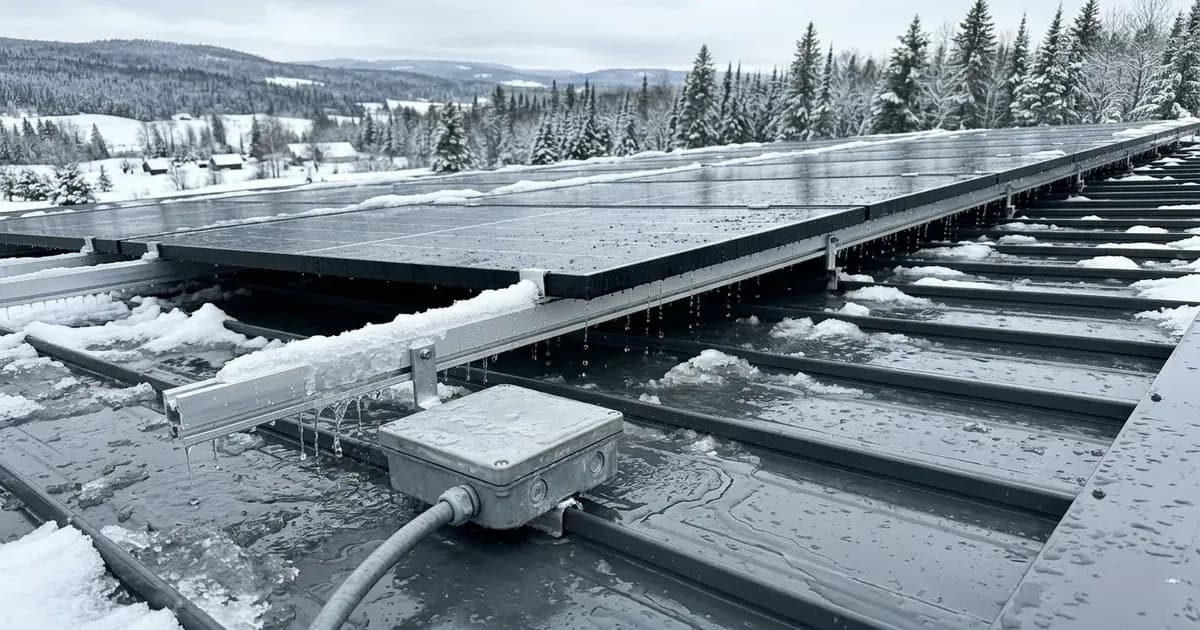
During Canadian winter thaws and early spring snowmelts, rooftop solar systems face severe moisture stress. As heavy snowpacks melt, saturated slush and pooling water saturate roof racking, module frames, and DC wiring harnesses. Homeowners frequently discover that their inverter refuses to start in the morning, displaying flashing warning alarms such as "Isolation Fault," "Riso Low," or "PV Ground Fault."
These alarms indicate that the inverter's pre-startup insulation check detected electrical leakage between high-voltage DC conductors and the grounded equipment frame. Understanding how moisture penetrates rooftop connections and selecting hardware engineered for harsh winter conditions allows system owners to diagnose and eliminate isolation errors permanently.
Key Takeaways
- Inverters perform pre-startup insulation resistance self-tests; meltwater pooling around nicked cables or unsealed connectors triggers protective isolation lockouts.
- The Thornova TS-BBT54-425W is a 425-watt, all-black bifacial solar panel built with high-efficiency N-type monocrystalline cells with up to 21.76% module efficiency.
- Heavy snow-load engineering is essential: the panel is certified to withstand wind loads up to 2,400 Pa and snow loads up to 5,400 Pa.
- External electrical controls like the IMO Rapid Shutdown Initiator provide an IP67, Type 12 enclosure protects against dust and water, making it suitable for indoor or outdoor installations in demanding Canadian environments.
Moisture Ingress and Ground Fault Physics
Modern grid-tied and hybrid solar inverters measure DC isolation resistance to ground (Riso) every morning before closing grid connection relays. If insulation resistance between the DC string conductors and earth ground falls below certified safety thresholds, the inverter halts operation.
During freezing and melting cycles, several mechanical failure modes allow water to bridge electrical conductors to grounded racking:
- Freeze-Thaw Seal Degradation: Repeated freezing expands trapped water around connector gaskets, loosening silicone seals and permitting conductive slush to enter DC terminals.
- Snowpack Compaction Stress: Deep snow loads pressing down on modules can push drooping wire harnesses into contact with sharp aluminum rail edges, abrading the outer jacket.
- Capillary Action in Conduit: Roof penetration boots without adequate drainage can fill with meltwater, submerging DC branch circuits in standing ice water.
Module Resistance to Canadian Winter Moisture
To minimize ground faults in heavy snow climates, arrays require robust weather-sealed components. The Thornova TS-BBT54-425W is a 425-watt, all-black bifacial solar panel built with high-efficiency N-type monocrystalline cells designed specifically for extreme northern environments.
The panel's physical construction provides superior environmental defense: its anodized aluminum frame, tempered glass, and IP68-rated junction box provide protection against demanding outdoor environments. This IP68-rated junction box prevents moisture ingress even when roof ice dams submerge lower module edges.
Mechanically, the hardware delivers exceptional strength: the panel is certified to withstand wind loads up to 2,400 Pa and snow loads up to 5,400 Pa. Maintaining certified for 5,400 Pa snow loads ensures that module glass will not flex excessively and pinch underlying wiring harnesses against roof mounts.
In addition to physical durability, the module achieves up to 21.76% module efficiency and features advanced rear-side generation: the rear surface can capture reflected sunlight, providing up to 25% additional energy production under suitable installation conditions. Even under heavy overcast skies, the TS-BBT54-425W continues generating power during cloudy, overcast, and lower-light conditions.
The hardware is engineered for multi-decade reliability, backed by a comprehensive package where the Thornova TS-BBT54-425W includes a 15-year product warranty and a 30-year linear power output warranty. System owners are protected by stringent performance benchmarks where annual degradation is limited to 0.40% after the first year.
Connector Sealing and Emergency Control Enclosures
The primary point of moisture entry during Canadian snowmelt is outdoor DC connectors. Premium installations utilize factory-crimped MC4-EVO2 connectors engineered to maintain high dielectric isolation under prolonged wet contact.
External safety devices must also withstand driving sleet and melting snowpacks. Installers add a clearly visible emergency shutdown point to your solar, battery-storage or backup-power system with the IMO Rapid Shutdown Initiator.
This safety device ensures that pressing the large red mushroom button activates the shutdown circuit of compatible connected equipment instantly. The unit provides a central manual activation point for rapid shutdown while maintaining one normally open and one normally closed contact for control circuits.
Crucially for Canadian winter thaws, its IP67, Type 12 enclosure protects against dust and water, making it suitable for indoor or outdoor installations in demanding Canadian environments. Sealed Type 12 and IP67 enclosures prevent condensation from accumulating on safety contacts and triggering false ground fault trips.
Step-by-Step Procedure to Fix Snowmelt Ground Faults
When morning snowmelt triggers an inverter isolation alarm, follow this systematic diagnostic protocol:
- Check Inverter Isolation Reading: Review the inverter LCD display to record the measured insulation resistance (Riso in kΩ or MΩ) and identify which MPPT channel is affected.
- Disconnect DC Strings: Open the DC isolator and separate the positive and negative leads of each series string.
- Measure Open-Circuit Voltage to Ground: Using a calibrated digital multimeter set to DC volts, measure voltage from the positive string lead to equipment ground, then from negative lead to ground. A healthy isolated string shows transient voltage that bleeds off to zero; a steady DC voltage indicates an active ground leakage point.
- Pinpoint the Compromised Connection: Divide the measured negative-to-ground voltage by the individual panel Voc to calculate the approximate module index where water has breached insulation.
- Inspect and Re-Seal Hardware: Ensure module leads use genuine MC4-EVO2 connectors, lift drooping cables away from pooled water, confirm the IP68-rated junction box is intact, and inspect external disconnects to confirm an IP67, Type 12 enclosure protects against dust and water.
By utilizing high snow-load rated modules certified for 5,400 Pa snow loads, maintaining sealed IP68 junctions, and following structured multimeter testing, Canadian solar operators can swiftly resolve snowmelt isolation faults and restore solar production.
References
- Canadian Off Grid Depot Thornova 425W Solar Panel Datasheet — accessed 28 August 2026
- Canadian Off Grid Depot IMO Rapid Shutdown Initiator Specifications — accessed 28 August 2026
Related guides
More from inverter errors & fixes.