Solar Panels Covered in Snow: Canadian Cleaning Guide & Study Data
Updated 19 September 2026 · By SolarNevs Research Desk, Dealer surveys + verified sources · 1 source · Method ↗
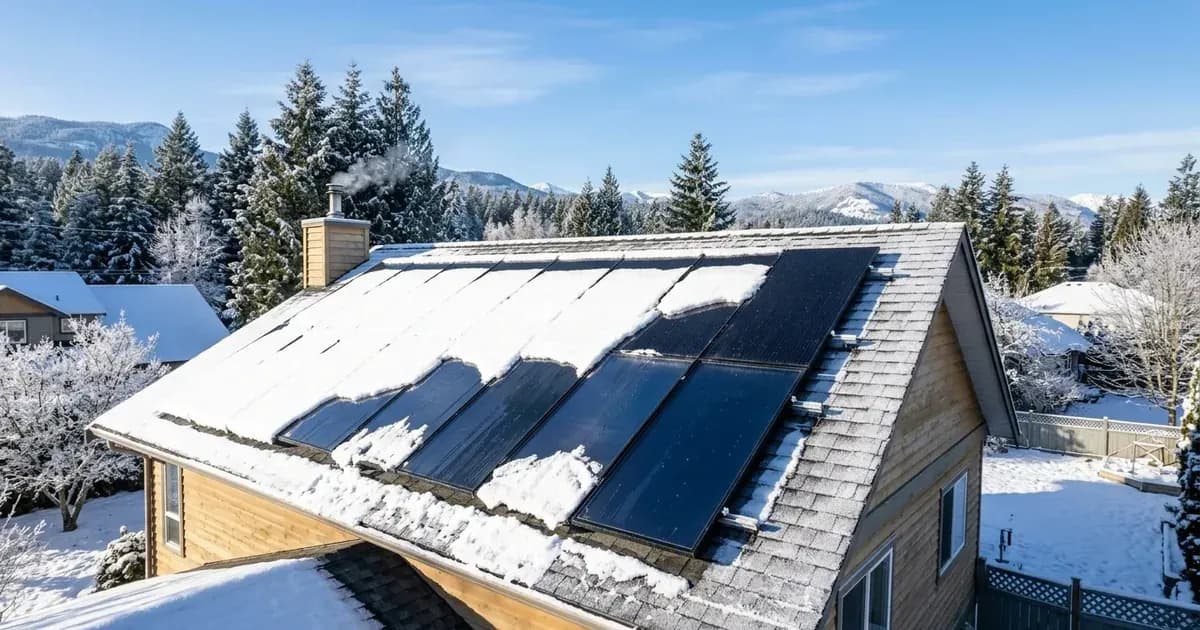
Canadian winters bring heavy snowfall, freezing rain, and prolonged sub-zero temperatures. For homeowners with rooftop photovoltaic arrays, seeing solar panels completely blanketed in thick snow often sparks anxiety about lost electricity production. Many consider climbing ladders with shovels or roof rakes to clear the glass.
However, comprehensive real-world empirical data demonstrates that manual snow removal is almost never economically justified or physically advisable.
Key Takeaways
- A five-year reference array study proved that snowfall on photovoltaic solar panels results in about a 3% energy loss annually.
- Historically, the rule of thumb throughout industry was to design a system as if it had no snow and then wipe 20% of energy production off the slate, an assumption proven false by empirical research.
- Array tilt angle has a substantially greater impact on winter generation than snow accumulation itself.
- Solar technologists strongly advise homeowners against clearing pitched roofs, emphasizing that professional labor costs far exceed winter energy recovery.
The NAIT Five-Year Solar Snow Study Findings
To determine the true impact of Canadian winter weather on solar photovoltaic systems, the Northern Alberta Institute of Technology (NAIT), in collaboration with the City of Edmonton and the Solar Energy Society of Alberta, conducted a rigorous multi-year reference array experiment. A system of 12 solar modules was installed atop the Shaw Theatre on Main Campus in Edmonton.
The study's experimental design specifically isolated snow impact from other seasonal variables. Solar modules were fixed at six different angles – 14, 18, 27, 45, 53 and 90 degrees – reflecting common residential and commercial roof pitches. To establish an exact baseline, six modules were cleared of snow every day, while the remaining six served as a control array left untouched throughout the winter.
Over the course of the project, energy performance data was collected from all 12 solar modules every five minutes every day for five years – enough to fill 6,000 spreadsheet files. The work of crunching through all the data fell to students (and now grads of the class of ’18) Christian Brown and Jackson Belley as the basis of their final course project, or capstone.
The conclusive findings upended decades of conventional installer assumptions:
- Minimal Annual Impact: The uncleaned control modules suffered only an average three percent loss in annual energy generation compared to the daily swept modules.
- Latitude Optimization: The module tilted to 53 degrees was most efficient, which confirmed an industry standard that solar systems are optimized when tilted to the equivalent of a city’s latitude.
- Optimal Snow Shedding: The ideal angle for maximum production with snow accumulation was 45 degrees, where gravity naturally slides snow off the smooth tempered glass once sunlight begins warming the dark silicon wafers.
- Vertical Wall Penalty: The least efficient was the module set at 90 degrees, like a wall-mount system, which saw a 24% loss in performance due to suboptimal sun angles during non-winter months.
Why Rooftop Snow Clearing Makes No Financial Sense
When asked whether homeowners should shovel their rooftop arrays, study lead Tim Matthews offered unequivocal advice: "Should you clean the ones on your [pitched] roof? Heck no."
The economic reality of Canadian solar production explains why. Solar arrays generate the vast majority of their annual kilowatt-hours between March and October, when days are long and the sun is high in the sky. Between November and January, days are short (often under eight hours of daylight in northern latitudes), and low solar elevation angles dramatically reduce potential irradiance. A 3% loss on winter production represents only a few dollars' worth of utility grid credits.
Matthew pointed out the stark labor economics: "Our recommendation is that it makes no sense. One hour of time from a professional or an apprentice is just not worth it." Hiring a contractor to clear a residential roof costs far more than the total retail value of electricity the panels could produce over the entire winter season. Nor does he recommend asking a contractor to remove it. It’s just not worth it for the minimal gain in power efficiency from a snow-free solar system.
Safety Hazards and Equipment Damage Risks
Beyond poor economics, manual snow clearing on residential roofs introduces severe physical and mechanical hazards:
Safety Warning: Never step onto a snow-covered or icy roof. Slipping on concealed frost or snow-covered skylights presents life-threatening fall risks. Furthermore, standard fall-arrest equipment requires certified anchor points that are rarely available on residential roofs in winter conditions.
Homeowners who attempt to clear panels using improvised tools frequently inflict costly mechanical damage:
- Tempered Glass Scratches: Metal snow shovels, garden hoes, and stiff plastic brooms drag abrasive grit across panel surfaces, stripping anti-reflective coatings and scratching glass.
- Micro-Cracks: Putting mechanical pressure or leaning body weight against solar modules flexes the silicon wafers beneath the glass, causing microscopic cell fractures that permanently degrade module performance.
- Thermal Shock: Throwing warm or hot water onto freezing solar glass creates immediate thermal shock that can shatter the tempered glass instantly.
The sole exception noted in the NAIT study applies to ground-accessible arrays: for anyone who operates a solar system, he cautions that snow should only be cleared if it’s safe to do so, such as on a flat commercial roof or accessible ground-mounted racks.
Natural Thermal Shedding
Photovoltaic arrays are naturally self-clearing under typical Canadian winter conditions. Even under overcast winter skies, solar cells absorb ambient radiation and begin generating small electrical currents. This process warms the dark silicon, creating a thin microscopic layer of meltwater between the bottom surface of the snowpack and the glass.
On arrays mounted at 30 to 60 degrees, this meltwater layer acts as a lubricant, causing large sheets of snow to slide off the array in slabs as soon as ambient temperatures climb toward freezing or direct sunlight emerges.
To learn more about optimizing array tilt for Canadian winter conditions, read our guide on solar panel snow load and shedding angles in Canada and discover how bifacial solar panels leverage snow reflection albedo.
References
- NAIT Reference Array Five-Year Snow Study — accessed 28 August 2026
Related guides
More from inverter errors & fixes.