Alberta Micro-Generation Guide: Solar Club Rates and AUC Rule 024
Updated 19 September 2026 · By SolarNevs Research Desk, Dealer surveys + verified sources · 2 sources · Method ↗
Key Takeaways
- Micro-generation in Alberta is governed by AUC Rule 024 and AR 27/2008, with systems capped at a maximum of 5 MW.
- The Solar Club allows micro-generators to earn high summer export credits of approximately 30 cents per kWh.
- A rigorous five-year NAIT research study proved winter snow accumulation accounts for an annual energy loss of only about 3%.
- The ideal angle for maximum production with snow accumulation was 45 degrees, whereas 53 degrees optimizes total annual irradiance.
- Manual snow clearing on pitched residential roofs is economically unnecessary and presents fall hazards.
The Regulatory Framework: AUC Rule 024 and AR 27/2008
Alberta possesses one of the most progressive and deregulated electricity markets in North America. Distributed renewable energy generation is regulated under the Micro-generation Regulation AR 27/2008, enacted under the Electric Utilities Act, and administered by the Alberta Utilities Commission (AUC) through AUC Rule 024.
Under provincial legislation, micro-generation is defined as electricity generation from renewable or alternative energy sources sized to match customer annual electricity consumption. The Micro-generation Regulation AR 27/2008 caps total customer micro-generation capacity at 5 MW. Micro-generation projects follow established utility approval paths through distribution wire owners (e.g., ATCO Electric, FortisAlberta, and EPCOR) based on customer load requirements. AUC Rule 024 governs micro-generation interconnection and customer annual load matching requirements across all participating distribution franchise areas.
Unlike regulated jurisdictions where generation credits expire without compensation, Alberta's competitive retail framework allows prosumers to actively monetize surplus electricity.
Maximizing Revenue: The Alberta Solar Club Mechanism
Because retail electricity supply in Alberta is deregulated, consumers can choose their retail energy marketer. Competitive retail aggregators and community energy marketers established what is commercially known as the "Solar Club."
Under this program, micro-generators can dynamically switch between high and low electricity rates to maximize their annual energy balance:
- High Summer Export Tariff: During sunny months when solar arrays overproduce household demand, Solar Club prosumers switch to high export tariff of approximately 30 cents per kWh during summer overproduction. Every exported kilowatt-hour earns a substantial credit on the utility bill.
- Low Winter Import Tariff: During winter when daylight hours are short and generation declines, micro-generators switch back to a lower wholesale-indexed or fixed retail tariff to minimize the cost of grid power imports.
This tariff flexibility significantly accelerates capital payback for Alberta residential systems. For a national economic comparison, review our guide to solar panels cost and payback by province.
Winter Solar Production: NAIT Five-Year Snow Study Data
Homeowners frequently assume that heavy Canadian snowfall severely diminishes solar output during prairie winters. However, empirical scientific data demonstrates that snow losses are minimal when arrays are properly engineered.
A five-year study led by NAIT's Alternative Energy Technology Program found that snowfall on photovoltaic solar panels results in about a 3% energy loss. This groundbreaking finding proved that winter snow impact is significantly less than the 20% drain that industry had traditionally estimated despite a lack of data. NAIT launched the reference array snow study in 2012 with the City of Edmonton and Solar Energy Society of Alberta.
To conduct this rigorous evaluation, a system of 12 solar modules was installed atop the Shaw Theatre on main campus in Edmonton. The researchers evaluated six tilt angles across multi-year cycles:
- Six Tested Angles: Solar modules were fixed at six different angles - 14, 18, 27, 45, 53, and 90 degrees.
- Reference Array Control Group: Six modules were cleared of snow every day while the remaining six served as a control.
- Optimal Annual Tilt: The module tilted to 53 degrees was most efficient which confirmed an industry standard that solar systems are optimized when tilted to the equivalent of a city's latitude.
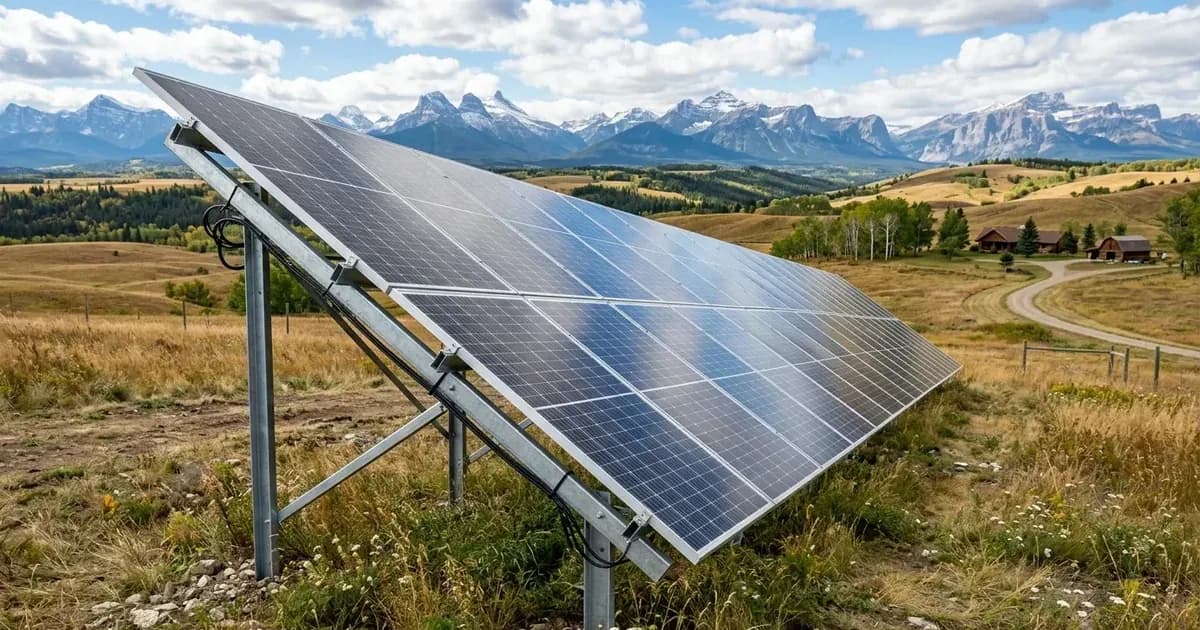
- Optimal Snow Shedding Angle: The ideal angle for maximum production with snow accumulation was 45 degrees. At 45 degrees, the panel surface allows snow to slide off rapidly when the sun warms the dark photovoltaic silicon.
- Vertical Wall-Mounting Losses: Conversely, the least efficient was the module set at 90 degrees like a wall-mount system which saw a 24% loss in performance.
Tilt Angle Tested | Performance Characteristic | Snow Shedding & Annual Efficiency |
|---|---|---|
53 degrees | Optimized to Edmonton latitude | Highest total annual generation over 5-year study |
45 degrees | Ideal snow shedding balance | Optimal balance of shedding accumulation and production |
90 degrees | Wall-mount vertical facade | Suffered a 24% performance loss compared to optimal tilt |
14 to 27 degrees | Low-slope commercial roofs | Higher snow retention; slower winter self-clearing |
Snow Clearing Economics and Rooftop Safety
Homeowners often ask whether they should hire contractors or climb onto roofs to sweep away winter snow. The NAIT research team explicitly evaluated this maintenance trade-off.
Their conclusion was unequivocal: one hour of time from a professional or an apprentice is just not worth it. The modest value of electricity recovered during short, low-insolation winter days cannot offset the hourly labor rate of a certified tradesperson. Furthermore, climbing onto frozen, snow-covered roofs creates severe fall hazards and risks scratching anti-reflective module coatings. When asked whether residential system owners should clean pitched arrays, researcher Tim Matthews cautioned: should you clean the ones on your [pitched] roof? Heck no.
Installers and system designers must ensure that ground-mounted and rooftop arrays follow Canadian Electrical Code Section 64 installation rules. Although federal Greener Homes Grant and Loan programs are closed to new applicants, provincial Solar Club economics ensure strong private returns across Alberta.
Frequently asked questions
What is the maximum capacity limit for micro-generation in Alberta?
Under the Alberta Micro-generation Regulation AR 27/2008, customer micro-generation capacity is capped at 5 MW nominal rating.
How do Solar Club rates work in Alberta?
Alberta's competitive retail market allows micro-generators to switch to a high export rate of approximately 30 cents per kWh during summer overproduction, returning to lower rates in winter.
How much solar production is lost to snow in Alberta winters?
A five-year study by NAIT demonstrated that snowfall on photovoltaic modules results in an average annual energy loss of only about 3%.
What tilt angle sheds snow most effectively in Alberta?
The NAIT solar study found that a 45-degree tilt provides the optimal balance for shedding snow accumulation while maximizing annual solar production.
References
- NAIT Five-Year Solar Snow Study — accessed 28 August 2026
- Alberta King's Printer Micro-generation Regulation AR 27/2008 — accessed 28 August 2026
Related guides
More from schemes, subsidies & financing.