LiFePO4 Battery Not Charging in Cold Weather: Canadian Winter Fixes
Updated 19 September 2026 · By SolarNevs Research Desk, Dealer surveys + verified sources · 2 sources · Method ↗
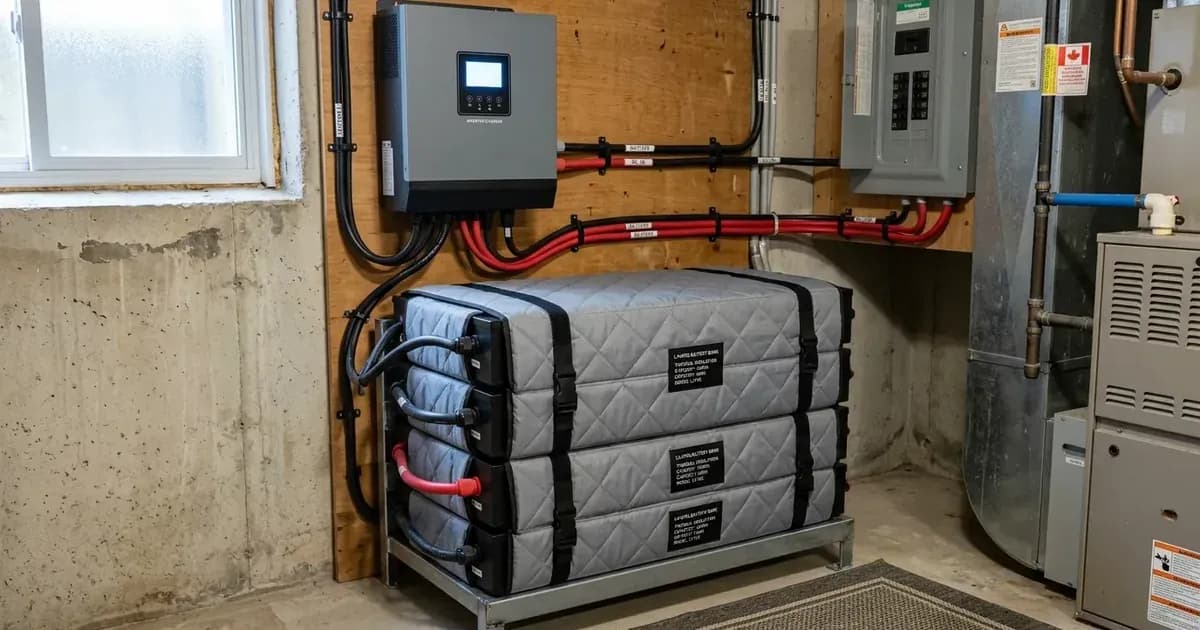
Off-grid cabin owners and rural homeowners across Canada often encounter a sudden winter issue: sunlight is shining brightly on the solar array, the charge controller displays absorption or bulk voltage, but exactly zero amperes of current flow into the battery bank. The battery discharges normally to power lights and inverters, but absolutely refuses to charge.
This behavior is almost never a broken battery or failed charge controller. It is an intentional, life-saving protection triggered by the internal Battery Management System (BMS).
Key Takeaways
- LiFePO4 cells must never be charged below freezing; attempting to do so causes irreversible metallic lithium plating and permanent destruction of cell capacity.
- Cold-weather platforms like the Pytes V5 are equipped with a heating element to maintain optimal performance in cold climates.
- Internal thermal heating elements raise core cell temperatures by approximately 14.4°F to 18°F per hour before allowing incoming charge current into the chemistry.
- Troubleshooting involves verifying cell temperature sensors, confirming heating power availability, and configuring proper external BMS disconnect contacts.
Understanding the Sub-Zero Lithium Charging Lockout
The root cause of cold-weather charging lockouts lies in lithium-ion electrochemistry. At temperatures below 0°C (32°F), the liquid electrolyte inside lithium iron phosphate cells thickens, and lithium ions move sluggishly. When incoming charging voltage forces ions toward the negative graphite anode faster than they can intercalate into the lattice, the ions accumulate on the surface as solid metallic lithium.
Safety Warning: Never bypass BMS low-temperature charge cutoff contacts or apply direct charging to frozen lithium cells. Charging sub-zero lithium iron phosphate forces metallic lithium plating onto the graphite anode, permanently ruining cell capacity and creating catastrophic short-circuit and thermal runaway hazards.
Because discharging does not cause lithium plating, smart BMS units selectively block charge current while keeping discharge paths open to power household backup loads.
Thermal Self-Heating Pad Diagnostics
Modern cold-climate batteries incorporate internal thermal elements to overcome freezing ambient conditions. For example, Pytes V5's integrated heating technology allows it to continue working smoothly in cold temperatures, maintaining constant charging and discharge.
When an off-grid solar array or auxiliary generator begins supplying power to a frozen battery bank, the internal system behaves as follows:
- Diverting Charge Current to Heat: Incoming power does not enter the lithium cells. Instead, the BMS directs all incoming current into internal heating blankets.
- Thermal Ramp Rate: The heating system operates with a thermal ramp rate where heating pad temperature rise reaches 14.4℉/h~18℉/h = -9.8°C/h~-7.8°C/h.
- Operational Thresholds: The integrated thermal pad operates within a specified window with temperature rise: 18°F/h, operation temperature: -0.4°F~50°F.
- Engaging Main Charge Gates: Only after internal sensors verify that cells have warmed safely above freezing does the BMS switch current from the heating elements to the chemical storage cells.
To verify whether your heating elements are functioning properly, inspect the telemetry interface. In advanced energy storage platforms, the BMS manages temperature, voltage, and current while allowing for remote monitoring and software changes, assuring smooth performance in any environment. Furthermore, the Pytes V5 has error detection and alert messages, enabling users to monitor battery health and improve productivity from everywhere.
High-Current Busbar and Scalability Troubleshooting
In multi-battery off-grid systems, cold weather can expose uneven heating or loose busbar connections. When packs are connected in parallel, colder batteries draw less current than warmer units, creating temporary current imbalances across the bank.
Heavy-duty architectures resolve this through robust distribution: Pytes V5 offers parallel interfaces for up to 300A confluence current, accommodating large surge demands and high-amperage generator recharging. In terms of charging velocity, V5 is intended for rapid energy replenishment and may be completely charged in about one hour. Its 1C discharge rate assures strong power output during emergency backup scenarios.
Constructed with sophisticated Lithium Iron Phosphate (LFP) cells that provide over 6,000 cycles, these systems can scale significantly for large rural properties, supporting up to 16 pcs (82kWh) in a group, 7 groups (573kWh) in a system w/a Hub.
External BMS Configuration for Modular Batteries
For modular battery architectures like the Victron Energy Smart Lithium series, temperature sensing and charge disconnection are handled externally rather than by an internal integrated contactor.
When diagnosing charging failures on modular systems, inspect the external control wiring:
- Hybrid Inverters: The battery requires one of these bms-es: ve. bus bms / ve.bus bms v2 - recommended for systems with our inverter/chargers. The VE.Bus BMS signals the hybrid inverter-charger via communication cables to immediately disable charging when cell temperature dips below 5°C.
- Mobile and Alternator Setups: The smart bms cl 12/100 - recommended for use in automotive and marine systems disconnects alternator charging feeds during freezing drives.
- Compact Off-Grid Rigs: The smallbms - recommended for use in small systems provides direct digital drive signals to external charge relays.
- Real-Time Cell Verification: Installers can verify individual cell diagnostics because batteries can be parallel and series connected bluetooth app available to monitor cell voltage and temperature. If any single cell probe registers below the cutoff threshold, the entire charging path remains open.
Step-by-Step Recovery Sequence
When your Canadian solar battery bank enters cold lockout, follow this recovery workflow:
- Read Sensor Telemetry: Connect via Bluetooth or PC monitoring software. Check individual cell temperatures to verify if cold-charge protection is actively asserted.
- Verify Auxiliary Power: Ensure your generator or solar charge controller is supplying sufficient voltage and current to drive the heating pads.
- Allow Thermal Soak Time: Do not power-cycle the system repeatedly. Allow the internal heating pads 1 to 2 hours of continuous auxiliary power to bring core cell temperatures up to operating thresholds.
- Check Terminal Torque: Inspect all DC cables and terminal lugs with a calibrated torque wrench. Loose connections increase resistance, causing premature low-voltage cutoff when heating loads engage.
Explore our comprehensive evaluation of best cold-weather solar batteries in Canada and our dedicated guide on heated LiFePO4 batteries for Canadian winter cabins.
References
- Pytes V5 48V 100Ah Server Rack Battery Specifications — accessed 28 August 2026
- Victron Energy Smart Lithium 12.8V Technical Datasheet — accessed 28 August 2026
Related guides
More from inverter errors & fixes.