Hybrid Inverters With EV-Charger Ports: What Exists in Pakistan
Updated 2 August 2026 · By SolarNevs Research Desk, Dealer surveys + verified sources · 3 sources · Method ↗
Hybrid Inverters With EV-Charger Ports - What Exists in Pakistan
{/* visual_plan: stat_block */}
Key Takeaways
- Smart hybrid inverters featuring dedicated EV charger ports enable direct routing of excess daytime solar energy into electric vehicles.
- Leading inverter brands in Pakistan including Deye, Huawei FusionSolar, Growatt, and Solis offer integrated smart EV wallbox communication.
- Dynamic load management automatically throttles EV charging speed when household heavy appliances activate, preventing breaker trips.
- An integrated 8 kW hybrid inverter with a matching smart wallbox charger costs between Rs. 420,000 and Rs. 550,000 (July 2026) installed.
Introduction
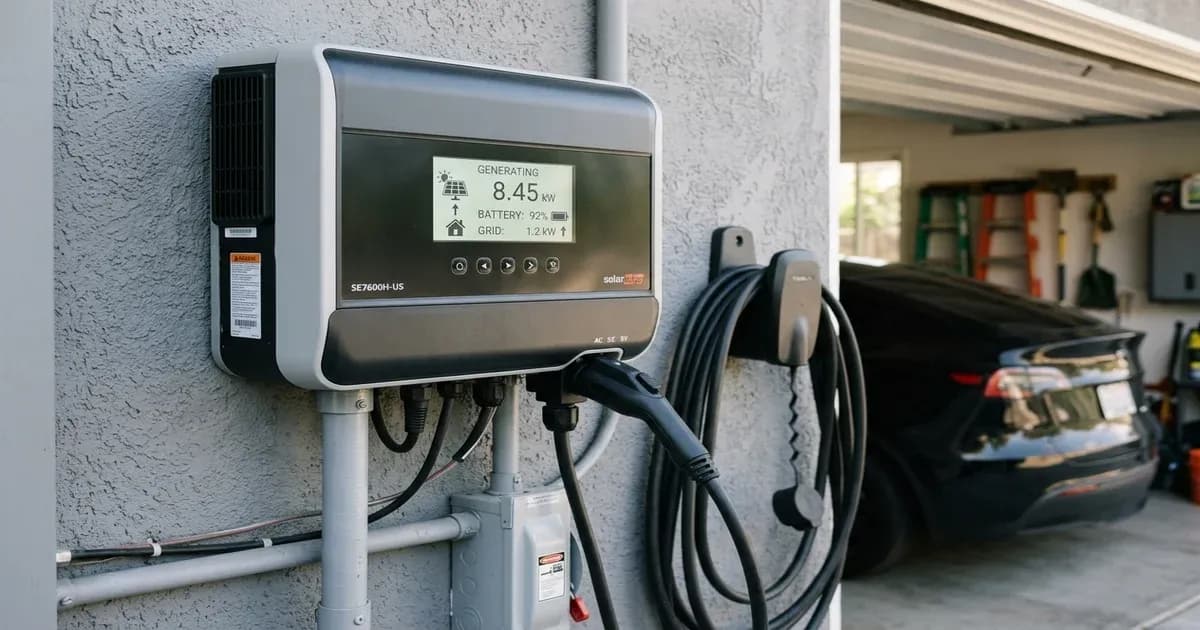
Connecting electric vehicle charging directly to home rooftop solar systems requires intelligent power management. Hybrid solar inverters equipped with dedicated EV charger communication ports allow homeowners to automatically route excess solar generation into their vehicles, maximizing energy self-sufficiency.
Why is inverter integration necessary for smart EV charging?
Standard electric vehicle chargers operate independently of home solar systems. When plugged in, a standalone wallbox draws fixed current regardless of whether the solar panels are producing excess power or whether the home is drawing expensive grid electricity.
Integrated hybrid inverters resolve this mismatch by communicating continuously with smart wallbox chargers. The inverter monitors real-time solar generation, home baseline consumption, and battery state-of-charge. When solar production exceeds household consumption, the inverter signals the EV charger to ramp up charging current. Conversely, when household loads increase or clouds pass overhead, the inverter reduces charger draw to protect home power stability.
What smart hybrid inverter models are available in Pakistan?
Several Tier-1 inverter manufacturers supply smart hybrid units with EV integration capabilities across Pakistani retail markets.
The comparison table below details top inverter brands and EV integration features:
Inverter Brand & Series | Power Output | EV Charger Protocol | Estimated Inverter Price | Smart Solar Priority Mode |
|---|---|---|---|---|
Deye SUN-8K-SG04LP1 | 8 kW Single-Phase | RS-485 / CAN Smart Bus | Rs. 340,000 | Automatic excess solar tracking |
Huawei FusionSolar SUN2000 | 10 kW Three-Phase | FusionCharge Wi-Fi App | Rs. 480,000 | Dynamic phase switching & balancing |
Growatt SPH 6000TL BL-UP | 6 kW Single-Phase | Thor Smart Wallbox Link | Rs. 295,000 | Dedicated solar-only charging mode |
Solis RHI-5K-48ES-5G | 5 kW Single-Phase | Modbus Serial Link | Rs. 265,000 | Programmable time-of-use discharge |
Figures as of July 2026.
These inverters allow users to set custom charging rules through smartphone applications, choosing between maximum charging speed, cost-optimized grid power, or 100 percent solar-only charging.
How does dynamic load balancing prevent electrical circuit overloads?
Residential electrical connections in Pakistan are limited by sanctioned grid load limits (such as 5 kW single-phase or 15 kW three-phase). Operating a 7 kW Level 2 EV charger simultaneously with domestic air conditioners can easily exceed total sanctioned load limits.
Dynamic load balancing continuously monitors total incoming AC current at the main distribution board using CT current transformer clamps. If domestic AC units and kitchen appliances consume 4 kW of a 6 kW connection, the smart inverter restricts EV charging draw to 2 kW (9 Amps). As household appliances switch off, the inverter immediately increases charging power back to 7 kW (32 Amps), preventing blown main fuses.
What are the installation requirements and total system costs?
Installing an integrated hybrid inverter and EV charging setup requires proper cable sizing, dedicated DC breakers, and RS-485 signal wiring between the inverter and wallbox.
Total equipment and installation costs for an 8 kW system setup are detailed below:
Installation Item | Technical Rating | Estimated Cost |
|---|---|---|
8 kW Smart Hybrid Inverter | Dual MPPT, RS-485 comm port | Rs. 340,000 |
Smart Level 2 Wallbox Charger | 7.4 kW / 32A single-phase | Rs. 140,000 |
RS-485 Signal Cable & CT Clamps | Shielded twisted-pair wiring | Rs. 12,000 |
AC/DC Protection Board & Labor | Breakers, SPD, installation | Rs. 38,000 |
Total Integrated Setup Cost | Complete smart charging system | Rs. 530,000 |
Figures as of July 2026.
Investing in smart integration prevents circuit overloads while maximizing clean solar energy use for daily vehicle travel.
Call to Action
Verify that your prospective hybrid inverter includes RS-485 or CAN communication ports before purchasing to ensure seamless smart EV charger integration.
Frequently Asked Questions
Can an existing hybrid inverter be upgraded with a smart EV charger?
Yes, if your existing inverter supports RS-485 Modbus protocol or external CT clamp monitoring, compatible smart wallboxes can be added to enable dynamic load balancing.
What is the advantage of 100 percent solar-only charging mode?
Solar-only charging mode ensures the charger draws energy strictly when excess solar generation is available, guaranteeing that your EV charges at zero effective grid cost.
Do integrated inverters work during grid power outages?
Yes, hybrid inverters can power EV chargers during outages using off-grid ports, provided solar generation or battery storage capacity is sufficient.
References
- aedb.org.pk Source - Alternative Energy Development Board Inverter Specifications (Verified)
- pbs.gov.pk Source - Pakistan Bureau of Statistics Electrical Imports (Verified)
- edb.gov.pk Source - Engineering Development Board Charger Protocols (Verified)
Frequently asked questions
Can an existing hybrid inverter be upgraded with a smart EV charger?
Yes, if your existing inverter supports RS-485 Modbus protocol or external CT clamp monitoring, compatible smart wallboxes can be added to enable dynamic load balancing.
What is the advantage of 100 percent solar-only charging mode?
Solar-only charging mode ensures the charger draws energy strictly when excess solar generation is available, guaranteeing that your EV charges at zero effective grid cost.
Do integrated inverters work during grid power outages?
Yes, hybrid inverters can power EV chargers during outages using off-grid ports, provided solar generation or battery storage capacity is sufficient.
References
- AEDB — accessed 25 July 2026
- Pakistan Bureau of Statistics — accessed 25 July 2026
- Engineering Development Board — accessed 25 July 2026
Related guides
More from reports & data stories.