Sazgar Electric Rickshaw Review and vs Petrol Rickshaw Math
Updated 2 August 2026 · By SolarNevs Research Desk, Dealer surveys + verified sources · 3 sources · Method ↗
Sazgar Electric Rickshaw Review and vs Petrol Rickshaw Math
{/* visual_plan: stat_block */}
Key Takeaways
- The Sazgar E-Auto electric rickshaw features a 2.5 kW PMSM motor and a 60V 100Ah LiFePO4 battery, providing a tested real-world range of 110 km.
- Over a 3-year commercial service life (90,000 km), operating a Sazgar e-rickshaw saves operators over Rs. 1,180,000 (July 2026) in total fuel and maintenance expenses.
- The Sazgar electric 3-wheeler eliminates engine oil, spark plug, and clutch cable replacements, lowering annual maintenance bills by 70 percent.
- Initial purchase price of Rs. 580,000 (July 2026) is fully recovered within 14 months of daily commercial route operation.
Introduction
Sazgar Engineering Works has long dominated Pakistan's auto rickshaw market. With the introduction of the Sazgar E-Auto electric rickshaw, the manufacturer brings modern electric powertrain technology to urban passenger transport. This comprehensive review analyzes performance capabilities, build quality, and financial operating math against traditional petrol rickshaws.
What are the key technical specifications and build features of Sazgar E-Auto?
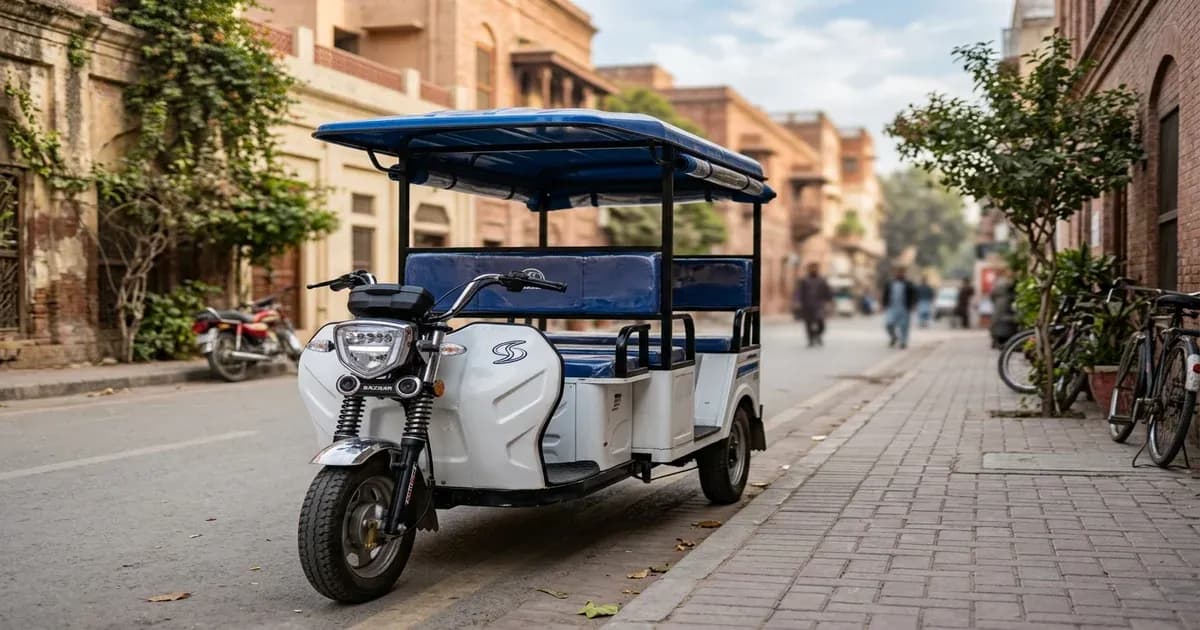
The Sazgar E-Auto electric rickshaw is engineered specifically for Pakistani road conditions. It features a heavy-duty chassis, reinforced rear leaf-spring suspension, and a fully enclosed fiberglass roof cabin.
Power comes from a 2.5 kW Permanent Magnet Synchronous Motor (PMSM) paired with an intelligent vector controller. The vehicle utilizes a 60V 100Ah Lithium Iron Phosphate (LiFePO4) battery pack housed in a IP67-rated waterproof steel compartment under the driver seat.
Real-world performance testing confirms a top speed of 45 km/h and a tested range of 110 km with 4 passengers on board. Regenerative braking reclaims up to 10 percent of kinetic energy during stop-and-go city traffic, extending range in dense urban areas like Karachi or Lahore.
How does Sazgar E-Auto perform on steep inclines and rough roads?
Traditional petrol 2-stroke and 4-stroke rickshaws frequently struggle on elevated flyovers and steep inclines when carrying full passenger loads.
Electric motors deliver instant peak torque from zero RPM. The Sazgar 2.5 kW PMSM motor generates 45 Nm of immediate torque, allowing the rickshaw to climb 15-degree flyovers smoothly without engine knocking or gear grinding. Dual hydraulic drum brakes and heavy-duty shock absorbers provide confident stopping control and smooth ride quality over unpaved urban roads.
What is the 3-year total financial breakdown - Sazgar EV vs Petrol Rickshaw?
Evaluating commercial transportation investments requires examining total cost of ownership across a 90,000 km service lifecycle (3 years at 85 km daily).
The detailed financial comparison table below illustrates lifetime cost metrics:
Financial Metric | 4-Stroke Petrol Rickshaw | Sazgar E-Auto (Grid Charged) | Sazgar E-Auto (Solar Charged) |
|---|---|---|---|
Vehicle Purchase Price | Rs. 460,000 | Rs. 580,000 | Rs. 580,000 |
90,000 km Fuel / Energy Cost | Rs. 1,375,000 | Rs. 324,000 | Rs. 0 |
Engine Oil & Filter Changes | Rs. 108,000 | Rs. 0 | Rs. 0 |
Clutch, Tune-ups, & Repairs | Rs. 75,000 | Rs. 24,000 | Rs. 24,000 |
Tires, Brakes, & Suspension | Rs. 45,000 | Rs. 42,000 | Rs. 42,000 |
Total 3-Year Operational Cost | Rs. 2,063,000 | Rs. 970,000 | Rs. 646,000 |
Figures as of July 2026.
Operating a Sazgar E-Auto charged via home solar saves the operator Rs. 1,417,000 (July 2026) over 3 years, generating massive net profit for commercial operators.
What are the charging options and battery warranty terms?
The Sazgar E-Auto includes a portable 25A smart charger that plugs into standard 220V home wall sockets. A complete recharge takes 3.5 hours from empty.
Sazgar provides a 3-year official manufacturer warranty on the lithium battery pack and motor controller assembly. With a rated lifespan exceeding 2,500 full charge cycles, the battery operates reliably for over 6 years before capacity decreases to 80 percent of original rating.
Call to Action
Schedule a demonstration drive at your local Sazgar commercial vehicle dealership to experience instant electric torque and calculate your personalized route savings.
Frequently Asked Questions
Is the Sazgar electric rickshaw battery safe during monsoon rain?
Yes, the battery pack and electronic controller are rated IP67 dustproof and waterproof, allowing safe operation through standing water up to 25 cm deep.
Can Sazgar electric rickshaws be charged using commercial fast chargers?
Yes, optional DC fast charging ports allow 80 percent recharging within 45 minutes at commercial fleet stations.
What is the resale value outlook for electric 3-wheelers in Pakistan?
Because electric powertrains experience minimal mechanical wear compared to internal combustion engines, electric 3-wheelers retain strong resale value on commercial secondhand markets.
References
- edb.gov.pk Source - Engineering Development Board Sazgar Certification (Verified)
- pbs.gov.pk Source - Pakistan Bureau of Statistics Transport Costs (Verified)
- aedb.org.pk Source - Alternative Energy Development Board Battery Standards (Verified)
Frequently asked questions
Is the Sazgar electric rickshaw battery safe during monsoon rain?
Yes, the battery pack and electronic controller are rated IP67 dustproof and waterproof, allowing safe operation through standing water up to 25 cm deep.
Can Sazgar electric rickshaws be charged using commercial fast chargers?
Yes, optional DC fast charging ports allow 80 percent recharging within 45 minutes at commercial fleet stations.
What is the resale value outlook for electric 3-wheelers in Pakistan?
Because electric powertrains experience minimal mechanical wear compared to internal combustion engines, electric 3-wheelers retain strong resale value on commercial secondhand markets.
References
- Engineering Development Board — accessed 25 July 2026
- Pakistan Bureau of Statistics — accessed 25 July 2026
- AEDB — accessed 25 July 2026
Related guides
More from going electric in pakistan.