Victron Smart BMS 12-200: Setup & Alternator Guide
Updated 6 September 2026 · By SolarNevs Research Desk, Dealer surveys + verified sources · 1 source · Method ↗
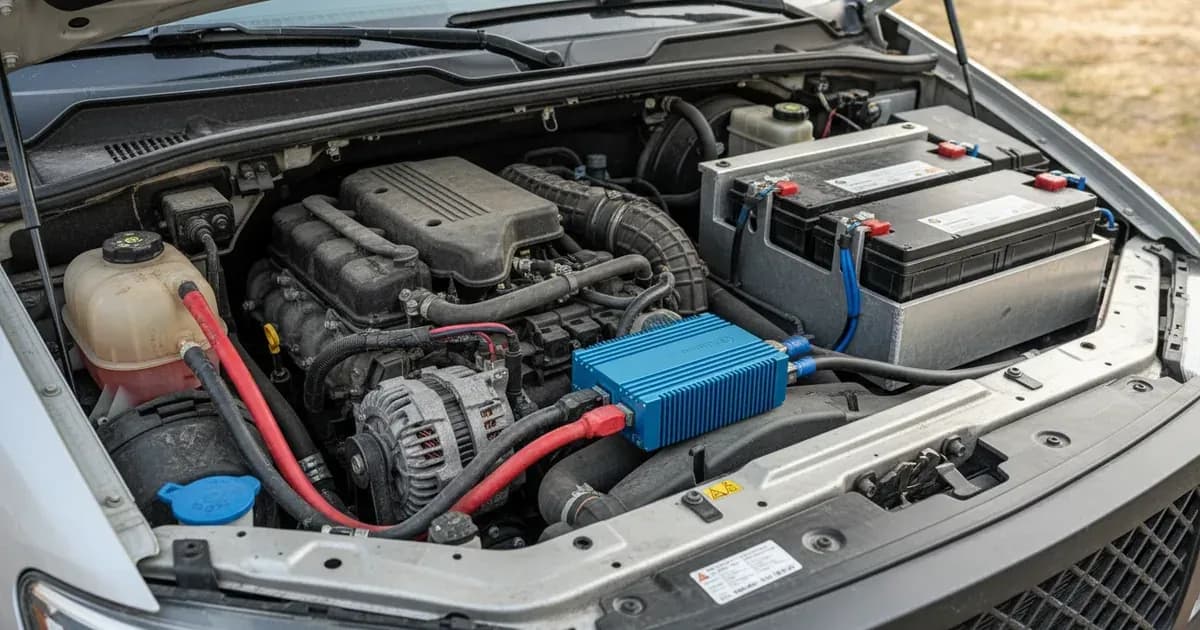
Key Takeaways
- The Victron Smart BMS 12-200 is specifically designed for 12V systems with a 12V alternator such as in vehicles and boats.
- Supports large battery arrays: The maximum number of batteries in one system is 20, which results in a maximum energy storage of 84kWh in a 12V system.
- Integrates an Alternator port - maximum charge current 100A (with a 125A fuse) with automatic engine-running detection (Input voltage to start charging >13V).
- Provides heavy-duty DC distribution: System+ port - max charge and discharge current 200A with a Peak discharge current 400A.
- Maintains low parasitic consumption: Current consumption, remote on 17.5mA (excluding Load output and Charge output current) and Current consumption, remote off 6.5mA (BMS functionality still active) 4.5mA (BMS functionality disabled).
- Includes safety alerting: Pre-alarm output Normally low High (Vbat) in case of alarm, max. 1A (not short circuit proof).
- Engineered with rugged Protection, electronics IP65, an Operating temperature range -40°C to +60°C, and a compact form factor (Weight 2kg Dimensions (hxwxd) 65 x 120 x 340 mm).
Alternator Current Limiter & Power Architecture
Directly connecting a low-resistance lithium battery bank to an engine alternator can cause severe stator overheating at low engine RPM and drain the starter battery when the engine is shut down.
The Smart BMS 12-200 incorporates an integrated solid-state current limiter and one-way blocking diode to protect vehicle alternators.
The Victron Smart BMS 12-200 is a 12V all-in-one BMS (Alternator Limiter, Combiner, and Battery Protector; Up to 20 Batteries Parallel, Max 84kWh Capacity) providing dual-port power distribution:
- Alternator Port (100A Max): 100A Current Limiter, 125A Inline Fuse, >13V Start Charging Threshold, One-Way Flow (No Starter Drain).
- System+ Port (200A Cont.): 200A Charge / Discharge, 400A Peak Discharge, Low Cell Load Cutout, High Cell Charge Cutout.
Alternator Charging Setup
- Alternator & Starter Battery Wiring: Connect the engine starter battery / alternator positive to the dedicated Alternator port using an Alternator port - maximum charge current 100A (with a 125A fuse).
- Automatic Engine Sensing: The BMS activates alternator charging only when detecting Input voltage to start charging >13V, ensuring the engine is running and the starter battery is charged before drawing power.
- Current Regulation: The internal limiter restricts alternator charging to 100A, preventing thermal overload on factory automotive alternators.
System+ Port & Bluetooth Telemetry
The System+ port acts as the primary DC distribution hub for non-alternator power:
- Bidirectional Power Flow: Sized for System+ port - max charge and discharge current 200A continuous and Peak discharge current 400A, it supplies DC fuse blocks, inverters, solar charge controllers, and AC battery chargers.
- Cell Protection Cutouts: The BMS monitors individual cell voltages via the battery cell communication cables. If any cell drops below cutoff thresholds, the System+ port instantly disconnects loads while allowing charging current to pass.
- Pre-Alarm Warning: A dedicated Pre-alarm output Normally low High (Vbat) in case of alarm, max. 1A (not short circuit proof) triggers a dashboard buzzer before shutdown.
- Low Standby Drain: Operates with Current consumption, remote on 17.5mA (excluding Load output and Charge output current) and drops to Current consumption, remote off 6.5mA (BMS functionality still active) 4.5mA (BMS functionality disabled) in storage mode.
Technical Specifications & Environmental Standards
Feature | Technical Specification | Operational Benefit |
|---|---|---|
Application Scope | specifically designed for 12V systems with a 12V alternator such as in vehicles and boats | Tailored for campervans, commercial utility vans, and marine yachts |
Maximum Storage | The maximum number of batteries in one system is 20, which results in a maximum energy storage of 84kWh in a 12V system | Expandable from single battery up to large multi-pack banks |
Electronic Ingress | Protection, electronics IP65 | Resilient against moisture and dust in vehicle engine bays |
Thermal Limits | Operating temperature range -40°C to +60°C | Uninterrupted performance in sub-zero and desert heat |
Physical Envelope | Weight 2kg Dimensions (hxwxd) 65 x 120 x 340 mm | Compact, sturdy chassis with heavy-duty M8 connection studs |
Add a battery at a surveyed price
Installers quote supply and fitting of the battery on this page for your existing or new system.
How this pays for the site: installers pay SolarNevs a fixed introduction fee when we pass them a genuine enquiry. They cannot pay to appear higher, and our surveyed prices are published before any introduction. You can also take our dated price tables straight to any installer.
Frequently asked questions
What systems and battery storage capacities is the Smart BMS 12-200 designed for?
It is **specifically designed for 12V systems with a 12V alternator such as in vehicles and boats**, where **The maximum number of batteries in one system is 20, which results in a maximum energy storage of 84kWh in a 12V system** (August 2026).
What are the charging and current ratings of the Alternator and System+ ports?
It features an **Alternator port - maximum charge current 100A (with a 125A fuse)** with **Input voltage to start charging >13V**, and a **System+ port - max charge and discharge current 200A** with **Peak discharge current 400A** (August 2026).
What is the standby power draw and pre-alarm output rating of the BMS?
It draws **Current consumption, remote on 17.5mA (excluding Load output and Charge output current)**, **Current consumption, remote off 6.5mA (BMS functionality still active) 4.5mA (BMS functionality disabled)**, and includes a **Pre-alarm output Normally low High (Vbat) in case of alarm, max. 1A (not short circuit proof)** (August 2026).
What are the physical dimensions and environmental ratings of the Smart BMS 12-200?
The module features **Protection, electronics IP65**, operates across **Operating temperature range -40°C to +60°C**, and weighs **Weight 2kg Dimensions (hxwxd) 65 x 120 x 340 mm** (August 2026).
References
- Victron Energy: Smart BMS 12-200 Manual — accessed 31 August 2026
Related guides
More from what to buy — and how not to get cheated.