AGS Battery Not Charging or Low Backup Time Fix
Updated 6 September 2026 · By SolarNevs Research Desk, Dealer surveys + verified sources · 7 sources · Method ↗
Key Takeaways
- The primary cause of AGS tubular battery charging trouble is an inverter left on default AGM charging profiles (56.4 V bulk on 48 V systems versus 58.4 V Flooded, referenced to 25 °C with -3 to -5 mV/cell/°C temperature compensation required for hot ambient installations).
- Kill power first and use insulated tools to inspect terminal posts and DC breakers (because a metal spanner across a bank shorts hundreds of amps), and wear eye protection when opening vent caps to inspect electrolyte levels (adding distilled water only, never acid).
- Equalization deliberately drives cells into the explosive hydrogen gassing region and requires an actively ventilated space away from sparks and open flames; perform it only after a full charge when cell specific gravity spread exceeds 0.030.
- Wear eye protection when testing specific gravity with a hydrometer (guarding against corrosive sulfuric acid splashes); stop DIY work and contact a qualified solar technician if specific gravity stops rising during equalization (conducted in an actively ventilated space away from sparks and flames because equalization deliberately drives cells into the explosive hydrogen gassing region) without reaching the fully charged 1.210–1.250 band at 27 °C, or if battery casings show physical swelling.
Why is my AGS tubular battery not charging or providing low backup time?
An AGS tubular battery fails to charge or provides short backup primarily because the solar inverter delivers insufficient bulk voltage. Growatt SPF and Axpert-class (Voltronic) units — the platform behind many inverters sold in Pakistan — leave the battery type defaulted to AGM, which sets 56.4 V bulk on a 48 V bank instead of the 58.4 V the same manuals apply once the type is switched to Flooded (referenced to 25 °C, with -3 to -5 mV/cell/°C temperature compensation for ambient heat) — in effect, on our reading of those manual figures, a standing 2 V undercharge on a tubular bank. A secondary common cause is unmonitored electrolyte evaporation, which leaves active plate area dry.
Your first step is checking Program 05 — the battery-type program on both the Growatt and Axpert program maps — to ensure Flooded is selected, followed by inspecting electrolyte levels in every cell.
Diagnosis Steps for AGS Battery Charging Issues
Follow these sequential checks to identify the root cause of charging failures or reduced backup:
- Check Inverter Display for Active Fault Codes:
- Action: Inspect the inverter LCD screen for warning icons or fault numbers.
- Meaning: AGS tubular batteries have no BMS, status LEDs, or fault codes of their own, so any code on screen is inverter-side. Note down active codes and check them against your inverter's own manual before changing settings.
- Verify DC Battery Breakers and Inline Fuses:
- Action: Check that the main DC circuit breaker between battery bank and inverter is closed (ON). Test continuity across inline DC fuses with a multimeter.
- Meaning: A tripped breaker or open fuse isolates the battery bank entirely, producing zero charge current and immediate shutdown upon grid loss.
- Inspect Battery Terminals and Interconnect Cables:
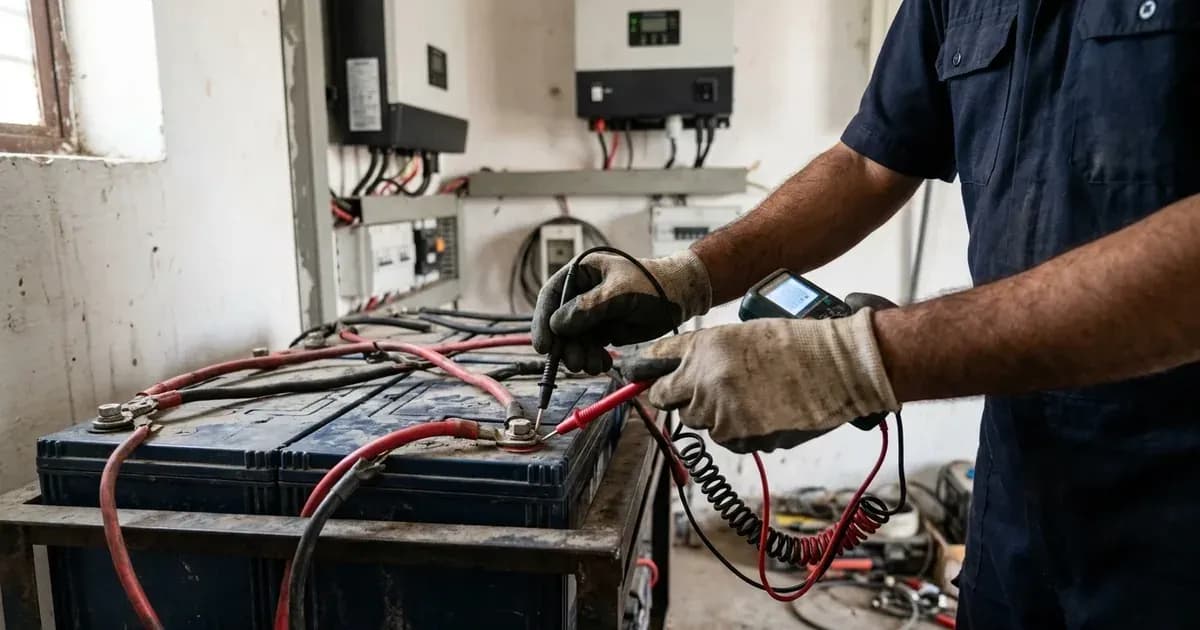
- Action: Kill power first and use an insulated tool to inspect terminal posts for green or white sulfate powder and check for loose cable lugs, because a spanner dropped across a 48 V bank shorts hundreds of amps.
- Meaning: High terminal resistance creates substantial voltage drops. Clean posts using AGS's recommended baking soda recipe (1 tablespoon per cup of water, external cleaning only, rinse and dry thoroughly). AGS advises connections should be clean and snug fitting. While Atlas publishes no torque rating, the flooded-battery industry standard (Trojan reference) is 95–105 in-lb (11–12 Nm) for standard posts.
- Check Electrolyte Levels in Every Cell:
- Action: Wear eye protection against corrosive sulfuric acid splashes, unthread vent caps, and visually examine liquid levels across all cells.
- Meaning: Electrolyte must cover the plates completely. Atlas publishes no level figure of its own; Trojan's flooded deep-cycle guidance puts the level 1/8 inch below the fill well, checked after charging. Plates exposed to air dry out and sulfate rapidly. Refill using distilled water only, never tap water and never acid.
- Measure Individual Rested 12V Battery Voltages:
- Action: Disconnect inverter charging, allow the bank to rest, and measure the rested voltage of each 12 V monobloc with a DC voltmeter.
- Meaning: In a 48 V series string (four 12 V batteries), look for one unit reading noticeably lower than the rest. A weak unit drags down the whole string, and the charger throttles to protect the string.
- Measure Specific Gravity (SG) per Cell with a Hydrometer:
- Action: Wear eye protection to guard against sulfuric acid splashes when drawing electrolyte from each cell into a hydrometer, and record temperature-corrected readings (normalized to 27 °C). Do not test hot or actively gassing cells.
- Meaning: A fully charged AGS tubular cell reads 1.210–1.250 ± 0.005 at 27 °C (subcontinent tubular practice documented in Exide India engineering manuals). A cell-to-cell spread exceeding 0.030 SG after full charge indicates cell imbalance requiring equalization (which must be performed in an actively ventilated area away from sparks and flames because equalization deliberately drives cells into the explosive hydrogen gassing region).
- Verify Inverter Charge Parameters:
- Action: Enter the inverter settings menu to review battery chemistry type, bulk voltage, float voltage, and charge current.
- Meaning: On a 48 V bank, set chemistry to Flooded, bulk/absorption to 58.4 V, and float to 54 V (referenced to 25 °C; hot ambient conditions require negative temperature compensation of -3 to -5 mV/cell/°C above 25 °C). Set maximum charge current between 10% and 20% of the C20 Ah rating — the 10% end is single-sourced industry guidance (Suvastika), the 20% end is Deye's own manual rule for AGM/Flooded banks (18–37 A for the EC-2200 185 Ah unit; 23–46 A for the EC-3000 230 Ah unit). If initiating corrective equalization at 58.4 V, ensure the room is actively ventilated away from sparks and flames because equalization deliberately drives cells into the explosive hydrogen gassing region. For detailed brand tables, refer to our guide on AGS battery inverter settings and pairing.
Common Causes and Fixes for AGS Battery Issues
Symptom detail | Likely cause | Fix |
|---|---|---|
Inverter does not charge from utility grid | Charge source priority set to "Only Solar" | Change charge source priority (Growatt Program 14) off "Only Solar" so grid charging is no longer blocked. |
Battery charges during day but locks out at night | Growatt Program 49 utility charging window enabled | Set Program 49 to "0000" (all-day charging) or expand the night charge window. |
Chronic undercharge and shrinking backup time | Inverter battery type left on default AGM profile | Switch Program 05 to Flooded. This raises 48 V bulk voltage from 56.4 V (AGM) to 58.4 V (Flooded), referenced to 25 °C (-3 to -5 mV/cell/°C temp compensation in heat). |
Zero charge current with healthy terminal voltage | Bank already fully charged or charge current starved | Confirm float state. If depleted, verify Program 02/11 charge current is set to 10%–20% of bank Ah (18–37 A for EC-2200, 23–46 A for EC-3000). |
Inverter fails to turn on from battery | Tripped DC breaker, blown DC fuse, or loose lugs | Kill power first and use insulated tools; reset DC breaker, replace fuse, and clean terminal posts with baking soda solution (1 tbsp per cup water). |
Backup shrinks while battery seems to charge fine | Water loss exposing plate tops to air — Pakistani summers can drop a tubular bank's water level within months | Wear eye protection against sulfuric acid and top up with distilled water only, never acid. Frequent water need is an overcharging warning sign — verify charge voltage settings. |
Backup collapses during summer peak heat | Lack of negative temperature compensation | Lower 48 V charge voltage by ~1.9 V at 45 °C ambient (setpoints referenced to 25 °C), or configure Deye TEMPCO to -3 to -5 mV/°C/cell. |
One 12 V unit reads noticeably lower than the rest at rest | Weak cell dragging the string; the charger throttles to protect the string | Isolate and test the unit individually; replace the weak monobloc to protect the remaining string. |
Backup halves after someone edits the cutoff | Low DC Cutoff (Growatt Prog 21, Axpert Prog 29) moved off its 42.0 V default — set too low it forces habitual deep discharge, set too high it ends the evening early | Return the cutoff to the 42.0 V default on 48 V systems. Depth of discharge is what costs cycles: the rating of 1250 cycles quoted for tubulars is stated at 80% DoD and is retailer-published, not printed on Atlas's own pages. |
Brand-new battery weak from day one | SP-Tall or flat-plate battery sold as "AGS for UPS" instead of an EC deep-cycle — a mis-sell pattern owners report on Pakistani forums, consistent with Atlas's official category structure | Confirm the model is an EC "Energy Core" tall tubular unit; only the EC line carries Atlas's deep-cycle positioning. |
Troubleshooting AGS Tubular Battery Charging
AGS tubular batteries operate without an internal BMS, communication cables, or status LEDs. All diagnosis relies on inverter voltage calibration and hydrometer readings (always wearing eye protection to guard against corrosive sulfuric acid splashes when drawing electrolyte). Inverter LCD battery percentage bars are voltage estimations rather than coulomb-counted measurements.
Inverter-Side Checks vs Battery-Side Checks
- Inverter-Side Verification:
- Chemistry Selection: Always change the default AGM setting to Flooded (Growatt Program 05, Axpert Program 05). AGM charging profiles cap bulk voltage at 56.4 V on 48 V banks versus the 58.4 V flooded setting (referenced to 25 °C, with -3 to -5 mV/cell/°C temperature compensation applied in summer heat) — a 2 V shortfall that, in our interpretation of the manual figures, leaves tubular cells chronically undercharged, and chronic undercharge drives plate sulfation.
- Bulk and Float Voltages: Set bulk absorption to 58.4 V and float to 54 V on 48 V systems (14.6 V and 13.5 V per 12 V battery, referenced to 25 °C with -3 to -5 mV/cell/°C temperature compensation for hot ambient conditions).
- Equalization Schedule: When cell gravity diverges, enable equalization at 58.4 V at the default interval of 30 days, keeping the default 60 min equalization time and 120 min timeout (Growatt Prog 43–48, Axpert Prog 30/31/33/34), in an actively ventilated space away from sparks and flames because equalization deliberately drives cells into the explosive hydrogen gassing region. On Growatt the equalization programs only become available once battery type is set to Flooded or User-Defined.
- Charge Current Allocation: Configure maximum charging current between 10% and 20% of battery Ah capacity. For a 48 V bank of four EC-2200 units (185 Ah), set 18–37 A. For a 4×EC-3000 bank (230 Ah), set 23–46 A.
- Low DC Disconnect: Set Low DC Cutoff (Growatt Prog 21, Axpert Prog 29) to the 42.0 V default to prevent abusive over-discharge.
- Battery-Side Physical Checks:
- Electrolyte Maintenance: Wear eye protection against sulfuric acid and check fluid levels in every cell regularly. Water consumption rises during hot summer months. Add distilled water only (never acid) when plates become exposed, preferably after charging.
- Specific Gravity Confirmation: Wear eye protection to guard against sulfuric acid splashes and measure each cell after full charge. A healthy cell reads 1.210–1.250 at 27 °C. Do not test hot or actively gassing cells.
- Model Identification: Verify that your battery is an authentic EC "Energy Core" tall tubular deep-cycle unit (EC-2200, EC-3000, or EC-3500). Owners on Pakistani forums report that budget flat-plate SP/GX units die young on daily cycling — consistent with Atlas's own category structure, which positions only the EC line as deep-cycle.
Settings Error vs Battery End of Life
- Settings Misconfiguration: If the bank was run on default AGM settings, correct the settings first: restore battery type to Flooded (58.4 V bulk on 48 V, referenced to 25 °C with -3 to -5 mV/cell/°C temp compensation) and run a controlled equalization cycle in an actively ventilated area away from sparks and flames (because equalization deliberately drives cells into the explosive hydrogen gassing region), then re-test backup before condemning the bank.
- Permanent Battery Degradation: If cell specific gravity (tested wearing eye protection against sulfuric acid) stops rising during equalization (conducted in an actively ventilated area away from sparks and flames because equalization deliberately drives cells into the explosive hydrogen gassing region) without reaching the fully charged 1.210–1.250 band at 27 °C, or if the bank has been through years of daily cycling (owner reports on Pakistani forums put life at roughly 3 years maintained, 1 to 4 years observed depending on temperature and maintenance), the bank has likely reached end-of-life. Explore current replacement options in our AGS battery review and price analysis.
For system-level charging diagnostics, see our generic parent guide on solar battery not charging. For detailed watering schedules (always wearing eye protection and adding distilled water only, never acid), read our guide to AGS battery care and lifespan.
Safety: Working with Flooded Lead-Acid Batteries
Flooded lead-acid installations require rigorous safety precautions:
- Explosive Hydrogen Gas: Charging releases flammable hydrogen and oxygen gas. Equalization intentionally drives cells into the gassing phase. Ensure adequate room ventilation and keep all sparks, open flames, and smoking materials away.
- Sulfuric Acid Hazard: Electrolyte is corrosive sulfuric acid. Always wear protective eye goggles and acid-resistant gloves whenever opening vent caps, watering, or testing with a hydrometer. Never add acid to an in-service battery, only distilled water. If acid splashes skin or eyes, flush immediately with clean water and seek medical evaluation. Neutralize terminal deposits with baking soda solution (1 tbsp per cup of water).
- Heavy Lifting: AGS EC-2200 units weigh 55.79 kg filled, and EC-3000 units weigh 64.90 kg filled. Always move them with two people, and keep the battery upright so electrolyte cannot escape the vents.
- High Short-Circuit DC Amperage: A 48 V bank can deliver massive short-circuit currents into a dropped tool. Kill power first, use insulated tools, remove metallic wristwatches or jewelry, and never place tools across open terminals.
- Inverter Capacitors and Live PV Strings: Inverter internal capacitors hold lethal voltages for up to 5 minutes following disconnection. PV arrays produce hazardous DC voltages whenever exposed to sunlight. Disconnect DC breakers and verify zero voltage before servicing.
When to call a technician instead
Contact a qualified solar technician under the following circumstances:
- Unresolved Specific Gravity Spread: If cell-to-cell specific gravity spread still exceeds 0.030 after a full charge and a completed equalization (conducted in an actively ventilated area away from sparks and flames because equalization deliberately drives cells into the explosive hydrogen gassing region; test SG wearing eye protection against sulfuric acid until readings plateau across successive hourly checks).
- Case Swelling or Leaking Electrolyte: Structural container bulging, cracked terminal posts, or acid leaks require immediate professional decommissioning.
- Persistent Inverter Fault Codes: If the inverter keeps tripping despite correct battery voltage, clean terminals, and a Flooded battery-type setting. Write the code down and match it against your own inverter's manual — the battery itself has no code to give you.
- Warranty Evaluation: Atlas Battery Limited runs claims through the selling dealer — a dealer-stamped warranty card plus the original invoice, then up the Atlas branch chain (~250 named dealers across 160+ cities). Atlas publishes no warranty terms online, so treat the widely repeated line that electrolyte dry-out from neglected watering (which must always be performed wearing eye protection, adding distilled water only, never acid) gets a claim refused as community-reported market convention rather than a stated AGS term.
Still showing the fault? Book a technician
If the steps above did not clear it, tell us the inverter or battery and the exact code. We pass it to a technician who covers your city; visit charges are quoted before they come.
How this pays for the site: the technician or verifier pays SolarNevs a fixed introduction fee. Nobody pays to be recommended, and you are free to use our free guides instead.
Products mentioned
Frequently asked questions
Why is my AGS battery not charging?
Common causes include incorrect inverter settings (such as battery type left at default AGM instead of Flooded, causing what our reading of inverter figures interprets as a 2 V standing undercharge on 48 V banks), low electrolyte levels exposing active plates, an open DC battery breaker or blown fuse, loose terminal connections, or a weak battery cell dragging the series string.
How do I fix low backup time on my AGS tubular battery?
Low backup time often points to chronic undercharging from incorrect inverter profiles, electrolyte water loss, or plate sulfation. Verify inverter charge voltages (58.4 V bulk and 54 V float on 48 V banks, referenced to 25 °C; hot installations require negative temperature compensation of -3 to -5 mV/cell/°C above 25 °C). When inspecting cells, wear eye protection against sulfuric acid and ensure plates are fully covered with distilled water (add distilled water only, never acid). Test specific gravity across all cells wearing eye protection (healthy target is 1.210–1.250 at 27 °C, per Exide India subcontinent conventions).
What is the correct specific gravity for a fully charged AGS tubular battery?
For AGS tubular batteries, a fully charged specific gravity is 1.210–1.250 ± 0.005 at 27 °C (~1.240 typical). Atlas publishes no official specific gravity datasheet; this range represents subcontinent tropical service gravity for flooded tubular cells documented in Exide (India) engineering manuals. Wear eye protection whenever drawing electrolyte into a hydrometer because drawing electrolyte out exposes you to corrosive sulfuric acid, and never test hot or actively gassing batteries.
What inverter settings should I use for AGS tubular batteries?
Set the inverter battery type to Flooded (Program 05 on Growatt SPF and Axpert-class inverters). This sets bulk/absorption to 58.4 V on a 48 V bank (referenced to 25 °C, with -3 to -5 mV/cell/°C temperature compensation required in ambient heat) with float at 54 V (referenced to 25 °C). Sizing charging current follows a 10% to 20% band of the battery C20 Ah capacity (18–37 A for the 185 Ah EC-2200, 23–46 A for the 230 Ah EC-3000) — the 10% lower bound is single-sourced industry guidance (Suvastika) and the 20% upper bound is Deye's manual rule for flooded banks.
Can I add tap water to my AGS battery?
No, wear eye protection to guard against corrosive sulfuric acid splashes and add only distilled water to your AGS tubular battery; never add tap water and never acid. AGS's official maintenance tutorials warn that using other water may add undesirable minerals reducing the life of the battery. Frequent water consumption is a warning sign of overcharging.
References
- AGS Battery Maintenance Tutorials — accessed 23 August 2026
- Growatt SPF 3500/5000 ES User Manual v4.0 — accessed 23 August 2026
- Voltronic Axpert VM III manual — accessed 23 August 2026
- Deye SUN-(3.6–6)K-SG03LP1-EU user manual — accessed 23 August 2026
- Exide Industries (India) battery tips — accessed 23 August 2026
- Trojan Battery Maintenance Guide — accessed 23 August 2026
- PakWheels Forum: Average Life of AGS Battery — accessed 23 August 2026
Related guides
More from inverter errors & fixes.