Exide Battery Not Charging or Low Backup Time Fix
Updated 6 September 2026 · By SolarNevs Research Desk, Dealer surveys + verified sources · 7 sources · Method ↗
Key Takeaways
- Check the inverter's battery-type setting first: left on its default AGM profile (56.4 V bulk on a 48 V bank), an Exide TR tubular battery never reaches a full charge; switch to Flooded (58.4 V bulk), noting that charge setpoints are 25 °C reference figures requiring temperature compensation of −3 to −5 mV/cell/°C above 25 °C in hot ambient conditions.
- Kill power first and use insulated tools when inspecting terminal connections (because a metal spanner dropped across a bank shorts hundreds of amperes), inspect cell electrolyte levels quarterly (wearing eye protection; add distilled water only, never acid), and check specific gravity monthly with eye protection as drawing electrolyte extracts corrosive acid; community-reported practice for regional tall tubular cells puts a full charge at 1.265–1.280 at 25 °C.
- Flooded lead-acid batteries emit explosive hydrogen + oxygen gas during charging and equalization; ensure active room ventilation and prohibit open flames, sparks, or smoking.
- Equalization deliberately drives cells into the explosive hydrogen gassing region and requires an actively ventilated space away from sparks and open flames; stop DIY work and contact an installer if specific gravity remains below 1.180 after equalization, or if electrolyte over 43 °C occurs.
Why is my Exide tubular battery not charging or providing low backup?
An Exide TR-series tall-tubular battery (such as the TR-1800 185 Ah or TR-2500 230 Ah) fails to charge or provides short backup primarily because the solar inverter delivers inadequate absorption voltage. Inverters like the Growatt SPF 3500/5000 ES and Voltronic Axpert VM III default to sealed AGM profiles (56.4 V bulk on 48 V banks; prog 26 default 28.2/56.4 V); the Axpert-based Fronus PV-5200 appears to follow the same platform pattern, though its published values are platform transcriptions — confirm on the unit LCD. Exide Pakistan Limited (incorporated 1953, corporate site exide.com.pk) publishes no charge-voltage spec or tubular manual of its own for the TR series, so the operational reference comes from inverter manuals: selecting Flooded instead of AGM raises bulk absorption to 58.4 V on a 48 V bank (Flooded preset 29.2/58.4 V; note that voltage setpoints are referenced to 25 °C and require temperature compensation of −3 to −5 mV/cell/°C above 25 °C in hot ambient conditions). Operating on AGM presets causes continuous daily undercharging and progressive sulfation, steadily eroding backup time.
Your first diagnostic step is checking Program 05 on your inverter to ensure Flooded chemistry is selected, followed by inspecting distilled water electrolyte levels across all cells while wearing eye protection (adding distilled water only, never acid).
Step-by-step diagnosis for Exide tubular battery charging problems
Follow these sequential diagnostic steps to identify whether charging issues stem from inverter programming, wiring resistance, or battery plate degradation:
- Check Inverter Chemistry Selection:
- Action: Enter the inverter programming menu (Program 05 on Growatt SPF 3500/5000 ES and Axpert VM III units; the Inverex Nitrox 6 kW uses a Deye-style Battery Setup menu instead).
- Result: Confirm whether the screen displays "Flooded" or "AGM".
- Meaning: If set to AGM, bulk voltage is capped at 56.4 V on a 48 V bank (prog 26 default 28.2/56.4 V; referenced to 25 °C, requiring temperature compensation of −3 to −5 mV/cell/°C above 25 °C in hot ambient heat). Exide TR tubular units remain chronically undercharged, causing lead sulfate to crystalize into hard, inactive layers.
- Verify Bulk and Float Voltage Calibration:
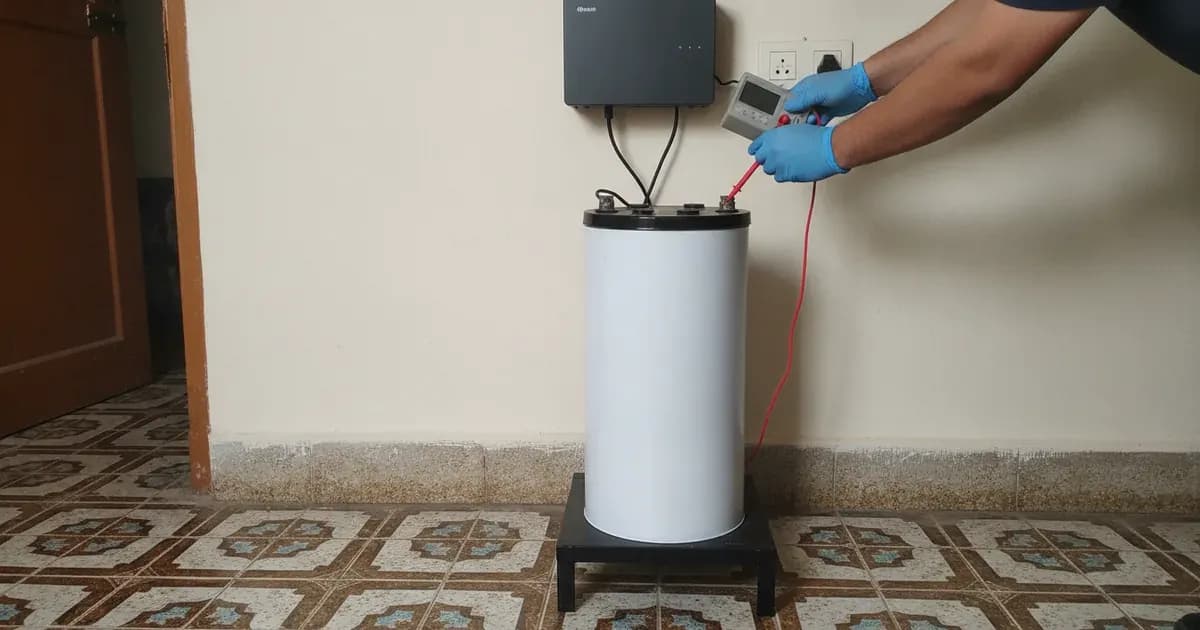
- Action: Measure voltage across battery terminals with a multimeter during active daytime charging.
- Result: Voltage must rise to 58.4 V on a 48 V bank during absorption and settle at 54V-class during float (54V-class on Fronus PV-5200; Deye "Wet" float 13.7 V (55.0 V), default 53.6 V; note that all charging voltage setpoints are 25 °C figures requiring temperature compensation of −3 to −5 mV/cell/°C above 25 °C, or Deye TEMPCO default −5 mV/°C/cell, to prevent thermal stress in summer heat).
- Meaning: If voltage never exceeds float voltage, check if utility charging is disabled, if charger priority is misconfigured, or if charge current is set too low for your bank capacity.
- Inspect Distilled Water Electrolyte Levels:
- Action: Wear safety goggles/eye protection, unthread cell vent caps, and inspect liquid levels inside each cell.
- Result: Electrolyte must cover plate separators completely, resting no higher than 1/8" from bottom of vent well.
- Meaning: Plates exposed to air from missed top-ups dry out and lose capacity permanently. Always wear eye protection and add distilled water only at the end of charge (pre-charge only if plates are exposed — just enough to cover), never tap water and never acid.
- Measure Rested Specific Gravity Across All Cells:
- Action: Wear eye protection (as drawing electrolyte extracts corrosive acid from the cell) and draw liquid into a hydrometer from every individual cell after completing a full charging cycle.
- Result: Community-reported practice for tall tubular cells in the region puts a healthy full charge at 1.265–1.280 at 25 °C (a Nitrox and flooded tubular user targets 1.275). (Exide Pakistan publishes no SG datasheet, so there is no local manufacturer figure to check against. The Exide Technologies industrial tubular motive-power range of 1.295–1.345 at 25 °C is an industrial spec and is not the target for a home TR bank.)
- Meaning: A reading of 1.180 indicates approximately 80% Depth of Discharge — do not discharge past 80% or let SG fall below 1.180. SG stuck ~1.220–1.240 despite "full" charge is a community-reported sign of too-low absorption voltage or time (recovered by a user only after 14.6–14.7 V per 12 V unit weekly sessions on an Inverex Nitrox 6 kW; note that all charging setpoints are referenced to 25 °C and require −3 to −5 mV/cell/°C temperature compensation in ambient heat). An SG monthly check is recommended; perform a freshening charge if SG fell ≥0.030, or every 3 months when idle. Cell OCVs varying by 0.15 V or more, or SG varying by 0.020 or more after equalization (which deliberately drives cells into the explosive hydrogen gassing region and requires a well-ventilated space away from sparks and open flames), indicate cell failure (industrial LMX trouble signs).
- Inspect DC Breakers, Inline Fuses, and Terminal Lugs:
- Action: Kill DC and inverter power first before touching connections, verify that the main DC circuit breaker is open during maintenance, and inspect terminal posts for corrosion.
- Meaning: Blown DC fuse, loose/corroded terminals or lugs raise resistance and drop charging voltage. Kill power first and always use insulated tools because a spanner dropped across battery posts shorts hundreds of amperes. Clean posts using a baking soda solution (neutralize spills on external surfaces only, flush with plain water, and dry). Exide publishes no post-torque figure for the TR series, so tighten snugly with an insulated correct-size spanner and never lay metal tools across the battery top. For inverter-end battery terminal bolts, apply 2–3 Nm torque per Growatt SPF 3500/5000 ES manual, and coat clamps with petroleum jelly or Vaseline, never grease.
- Review Grid Charging Priorities and Current Limits:
- Action: Review charger priority setting and Prog 02/11 (Charging Current).
- Meaning: If charger priority is set to "Only Solar" during cloudy monsoon weather, grid charging is blocked (needs "Solar & Utility" or "Solar first"). Set charge current according to manufacturer guidelines: Growatt SPF manual states for lead acid battery, the recommended charge current is 0.2C (and suggests ≥200 Ah bank), while Deye manual prescribes AGM/Flooded charge amps = Ah x 20%.
Common Causes and Fixes for Exide Tubular Batteries
Symptom detail | Likely cause | Fix |
|---|---|---|
Inverter locks out grid charging on cloudy days | Charger priority set "Only Solar" (cloudy days = no charge) | Change charger priority to "Solar first" or "Solar & Utility". |
Zero charge current with healthy battery voltage | Battery full; charging disabled in settings; protection mode; load prioritisation | Verify battery state of charge. Check breaker continuity, protection mode, and cable terminals. |
Chronic undercharge and collapsing backup time | Inverter Program 05 left on AGM default | Switch Program 05 to Flooded. This raises 48 V bulk voltage from 56.4 V to 58.4 V (Flooded preset 29.2/58.4 V; 25 °C reference requiring −3 to −5 mV/cell/°C temperature compensation in ambient heat). |
Inverter shuts down early during load shedding | Bank routinely hitting inverter low-DC cutoff (42.0 V default @48V) or bank sulfated | Set Prog 21/29 cutoff to default 42.0 V (range 40.0–48.0 V; referenced to 25 °C). Limit DOD to 80% (do not discharge past 80% / SG below 1.180). |
One cell specific gravity sits 0.020 or more below adjacent cells after equalizing | Cell failure or lagging cell (industrial LMX trouble signs: SG varies ≥0.020 after equalize) | Wear eye protection when measuring specific gravity with a hydrometer (corrosive acid splash hazard); equalization deliberately drives cells into the explosive hydrogen gassing region; perform an equalizing charge in an actively ventilated space away from sparks and open flames (Exide India aftercare: ~3% of Ah capacity, or 3 A per 100 Ah, at least once a year; Industrial LMX: equalize after every 10 cycles to 80% DOD). If the cell still lags, replace the unit. |
Battery gets hot while charging, or one unit needs excessive water | Overcharge (too-high voltage / failed regulation) | Bring bulk voltage back to the 58.4 V Flooded preset (referenced to 25 °C, requiring −3 to −5 mV/cell/°C temperature compensation); stop charging and let the bank cool if electrolyte over 43 °C. |
Slow recharge between daily load-shedding outages | Utility charge current (Prog 11 default 30 A) set far below 0.2C recommendation | Increase charge current (Prog 02/11) to 0.2C (Ah x 20% per Growatt and Deye manuals; Prog 11 0–80 A range). |
A newly bought unit will not take charge at all | Possible manufacturing defect | Claim free replacement under the official store's "6 months + 6 months exclusive online warranty (Free Replacement)". |
Inverter-Side Settings vs Battery-Side Physical Health
Because Exide TR tubular monoblocs contain no internal BMS and no comms (BMS ports are for Li battery type only; SOC on the inverter is voltage-estimated only), troubleshooting requires separating electrical settings from physical cell maintenance:
Inverter Configuration Best Practices
- Bulk Absorption Voltage: Set bulk absorption to 58.4 V on 48 V banks (Flooded preset 29.2/58.4 V on 24 V / 48 V) by selecting Flooded on Program 05 (Growatt SPF 3500/5000 ES and Axpert VM III; User-Defined → prog 19/20/21 or prog 26/27/29). On Deye hybrid units (SUN-3.6/5/6K-SG03LP1), select "Use Batt V" and apply the manufacturer-recommended "Wet" absorption at 14.7 V (59.0 V on 48 V; defaults on Set3 page: Absorption 57.6 V). Note that all voltage setpoints are referenced to 25 °C and require temperature compensation of −3 to −5 mV/cell/°C above 25 °C in hot ambient conditions.
- Float Standby Voltage: Maintain 54V-class float on 48 V systems (54V-class on Fronus PV-5200; Deye "Wet" float 13.7 V (55.0 V), default 53.6 V), referenced to 25 °C with ambient temperature compensation applied (−3 to −5 mV/cell/°C above 25 °C).
- Equalization Programming: Equalization deliberately drives cells into the explosive hydrogen gassing region and requires active room ventilation away from sparks and open flames. Exide India aftercare prescribes equalizing charge at ~3% of Ah capacity (3 A per 100 Ah), at least once a year, to lift lagging cells and dissolve sulphate patches; Industrial LMX specifies equalizing after every 10 cycles to 80% DOD or bi-weekly; Deye hybrids run auto-equalization default every 30 days for 3.0 h (recommended "Wet" equalize 14.7 V / 59.0 V, referenced to 25 °C with −3 to −5 mV/cell/°C temperature compensation required in hot ambient conditions).
- Charge Current Sizing: Program maximum charge current according to the Growatt SPF manual recommendation of 0.2C (or Deye's rule of Ah x 20% for AGM/Flooded banks). For Growatt SPF units, Prog 11 utility default is 30 A (0–80 A settable; total max 80/100 A; manual suggests ≥200 Ah bank); on Axpert VM III, Prog 02 is 10–80 A, default 60 A; on Deye, charge range spans 0–90 A (3.6 kW), 0–120 A (5 kW), or 0–135 A (6 kW).
- Low DC Cutoff Setting: Maintain Prog 21/29 at default 42.0 V on 48 V banks (Prog 29 default 21.0/42.0 V; Growatt Prog 21 range 40.0–48.0 V; Axpert range 42–48 V; referenced to 25 °C). Limit DOD to 80% (do not drop SG below 1.180) and recharge immediately after full discharge to preserve cyclic life.
- Temperature Compensation: Apply temperature compensation of −3 to −5 mV/cell/°C above 25 °C (Deye TEMPCO default −5 mV/°C/cell). In hot climates, at 45 °C a 48 V bank's 57.6 V absorption should fall ~1.9 V to prevent summer overcharge and water loss.
For general inverter-side faults, consult our parent diagnostic guide for solar battery not charging.
Battery Physical Health and Maintenance
- Distilled Water Top-Ups: Always wear eye protection when inspecting or opening cells. Check fluid levels quarterly, or per use — water consumption accelerates during hot summer months. Add distilled water (water-quality limits: total solids <125 ppm, fixed solids <75 ppm, organics <50 ppm, iron <4 ppm, chlorides <25 ppm, manganese <0.007 ppm; never acid) at the end of a charge cycle. Pre-charge watering is permitted only if plates are exposed, adding just enough to cover them.
- Specific Gravity Discipline: Always wear eye protection when drawing electrolyte into a hydrometer, as drawing liquid extracts corrosive sulfuric acid. Test each cell monthly. Industrial tubular guidance calls for a freshening charge whenever specific gravity has fallen by 0.030 or more (SG fell ≥0.030), and every 3 months when idle. PK tall tubular practice targets full-charge SG ≈1.265–1.280 at 25 °C.
- Temperature Management: Normal electrolyte temperature is 15–38 °C. Industrial tubular manuals put the hard ceiling at 43 °C: electrolyte over 43 °C requires stopping and cooling before charging or discharging further, because life is severely diminished if run at or above 43 °C.
- Cyclic Lifespan: Retail chatter says 3–4 years with monthly maintenance (community-reported; Exide Pakistan publishes no official cycle-life or year figure). Review our detailed analysis in Exide battery care and lifespan and our dedicated guide on Exide battery inverter settings and pairing.
Safety: Working with Flooded Tubular Batteries
Always observe these mandatory safety standards when maintaining unsealed lead-acid banks:
- Explosive Hydrogen Gas: Hydrogen + oxygen gas evolve during charge. Prohibit open flames, sparks, and smoking near the bank; never check electrolyte level with a lighter, and ensure adequate room cross-ventilation.
- Corrosive Sulfuric Acid & Distilled Water Topping: Sulfuric-acid electrolyte requires safety goggles/eye protection and protective gloves. Flush with plain water and get medical help immediately on contact; neutralize acid spills on floors or battery tops with baking soda. Always top up with distilled water only, never add acid and never use tap water.
- Heavy Lifting Precautions: Exide TR-1800 units weigh 56.5 kg (12 V, 185 Ah @20hr, 5 plates/cell, 56.5 kg, 503x410x190 mm) and TR-2500 units weigh 66.1 kg (12 V, 230 Ah @20hr, 7 plates/cell, 66.1 kg, 503x410x190 mm). Always use two people to lift and carry batteries safely.
- Electrical Shock and Stored Energy: Series-string voltage (48 V bank) is a shock hazard during install; kill DC power before handling connections and use a DC over-current protector/disconnect between battery and inverter. Inverter capacitors hold lethal voltage up to 5 minutes after shutdown, and PV conductors are live whenever light hits the panels. Always kill power first, use insulated tools, and never lay metal tools across the battery top, as a spanner dropped across a bank shorts hundreds of amperes.
When to call a technician instead
Contact a certified solar technician under the following conditions:
- Irreversible Specific Gravity Imbalance: If a cell stays below 1.180 SG after an equalizing charge (wearing eye protection during SG hydrometer testing; equalization deliberately drives cells into the explosive hydrogen gassing region and must only be performed in an actively ventilated space away from sparks and open flames), if cell OCVs vary ≥0.15 V, or if one cell alone needs excessive water — all are industrial LMX trouble signs of internal cell failure.
- Bulging or Leaking Containers: Physical case distortion, cracked terminal posts, or acid leaks require immediate professional decommissioning and replacement.
- Warranty Processing: Exide's official online store lists "6 months + 6 months exclusive online warranty (Free Replacement)" on TR tubulars. The store does not explain how the two 6-month periods split, so confirm exact terms with the seller before filing a claim. Compare replacement pricing in our Exide battery price guide for Pakistan.
For professional maintenance standards, consult our guide on when to call a solar technician.
Still showing the fault? Book a technician
If the steps above did not clear it, tell us the inverter or battery and the exact code. We pass it to a technician who covers your city; visit charges are quoted before they come.
How this pays for the site: the technician or verifier pays SolarNevs a fixed introduction fee. Nobody pays to be recommended, and you are free to use our free guides instead.
Frequently asked questions
Why is my Exide TR tubular battery not charging fully?
Exide Pakistan publishes no proprietary charging-voltage spec for the TR series, so the benchmark comes from inverter manuals: the Flooded preset on Growatt SPF 3500/5000 ES and Voltronic Axpert VM III units charges a 48 V bank at 58.4 V bulk (Flooded preset 29.2/58.4 V; note that all charge setpoints are 25 °C reference figures requiring temperature compensation of −3 to −5 mV/cell/°C above 25 °C in hot climates). If your solar inverter remains on its default AGM profile (56.4 V bulk on a 48 V bank; prog 26 default 28.2/56.4 V), the battery stays chronically undercharged, causing lead sulfate to crystalize into hard, inactive layers and reducing backup time.
What specific gravity indicates a fully charged Exide tubular battery?
Exide Pakistan publishes no proprietary specific gravity figures. Community-reported South Asian tall-tubular practice targets a full-charge reading of 1.265–1.280 at 25 °C (a Nitrox and flooded tubular user targets 1.275). Always wear eye protection when using a hydrometer as drawing electrolyte extracts corrosive acid from the cell. Do not let specific gravity fall below 1.180, which corresponds to roughly 80% depth of discharge in Exide Technologies industrial tubular guidance.
What are the correct inverter settings for Exide TR batteries?
Set your inverter battery type to Flooded (Program 05 on Growatt SPF 3500/5000 ES and Axpert VM III units; User-Defined → prog 19/20/21 or prog 26/27/29). Configure 48 V bulk absorption to 58.4 V and float voltage to 54V-class (54V-class on Fronus PV-5200; note that voltage setpoints are referenced to 25 °C and hot ambient conditions require temperature compensation of −3 to −5 mV/cell/°C above 25 °C, or Deye TEMPCO default −5 mV/°C/cell). Maintain Low-DC Cutoff at default 42.0 V (Prog 21 default 42.0 V on Growatt; Prog 29 default 21.0/42.0 V on Axpert). For charge current, follow the Growatt SPF manual recommendation of 0.2C (or Deye's rule of Ah x 20% for AGM/Flooded banks).
Can low electrolyte levels cause an Exide battery to lose backup?
Yes. When electrolyte drops below the plate separators, exposed active lead material dries out, hardens into permanent sulfate crusts, and loses capacity. Always wear eye protection when opening cells, and top up using only distilled water (never acid and never tap water), keeping fluid no higher than 1/8" from bottom of vent well at the end of charge.
How does Exide's 6+6 month warranty work in Pakistan?
Exide's official store offers '6 months + 6 months exclusive online warranty (Free Replacement)'. The store does not explain how the two 6-month periods split, so confirm the exact terms with the seller upon purchase.
References
- Exide Pakistan Official Store (TR-1800) — accessed 23 August 2026
- Exide Pakistan Official Store (TR-2500) — accessed 23 August 2026
- Growatt SPF 3500/5000 ES user manual — accessed 23 August 2026
- Deye SUN 3.6-6K-SG03LP1-EU Hybrid Inverter User Manual — accessed 23 August 2026
- Exide Industries (India) Maintenance Guide — accessed 23 August 2026
- Exide GNB Tubular LMX Installation & Operating (I&O) Manual — accessed 23 August 2026
- DIY Solar Forum Community Discussion (id 115641) — accessed 23 August 2026
Related guides
More from inverter errors & fixes.