Exide Battery Inverter Settings for Solar Systems in Pakistan
Updated 6 September 2026 · By SolarNevs Research Desk, Dealer surveys + verified sources · 5 sources · Method ↗
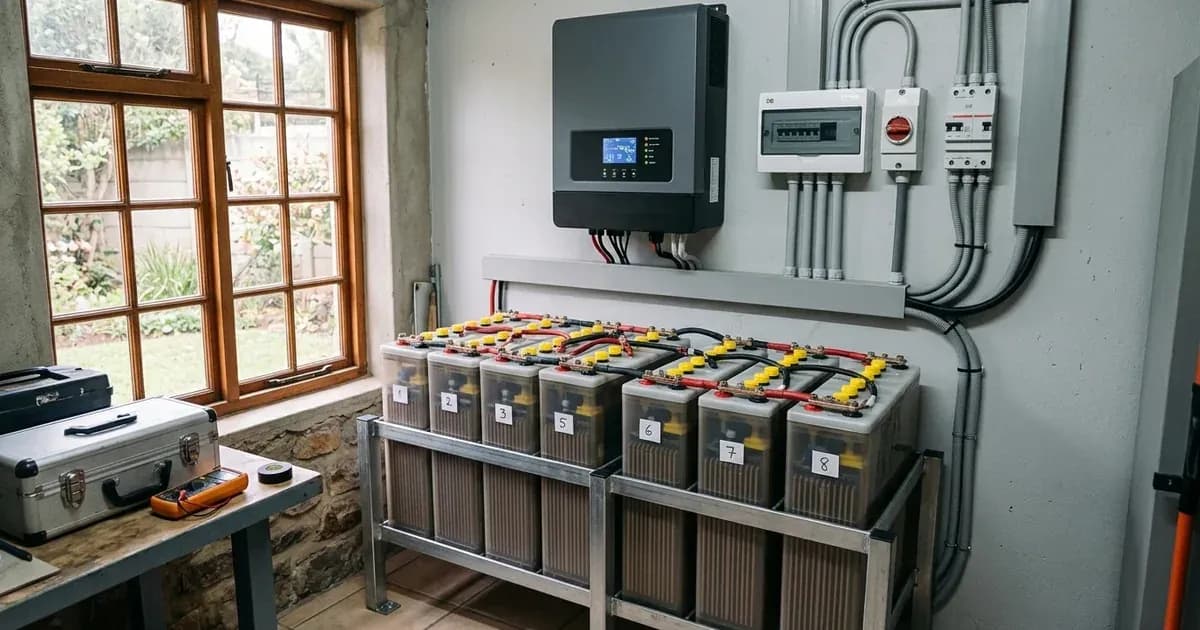
Key Takeaways
- Select the "Flooded" battery chemistry profile (such as Program 05 on Axpert and Growatt) for Exide TR series tall tubular batteries to avoid chronic undercharge from default AGM presets (56.4 V bulk on 48V; prog 26 default 28.2/56.4 V; all charge setpoints are 25°C reference figures requiring −3 to −5 mV/cell/°C temperature compensation in ambient heat).
- Configure 48V bulk absorption voltage to 58.4 V (Flooded preset 29.2/58.4 V on 24V/48V) and float voltage to 54V-class (Prog 20 on Growatt, Prog 27 on Axpert; 24V = half; 12V = quarter) — note that all charge setpoints are 25°C reference figures requiring temperature compensation of −3 to −5 mV/cell/°C above 25°C in hot ambient conditions (Deye TEMPCO default −5 mV/°C/cell).
- Equalization delivers a controlled overcharge to lift lagging cells and dissolve sulphate patches (such as 59.0 V for 3.0 h every 30 days on Deye or ~3% of Ah yearly; 14.7 V per 12V unit @ 25°C reference with −3 to −5 mV/cell/°C temp-comp); because equalization deliberately drives cells into the explosive hydrogen gassing region, always maintain active room ventilation away from sparks and open flames.
- Always wear safety goggles or eye protection when inspecting or opening cells for water replenishment to guard against corrosive sulfuric acid splashes; add pure distilled water only (never sulfuric acid and never tap water; total solids <125 ppm) at the end of a full charge, keeping electrolyte no higher than 1/8" from bottom of vent well.
- Kill DC power first and use insulated tools when tightening or servicing battery terminals, because a spanner across battery posts shorts a bank capable of delivering hundreds of amperes; apply petroleum jelly or Vaseline to clamps (never grease), avoid laying metal tools across battery tops, and torque inverter bolts to 2–3 Nm.
- Exide TR tubular monoblocs operate on voltage-mode charging only and feature no BMS or communication protocols; never connect BMS communication cables to inverter RJ45 ports.
How do I correctly set my solar inverter for Exide TR series tubular batteries?
To correctly configure a solar inverter for Exide TR series tall tubular batteries (such as the TR-1800 with 185Ah or TR-2500 with 230Ah), you must select the "Flooded" battery chemistry profile. The Axpert and Growatt platforms behind most inverters sold in Pakistan ship with Program 05 default set to AGM, which charges a 48V bank at 56.4 V bulk (prog 26 default 28.2/56.4 V; referenced to 25°C, with −3 to −5 mV/cell/°C temperature compensation applied in ambient heat). The Flooded preset raises that to 58.4 V (Flooded preset 29.2/58.4 V; referenced to 25°C with −3 to −5 mV/cell/°C temperature compensation required in ambient heat), which is what a tall tubular bank needs. Left on the AGM preset, the bank is undercharged every day and its specific gravity never recovers; running in a partial state of charge month after month drives sulphation and premature capacity loss.
Exide Pakistan does not publish a proprietary inverter programming datasheet; the settings below represent verified engineering parameters across major inverter platforms.
Inverter Configuration and Verification Steps
Follow these sequential steps to inspect and adjust your solar inverter parameters for Exide TR batteries:
- Select Flooded Chemistry Mode:
- Growatt SPF 3500/5000 ES: Program 05 defaults to AGM. Switch to "Flooded" or "User-Defined" (User-Defined → prog 19/20/21).
- Voltronic Axpert VM III and Fronus Units: Program 05 picks the battery type (User-Defined → prog 26/27/29), and on the Axpert it defaults to AGM. Change the setting to "Flooded". Note that Fronus PV-5200 menu values are medium confidence — the official manual is image-based, so figures come from a ManualsLib transcription and the shared Voltronic platform. Confirm each setting on the unit LCD.
- Deye Hybrid Inverters: In the Battery Mode menu, select "Use Batt V". Lithium mode is only for batteries with BMS communication, which flooded tubular banks lack.
- Inverex Nitrox 6kW SP-48V: Select the Deye-style Battery Setup menu in voltage mode.
- Set Bulk / Absorption Voltage:
- On a 48V bank (four 12V units in series; 24V = half; 12V = quarter), configure bulk voltage to 58.4 V (Flooded preset 29.2/58.4 V; prog 26 default 28.2/56.4 V on Axpert, 56.4 V on Growatt prog 19 range 48.0–58.4 V; Fronus Flooded 58.4 V, AGM/Gel 56.4 V). On Deye units, the recommended "Wet" mode uses 59.0 V (14.7 V per 12V battery), while default absorption is 57.6 V. On Inverex Aerox 1.2kW (12V), Flooded bulk is 14.6 V (AGM/Gel 14.1 V). Note that all voltage setpoints are referenced to 25°C; apply −3 to −5 mV/cell/°C temperature compensation above 25°C (at 45°C a 48V bank's 57.6 V absorption should fall ~1.9 V).
- Set Float Standby Voltage:
- Configure float to 54V-class on 48V systems (Growatt Prog 20 default 54V-class; Axpert Prog 27: 54V-class float preset; Fronus 54V-class). On Deye units, set float to 55.0 V under the recommended "Wet" profile ("Wet" float 13.7 V (55.0 V), default 53.6 V). On Inverex Aerox 1.2kW (12V), float is platform preset. These values represent 25°C reference targets requiring −3 to −5 mV/cell/°C temperature compensation in ambient heat.
- Configure Equalization Parameters (Ventilation Required):
- Because equalization deliberately drives the cell into the hydrogen gassing region, perform it only in an actively ventilated space away from sparks and open flames. Equalization delivers a controlled overcharge to lift lagging cells and dissolve sulphate patches. Exide Pakistan publishes no equalization schedule for the TR series. On Deye hybrids, auto-equalization runs by default every 30 days for 3.0 h, and the recommended "Wet" profile equalizes at 59.0 V (14.7 V per 12V unit; referenced to 25°C with −3 to −5 mV/cell/°C temperature compensation). Exide India's aftercare guidance — a separate company from Exide Pakistan — suggests an equalizing charge at about 3% of Ah capacity (3 A per 100 Ah) at least once a year. Industrial LMX documentation specifies equalizing after every 10 cycles to 80% DOD or bi-weekly, and after each water addition.
- Set Maximum Charging Current:
- Inverter manuals (including Growatt and Deye) recommend setting charging current to 0.2C (20% of bank Ah capacity for lead-acid batteries, with a suggested bank capacity of ≥200Ah (such as TR-2500)). Growatt utility charging (Prog 11) defaults to 30 A (adjustable from 0–80 A; total max 80/100 A). Voltronic Axpert Prog 02 allows 10–80 A (default 60 A; 20% of Ah). Deye hybrids offer charge current ranges of 0–90 A (3.6kW), 0–120 A (5kW), and 0–135 A (6kW).
- Set Low DC Cutoff Voltage:
- Maintain Growatt Prog 21 at default 42.0 V (range 40.0–48.0 V; spec-table cutoffs 42.0/40.8/38.4 V by load) and Axpert Prog 29 default 21.0/42.0 V (range 21–24 V on 24V / 42–48 V on 48V). Deye units configure SOC-based shutdown at 20%, low battery warning at 35%, and restart at 50% (voltage-mode equivalents configured by installer). Industrial LMX guidance warns never to discharge past 80% DOD or let specific gravity fall below 1.180, and to recharge immediately after full discharge.
- Verify Charger Source Priority:
- If grid charging fails during cloudy weather, check the charger source priority setting. Change it from "Only Solar" (which results in no charge during cloudy days) to "Solar First" or "Solar & Utility". Zero charge current can also occur when the battery is full, charging is disabled in settings, protection mode is active, or load prioritisation is taking precedence.
Common Inverter Settings for Exide Tubular Batteries
All charge voltage setpoints in this table (bulk/absorption, float, and equalization) are referenced to 25°C; in hot ambient conditions, apply negative temperature compensation of −3 to −5 mV/cell/°C (Deye TEMPCO default −5 mV/°C/cell). Equalization charging deliberately drives flooded cells into the explosive hydrogen gassing region and requires active room ventilation away from sparks and flames.
The table below summarizes programming parameters across popular solar inverters sold in Pakistan:
Inverter Platform (PK) | Battery Chemistry Setting | Bulk / Absorption (48V) | Float Voltage (48V) | Low-DC Cutoff (48V) | Max Charge Current | Equalization (48V; drives into explosive hydrogen gassing region; requires active ventilation away from sparks and flames) |
|---|---|---|---|---|---|---|
Growatt SPF 3500/5000 ES | Program 05: Flooded (default AGM) | 58.4 V (Flooded preset; prog 19 default 56.4 V, range 48.0–58.4 V) | 54V-class (Prog 20) | 42.0 V (Prog 21 default, range 40.0–48.0 V) | Prog 11: 30 A default (0–80 A; manual: 0.2C) | — (RJ45 BMS port lithium only) |
Voltronic Axpert VM III | Program 05: Flooded (default AGM) | 58.4 V (Flooded preset 29.2/58.4 V; prog 26 default 28.2/56.4 V) | 54V-class (Prog 27 float preset 54V-class) | 42.0 V (Prog 29 default 21.0/42.0 V, range 42–48 V) | Prog 02: default 60 A (10–80 A; 20% of Ah) | — (BMS RS485/CAN lithium only) |
Fronus PV-5200 (Infineon) | Program 05: Flooded* (default AGM) | 58.4 V (Flooded preset; AGM 56.4 V)* | 54V-class (platform value)* | Prog 29 (Axpert-pattern)* | per prog 02* | — |
Deye SUN-3.6/5/6K-SG03LP1 | Batt Mode: "Use Batt V" | 59.0 V ("Wet" preset; default 57.6 V, 14.7 V/12V) | 55.0 V ("Wet" preset; default 53.6 V, 13.7 V/12V) | SOC-based: Shutdown 20% / Low Batt 35% / Restart 50% (voltage mode set by installer) | Max A Charge: 20% of Ah (0–90 A/120 A/135 A) | 59.0 V ("Wet"), 3.0 h, default 30 days (TEMPCO −5 mV/°C/cell) |
Inverex Aerox 1.2kW (12V) | Battery type: Flooded (default AGM)* | 14.6 V (Flooded preset; AGM/Gel 14.1 V)* | Platform preset* | — (model manual gated) | — | — |
Inverex Nitrox 6kW SP-48V | Batt Mode: voltage mode (Deye-style menu) | 14.6–14.7 V per 12V unit (community practice) | Deye-style Battery Setup menu | — | 20% x Ah guidance | Community recovery practice |
*Fronus PV-5200 and Inverex Aerox values are medium confidence: the Fronus official manual is image-based, so figures come from a ManualsLib transcription and the shared Voltronic platform. Confirm every value on the unit LCD before saving.
Figures as of August 2026.
Platform Rebadging and Practical Bank Wiring Rules
Several inverter brands sold in Pakistan — Fronus among them — are built on Voltronic Power OEM platforms, with the Axpert VM III sitting underneath as the base unit. Their menu numbering and voltage presets follow the Voltronic Axpert VM III programming map (with a 3-step charge curve: bulk 2.43 V/cell, float 2.25 V/cell; referenced to 25°C with −3 to −5 mV/cell/°C temperature compensation). When pairing Exide TR tubular banks with these local brands, follow the Axpert Program 05 Flooded guidelines. Review our investigation on who actually makes Knox, Fronus, and Crown inverters.
Practical Bank Wiring and String Sizing
- Series String Matching: Always install four identical 12V Exide TR monoblocs of the same model and manufacturing batch in a 48V bank (1x 12V for home UPS 1kVA-class; 2x series = 24V for 1.5–3kW Axpert-class; 4x series = 48V for 3.5–6kW hybrids). Installers commonly report that mixing aged and new units in a series string leads to weak backup and uneven charging — community-reported guidance, with no manual source.
- Interconnect Cable Gauge & Connections: Kill DC power first and use insulated tools before tightening or servicing connections, because a metal tool dropped across battery terminals shorts a bank delivering hundreds of amperes. Use properly sized copper interconnects between batteries and to the inverter. A blown DC fuse, loose or corroded terminals or lugs cause high resistance or complete charging failure. Growatt SPF manuals specify inverter-end battery terminal bolts tightened to 2–3 Nm torque.
- Terminal Care: Kill DC power first and use an insulated tool before servicing connections, because a spanner across battery posts shorts a bank capable of delivering hundreds of amperes. Exide publishes no battery-post torque figure for the TR series, so tighten the posts snugly with a correct-size spanner and never lay metal tools across the battery top (short/arc risk). Coat the connections with petroleum jelly or Vaseline — never grease — to keep them from corroding. Always wear eye protection when inspecting cells to guard against corrosive sulfuric acid splashes, add distilled water ONLY, never acid (<125 ppm total solids), and keep electrolyte above plate separators (no higher than 1/8" from bottom of vent well).
- Temperature Compensation: Normal electrolyte temperature is 15–38°C. Without temperature compensation (−3 to −5 mV/cell/°C above 25°C; Deye TEMPCO default −5 mV/°C/cell), summer heat leads to overcharging: at 45°C a 48V bank's 57.6 V absorption should fall ~1.9 V.
Review our dedicated guide on solar battery installation mistakes and cable sizing.
For lithium communication errors, refer to our guide on lithium battery inverter compatibility errors. If you encounter low backup problems, check our troubleshooting walkthrough on Exide battery not charging and low backup fixes. For water maintenance, read our guide on Exide battery care and lifespan.
Safety: Working with Flooded Lead-Acid Batteries
Observe these mandatory safety standards during inverter configuration and battery commissioning:
- Explosive Hydrogen Gas: Hydrogen and oxygen gas evolve during charge. Maintain active ventilation in battery rooms and prohibit flames, sparks, and smoking nearby; never check level with a lighter.
- Corrosive Sulfuric Acid: Electrolyte contains sulfuric acid. Wear safety goggles and gloves. If acid splashes skin or eyes, flush with plain water and get medical help immediately; neutralize spills with baking soda. Top up with distilled water only, never acid.
- Heavy Lifting Precautions: Exide TR-1800 units weigh 56.5 kg and TR-2500 units weigh 66.1 kg. Always use two people and lifting handles to move batteries safely.
- Inverter Stored Voltage and PV Strings: Inverter capacitors hold lethal voltage for up to 5 minutes after shutdown. PV conductors are live whenever light hits the panels — a house breaker does not de-energise DC. Series-string voltage on a 48V bank is a shock hazard during install; use a DC over-current protector or disconnect between battery and inverter. Kill power first and use insulated tools; never lay metal tools across the battery top, as a spanner across terminals shorts hundreds of amperes.
- Thermal Ceiling: Normal electrolyte operating temperature is 15–38°C. If electrolyte climbs past 43°C, stop and cool before charging or discharging; battery life is severely diminished if run at or above 43°C.
When to call a technician instead
Contact a certified solar technician under the following conditions:
- You are unfamiliar with DC breaker installation, series string wiring, or menu programming.
- The inverter throws a hardware fault or alarm as soon as the bank is connected — look the code up in your own model's manual rather than guessing at settings.
- The electrolyte climbs past 43°C during a normal charge. Exide Technologies' industrial tubular manual — a different company from Exide Pakistan — treats 43°C as the hard ceiling and warns that life is severely diminished at or above it. High on-charge temperatures or frequent watering (wear eye protection against corrosive sulfuric acid, adding distilled water only, never acid) indicate overcharge.
- Cell failure or trouble signs appear: temperature rise >14°C during normal charge, cell OCVs vary ≥0.15 V or specific gravity varies ≥0.020 after equalization (which deliberately drives cells into the explosive hydrogen gassing region in an actively ventilated space away from sparks and flames), top is always wet, or one cell needs excessive water.
- Specific gravity is stuck ~1.220–1.240 despite a full charge. Always wear eye protection when testing specific gravity with a hydrometer as it draws corrosive sulfuric acid out of the cell. In community reports on DIY Solar Forum (thread id 115641), a user recovered specific gravity to 1.275 only after 14.6–14.7 V (12V basis; referenced to 25°C with −3 to −5 mV/cell/°C temp compensation) weekly 8–10h sessions on an Inverex Nitrox 6kW + 4x 280Ah flooded bank.
- Warranty questions: the official Exide online store lists "6 months + 6 months exclusive online warranty (Free Replacement)" on TR batteries. The store does not explain how the two periods differ, so ask the seller what each one covers before you rely on it. Retail chatter mentions "3–4 years with monthly maintenance", but no official Exide Pakistan cycle-life or lifespan figure exists.
For professional maintenance standards, consult our guide on when to call a solar technician.
Figures as of August 2026.
Still showing the fault? Book a technician
If the steps above did not clear it, tell us the inverter or battery and the exact code. We pass it to a technician who covers your city; visit charges are quoted before they come.
How this pays for the site: the technician or verifier pays SolarNevs a fixed introduction fee. Nobody pays to be recommended, and you are free to use our free guides instead.
Frequently asked questions
What battery type setting should I use for Exide tubular batteries?
For Exide TR series tall tubular batteries, select 'Flooded' as the battery type in your inverter menu (such as Program 05 on Axpert and Growatt). Avoid default 'AGM' or 'Lithium' presets: the AGM preset limits bulk to 56.4 V on a 48V bank (prog 26 default 28.2/56.4 V; note that charge voltage setpoints are referenced to 25°C and hot ambient conditions require temperature compensation of −3 to −5 mV/cell/°C above 25°C), causing chronic undercharging, while lithium modes require BMS communication that tubular batteries do not support.
What are the recommended absorption and float voltages for Exide TR batteries?
Exide Pakistan publishes no proprietary inverter charging datasheet. Inverter engineering presets for flooded lead-acid recommend 58.4 V bulk/absorption (Flooded preset 29.2/58.4 V on 24V/48V) and 54V-class float (24V = half; 12V = quarter) on a 48V bank (four 12V units in series; prog 19 default 56.4 V, range 48.0–58.4 V). Deye hybrids recommend 59.0 V absorption (14.7 V per 12V unit; default 57.6 V) and 55.0 V float ('Wet' float 13.7 V (55.0 V), default 53.6 V). These voltage setpoints are referenced to 25°C; in ambient heat above 25°C, apply −3 to −5 mV/cell/°C temperature compensation (Deye TEMPCO default −5 mV/°C/cell).
How do I set the charge current for Exide tubular batteries?
Inverter manuals (including Growatt and Deye) recommend setting charge current to 0.2C (20% of bank Ah capacity for lead-acid batteries, with a suggested bank capacity of ≥200Ah (such as TR-2500)). Growatt utility charging (Prog 11) defaults to 30 A (adjustable from 0–80 A; total max 80/100 A), while Axpert Prog 02 defaults to 60 A (adjustable from 10–80 A; 20% of Ah).
Do Exide tubular batteries use BMS communication with solar inverters?
No. Exide TR flooded tubular batteries have no Battery Management System (BMS) and no communication ports. Inverter RJ45 BMS ports (such as CAN and RS485 on Growatt and Axpert) are exclusively for lithium batteries; configure Exide tubular units using voltage mode only.
What low-DC cutoff voltage should I set for Exide tubular batteries?
Maintain the inverter default low-DC cutoff of 42.0 V on a 48V bank (Prog 21 default 42.0 V on Growatt with range 40.0–48.0 V; Prog 29 default 21.0/42.0 V on Axpert with range 21–24 V on 24V / 42–48 V on 48V). Setting the cutoff lower forces deep discharges beyond the recommended 80% depth of discharge (do not discharge past 80% / SG below 1.180), degrading cyclic life.
How should equalization charging be configured for Exide tubular batteries?
Because equalization deliberately drives the cell into the hydrogen gassing region, perform it only in an actively ventilated space away from sparks and open flames. Exide Pakistan publishes no proprietary equalization schedule. On Deye hybrid inverters, auto-equalization runs by default every 30 days for 3.0 h at recommended 'Wet' 59.0 V (14.7 V per 12V unit; referenced to 25°C with −3 to −5 mV/cell/°C temperature compensation). Exide India aftercare guidance suggests an equalizing charge at ~3% of Ah capacity (3 A per 100 Ah) at least once a year to lift lagging cells and dissolve sulphate patches.
References
- Growatt SPF 3500/5000 ES user manual — accessed 23 August 2026
- Deye SUN 3.6-6K-SG03LP1-EU Hybrid Inverter User Manual — accessed 23 August 2026
- Exide Pakistan Official Store (TR series) — accessed 23 August 2026
- Exide GNB Tubular LMX Installation & Operating (I&O) Manual — accessed 23 August 2026
- Exide Industries India Battery Maintenance — accessed 23 August 2026
Related guides
More from inverter errors & fixes.