Solar Battery Backup Time Suddenly Dropped: Diagnosis Guide
Updated 6 September 2026 · By SolarNevs Research Desk, Dealer surveys + verified sources · 5 sources · Method ↗
Key Takeaways
- A single shorted cell in a lead-acid string, or cell imbalance in a lithium module, can collapse backup overnight — rule that out before you condemn the whole bank.
- Unmonitored household "load creep" (such as adding inverter fans, water dispensers, or refrigeration) raises real discharge wattage; the only honest way to size it is to meter the load, not to estimate it.
- Tubular data sheets quote their figures at 25°C and note that running hotter reduces backup — a Pakistani battery room sits well above 25°C for months at a stretch.
- Always wear eye protection when testing specific gravity with a hydrometer (since it draws corrosive acid out of the cell) or check individual cell voltages via BMS telemetry before replacing entire battery banks.
Why did my solar battery backup time suddenly drop?
Experiencing a sudden, sharp decrease in backup duration—such as a solar storage system that previously powered your household through four hours of blackout collapsing after only 30 or 45 minutes—is a frequent issue across Pakistani solar installations.
A sudden reduction in runtime rarely occurs without a clear physical cause. Diagnosing the issue requires separating five distinct possibilities: a single collapsed dead cell, plate sulfation from chronic undercharging, hidden household load increases, lithium cell imbalance or coulomb-counter drift, and high summer temperatures. The flowchart below also screens one purely configurational suspect — an inverter low-DC cutoff set too high.
Age alone is a slow curve, not a cliff. A flooded tubular is good for roughly 800–1,200 real cycles against 6,000+ for LiFePO4, so a bank that lost half its backup inside a week has something specific wrong with it beyond ordinary wear — and that something is usually findable with a hydrometer, a multimeter and a clamp meter.
Systematic Diagnostic Flowchart and Symptom Table
Follow this structured matrix to identify why your battery backup duration has deteriorated:
Observable Symptom | Most Probable Root Cause | Verification Method | Recommended Corrective Action |
|---|---|---|---|
Backup dropped abruptly from hours to <30 mins | Single Dead / Shorted Cell | Specific gravity test across all cells (wearing eye protection as drawing electrolyte out carries acid splash hazard) or per-block DC voltage under load | Replace the single defective 12 V block (or rebalance lithium pack). |
Backup deteriorated gradually over months | Plate Sulfation from Chronic Undercharge | Electrolyte gravity sits at or below the 1.190 half-charge rung even after a full charge; terminal voltage spikes rapidly on charge | In a well-ventilated space away from sparks and flames (equalization drives cells into the hydrogen gassing region), run the equalization your own inverter documents — on an Axpert that is 58.4 V (referenced to 25°C) for 60 minutes every 30 days, and only with battery type set to Flooded or User. |
Inverter shuts off, but battery voltage rebounds | Low DC Cutoff Set Too High (Axpert Program 29) | Axpert Program 29 sitting toward the top of its 42–48 V range instead of at the 42.0 V default | Return Program 29 to its 42.0 V default to use the reserve capacity you already paid for. |
Battery backup collapses only when motor starts | Heavy Inrush Voltage Sag on Aged Bank | High internal resistance; voltage collapses under motor compressor start | Add battery capacity or soft-start devices on heavy inductive motor loads. |
Lithium pack shuts off while the app still shows charge left | Lithium Cell Imbalance | BMS cell telemetry shows one cell falling to its under-voltage limit (2.50 V absolute on typical LiFePO4) while the rest sit near 3.2 V nominal | Give the pack one full, uninterrupted charge to the BMS's own end-of-charge point so it can balance and re-reference 100%; take the absorption voltage from your battery's datasheet, not from a generic number. |
The Five Main Causes of Sudden Runtime Drop
1. The Single Dead Cell in a Series String
In a 48 V lead-acid battery bank composed of four 12 V batteries (24 total individual 2 V cells), every cell is wired in series. If just one individual cell develops an internal short circuit (caused by plate shedding or separator failure), that block contributes only five working 2 V cells instead of six, leaving its terminal voltage significantly depressed below the other blocks. Under load, the whole string plunges past the inverter's low-voltage cutoff — 42.0 V is the Axpert default, adjustable across a 42–48 V range — killing power instantly even though the other 23 cells remain healthy.
How to verify: After a full charge, wear eye protection (since hydrometer testing draws corrosive acid out of the cell) and measure specific gravity with a hydrometer as explained in our tubular battery water topping and specific gravity guide. If one cell reads 1.120 while all others read 1.260, that cell has failed.
2. Chronic Undercharging and Plate Sulfation
During prolonged cloudy weather or periods of heavy load-shedding, solar generation may never be enough to finish the charge at all. The same thing happens on the UPS side of the house: a tubular that gets cycled every evening but is only ever held at a 13.8 V float never comes back to full, because Osaka's data sheet puts the cycle (charging) window at 14.4–14.7 V per 12 V battery (referenced to 25°C) and reserves 13.8–14.2 V for float and standby duty. Operating in a chronic partial state of charge produces sulfation — soft and reversible while it is early, crystallized and permanent once it hardens — choking active plate area and cutting usable runtime.
How to verify: If terminal voltage shoots up into the 14.4–14.7 V cycle band almost as soon as charging starts, then collapses within minutes of discharge, you are watching surface charge rather than stored energy. Learn what can and cannot be recovered in our battery sulfation and desulfation guide.
3. Unmonitored Household "Load Creep"
In many homes, family members gradually connect additional appliances to solar-backed circuits (such as LED TVs, deep freezers, inverter refrigerators, or Wi-Fi routers). Unmonitored household load creep increases total running draw and significantly cuts backup runtime — and a lead-acid bank gives up even more usable energy under heavier loads, because tubular capacity is rated at a slow 10–20 hour discharge rate and delivers less than its label when you discharge it faster.
How to verify: Use an AC clamp meter or check your inverter LCD output wattage during load-shedding to measure true total power consumption. Review load calculations in our guide on how many kWh of battery storage you need.
4. Lithium Cell Imbalance and Coulomb Drift
On lithium battery banks the coulomb counter drifts: currents below the sensor's noise floor read as zero while the battery quietly drains, so the displayed percentage stops matching what is actually in the pack. Separately, if cells become imbalanced, the BMS stops discharging the entire module the moment the lowest cell reaches its under-voltage limit — 2.50 V is the absolute floor on typical LiFePO4 cells, though many packs are set higher, at 2.8–3.0 V. These are typical figures; your BMS's own datasheet governs.
How to verify: Review diagnostic steps in our guide on battery SOC stuck or jumping.
5. High Ambient Summer Temperatures
Flooded tubular data sheets quote their capacity and specific-gravity figures at 25°C, and state that running above that reduces backup. A Pakistani battery room sits far past 25°C for months on end, so the numbers on the label were never the numbers you were going to get in June.
Heat also moves the correct charge voltage. Charging should be temperature-compensated by roughly -3 to -5 mV per cell per °C above 25°C, which pulls a 57.6 V setpoint down to about 55.7 V at 45°C — a charger left on its cool-weather setting is quietly overcharging the bank all summer, which is its own route to lost capacity. What we cannot give you is a percentage: no Pakistani brand publishes how much cyclic life a tubular loses at 45°C, so do not accept one from a shop counter either. Judge it by your own measured runtime.
Practical Diagnostic Testing Procedure
To definitively isolate the cause of reduced backup runtime:
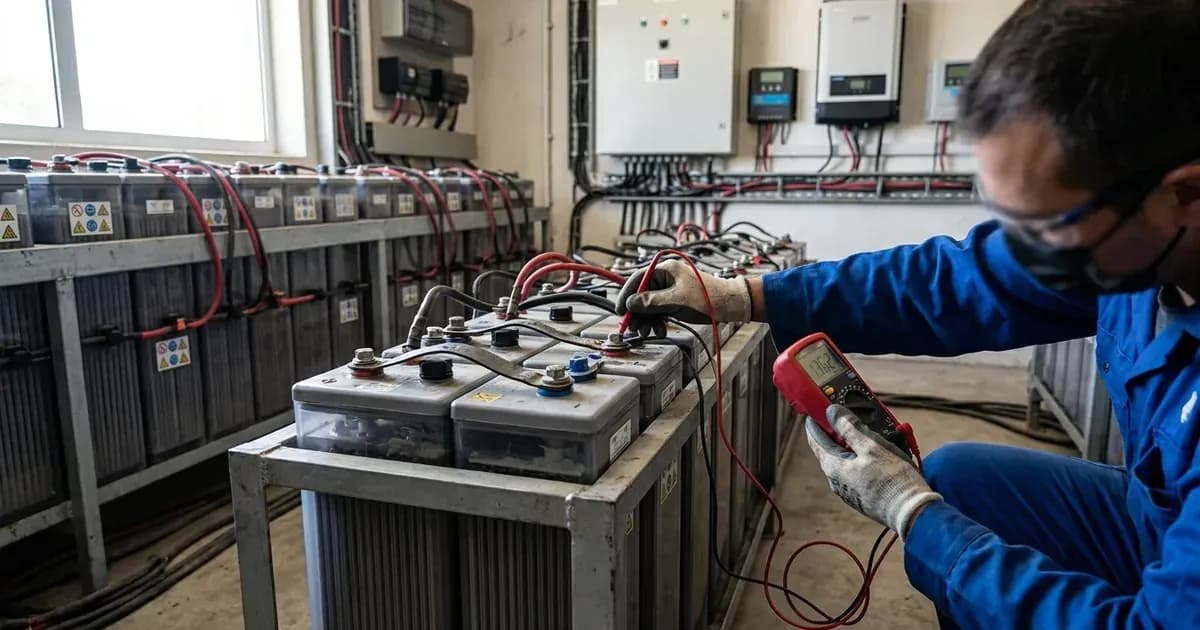
- Conduct an Open Circuit Voltage Test: After a full solar charge, switch off the DC breaker and use an insulated tool to disconnect the battery bank from the inverter (a spanner dropped across a bank shorts hundreds of amps). Leave the bank with no charge and no load until the surface charge has decayed — the rested reading is the only one the ladder applies to. Then measure the voltage across each 12 V block. On the rested open-circuit ladder, 12.6 V and above is full, 12.20 volts is about half and 12.00 volts is about a quarter; a block reading 12.00 volts straight after a full charge has collapsed.
- Conduct a Specific Gravity Cell Mapping: Wear eye protection because hydrometer testing draws corrosive acid out of the cell, then measure the electrolyte specific gravity across all cells in the bank and log the values. A full tubular reads 1.260 on Osaka's own figure, with other makers quoting 1.240–1.250, so a bank whose cells all land in that band is chemically intact. If one cell sits down at 1.150 (the quarter-charge rung, with 1.120 marking flat) while its neighbours are full, that cell is your failure. Read specific gravity at the 25°C the figures are quoted at, or correct for temperature before you trust the comparison.
- Perform an Active Load Voltage Sag Test: Reconnect the battery bank to the inverter, apply a known steady load (such as steady lighting and fan loads), and monitor the voltage of each 12 V block every 15 minutes. The block whose voltage drops significantly faster than the others is the defective unit.
Step-by-Step Runtime Recovery Checklist
Follow these sequential steps to troubleshoot and restore lost backup time:
- Measure Individual Block Voltages Under Active Load: Turn on a steady household load during load-shedding and measure the DC voltage across each 12 V battery block. You are not comparing to a table here, you are comparing the blocks to each other under the same current: the one sitting volts below its neighbours is the failed unit, and it has to come out before you judge the rest of the bank.
- Inspect Distilled Water Levels: Wear eye protection when opening vent caps and ensure electrolyte covers the plates in every cell. Top up with distilled or demineralised water only — never tap water, and never acid.
- Perform an Equalization / Balance Charge: On a tubular bank, perform equalization in a well-ventilated space away from sparks and flames because it drives cells into the hydrogen gassing region. Run the equalization your inverter actually documents — the Axpert setting is 58.4 V (referenced to 25°C) for 60 minutes, every 30 days, and only with the battery type set to Flooded or User. On lithium, give the pack one full, uninterrupted charge through to the BMS's own end-of-charge point so it can balance the cells and re-reference its 100% mark.
- Verify Inverter Low-Voltage Thresholds: Confirm that Low DC Cutoff (Axpert Program 29) is set to its 42.0 V default rather than parked near the 48 V top of its range.
- Audit Total Connected AC Load: Use a clamp meter to measure true real-time wattage on emergency backup circuits to identify hidden load growth.
Safety: Working with DC Battery Testing
Observe these mandatory safety protocols when performing load and gravity tests:
- Insulated Multimeter Probes and Terminal Safety: Kill power before working and use category-rated, insulated multimeter probes and insulated tools to avoid accidental short circuits across heavy DC busbars, as a spanner across terminals shorts hundreds of amps.
- Acid Splash Precautions: Wear safety glasses when opening vent caps for hydrometer testing on warm, cycled batteries. Hydrometer testing draws corrosive sulfuric acid out of the cell, and water goes into the cell — acid never does.
- Ventilate Before You Charge Hard: Flooded batteries gas hydrogen while charging, and an equalization charge deliberately drives them into that gassing region. Open the room up, and keep sparks and flames away from the bank.
- Wait After Switching Off: Inverter capacitors hold a lethal charge for up to five minutes after shutdown, and PV conductors stay live in daylight regardless of what the inverter is doing.
- Lift With Two People: A tall tubular weighs 55–73 kg. Pulling a suspect block out of a rack alone is how backs and toes get broken.
When to call a technician instead
Contact a certified solar technician or professional installation company under the following conditions:
- Specific gravity testing (wearing eye protection against corrosive sulfuric acid) reveals multiple failed cells across different battery blocks.
- A battery casing gets too hot to keep your hand on during normal charging. The threshold Pakistani forum users commonly cite is around 50°C — treat that as a community-reported rule of thumb rather than a manufacturer specification, and stop the charge either way.
- Battery voltage drops instantly to near zero the moment even a small load is applied.
For professional maintenance standards, consult our guide on when to call a solar technician.
Figures as of August 2026.
Still showing the fault? Book a technician
If the steps above did not clear it, tell us the inverter or battery and the exact code. We pass it to a technician who covers your city; visit charges are quoted before they come.
How this pays for the site: the technician or verifier pays SolarNevs a fixed introduction fee. Nobody pays to be recommended, and you are free to use our free guides instead.
Frequently asked questions
Why did my tubular solar battery backup drop from 4 hours to 30 minutes?
A sudden, drastic drop in tubular battery backup time commonly comes down to one of three root causes: a dead or shorted cell in a 12 V block, plate sulfation from chronic undercharging, or unmonitored electrical load increases (such as running water pumps or AC units on inverter circuits).
How do I identify a dead cell in a flooded tubular battery bank?
Wear eye protection because hydrometer testing draws corrosive sulfuric acid out of the cell, then measure the specific gravity of every individual cell after a full charge. Osaka's data sheet puts a full tubular at 1.260 at 25°C, with 1.150 sitting at roughly 25% and 1.120 flat. If five cells land in the full-charge band while one stays down near 1.150 or below, that specific cell has failed internally.
How much does high summer temperature reduce solar battery life?
Tubular data sheets quote their capacity and specific-gravity figures at 25°C and note that running hotter than that reduces backup. We have not found a published Pakistani-brand figure for exactly how much service life you lose at 45°C, so treat heat as a real but unquantified loss and judge it by your own measured runtime rather than by a number from a shop counter.
Why does my lithium battery shut down early despite the inverter showing 50% charge?
If individual cells inside a lithium pack become unbalanced, the weakest cell hits its under-voltage limit while the others still sit near their 3.2 V nominal. Typical LiFePO4 under-voltage protection is 2.50 V absolute, with common setpoints of 2.8–3.0 V — your BMS datasheet governs. The BMS then stops discharge to protect the weak cell, terminating backup early.
How can I calculate the expected backup time for my battery bank?
Use the standard runtime formula: Backup Hours = (Battery Capacity in Ampere-Hours × Battery Voltage in Volts × Depth of Discharge) ÷ Total Connected Load in Watts, then deduct your inverter's conversion loss using the efficiency printed on its own data label. For flooded lead-acid tubulars, plan around ~50% DoD (compared to 90–95% on LiFePO4), and measure actual running wattage with a meter rather than estimating.
References
- Osaka Tubular Technical Data Sheet — accessed 23 August 2026
- Voltronic Axpert VM III Manual PDF — accessed 23 August 2026
- Voltronic Axpert V PF1 Manual PDF — accessed 23 August 2026
- Pylontech US5000 Technical Datasheet — accessed 23 August 2026
- Battery University Sulfation and Prevention BU-804b — accessed 23 August 2026
Related guides
More from inverter errors & fixes.