Volta Battery Troubleshooting: Low Backup and Charging Fixes
Updated 7 September 2026 · By SolarNevs Research Desk, Dealer surveys + verified sources · 5 sources · Method ↗
Key Takeaways
- Volta's official datasheet warns that a 13.8 V UPS charger may not fully charge a hard-cycled tubular battery; it prescribes a boost charge of 14.1 V–14.4 V per 12 V unit (56.4 V–57.6 V on 48 V banks, referenced to 25 °C with -3 to -5 mV/cell/°C temperature compensation in ambient heat), which deliberately drives cells into the hydrogen gassing region and requires a well-ventilated space away from sparks and open flames.
- Always wear eye protection when using a hydrometer because testing draws corrosive acid out of the cell; a healthy full charge reads 1.260 specific gravity at 25 °C (1.220 = 75%, 1.190 = 50%, 1.150 = 25%, 1.120 = discharged).
- Always wear eye protection when opening cells to inspect electrolyte levels, and top up with distilled or demineralized water only (never acid) to keep plates and gauntlets fully submerged.
- Stop DIY troubleshooting and call an installer if a cell's specific gravity fails to recover after an equalization charge (an operation that deliberately drives cells into the hydrogen gassing region and demands active room ventilation away from sparks and flames).
Why is my Volta tubular battery not charging or providing low backup?
A Volta tall-tubular battery (such as the TA-1800, TA-2500, or TA-3000) fails to deliver expected backup primarily because the solar inverter delivers inadequate absorption voltage. Axpert-family inverters (including Inverex units built on the Axpert platform) default to a sealed AGM profile (56.4 V bulk on 48 V banks). Volta's published technical datasheet states that a 13.8 V UPS charger may not fully charge a hard-cycled tubular battery, and prescribes a boost charge of 14.1 V–14.4 V per 12 V unit (56.4 V–57.6 V on 48 V banks; these are 25 °C reference setpoints that require -3 to -5 mV/cell/°C temperature compensation in ambient summer heat). Because boost charging deliberately drives cells into the hydrogen gassing region, it must be performed in a well-ventilated space away from sparks and open flames until specific gravity climbs back to the datasheet's full-charge figure of 1.260.
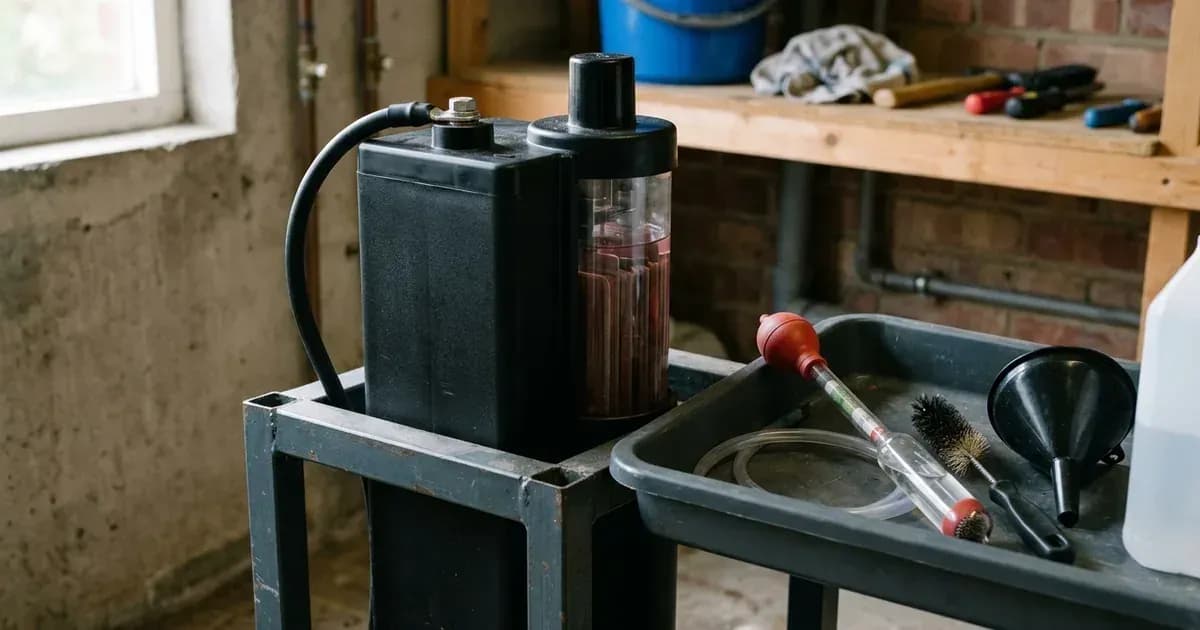
Your first step is checking Program 05 on your inverter to ensure Flooded chemistry is selected, followed by testing specific gravity across all cells using a hydrometer while wearing eye protection (hydrometer testing draws corrosive sulfuric acid out of the cell).
Step-by-step diagnosis for Volta tubular battery charging problems
Follow these sequential diagnostic steps using Volta's published engineering data to locate electrical or chemical faults:
- Verify Inverter Chemistry Selection:
- Action: Enter the inverter programming menu — Program 05 on Voltronic Axpert platforms and the Inverex units built on them; Growatt SPF units carry the same battery-type list under their own menu item.
- Result: Confirm the screen displays "Flooded" (FLD) or "User-Defined" (USE) rather than "AGM".
- Meaning: If left on AGM, bulk absorption voltage caps at 56.4 V (48 V bank). The Flooded preset lifts it to 58.4 V, which sits inside the 57.6 V–58.8 V window implied by Volta's own 14.4 V–14.7 V cycle-use figures (all 25 °C reference setpoints that require -3 to -5 mV/cell/°C temperature compensation in ambient heat) — enough to convert lead sulfate back into active sponge lead. If charge priority is set to "Only Solar", grid charging remains blocked on cloudy days.
- Measure Terminal Voltage and Compare Against Volta's OCV Ladder:
- Action: Disconnect the battery bank from active loads, let it rest off charge, then measure resting DC voltage across the terminals.
- Result: Compare with Volta's official open-circuit voltage (OCV) table:
- 12.6 V+: 100% State of Charge.
- 12.35 V: 75% State of Charge.
- 12.20 V: 50% State of Charge.
- 12.00 V: 25% State of Charge.
- 11.80 V: Discharged (recharge immediately).
- Inspect Distilled Water Electrolyte Levels:
- Action: Put on eye protection goggles and chemical-resistant gloves before opening vent caps. Check the electrolyte level in each cell; Volta offers float-type vent plugs as an option on its tubular line, and where fitted the float shows the level at a glance.
- Result: Plates and gauntlets must stay fully submerged in every cell.
- Meaning: Exposed positive gauntlets and plate active material oxidize permanently. Always wear eye protection and add pure distilled or demineralized water only, never tap water and never acid.
- Measure Specific Gravity Across All Cells:
- Action: Always wear eye protection goggles and protective gloves because drawing electrolyte into a hydrometer pulls corrosive sulfuric acid out of the cell. Test each individual cell after a full daytime charge.
- Result: Volta's official factory standard targets 1.260 SG at 25 °C (1.220 = 75%, 1.190 = 50%, 1.150 = 25%, 1.120 = discharged). Note that the datasheet prints the reference temperature as 25 °C on page 2 and 20 °C on page 4.
- Meaning: If SG remains stuck near 1.220 after hours of charging, the inverter has prematurely dropped into float mode. In a well-ventilated space away from sparks and flames, run a boost charge at 14.1 V–14.4 V per 12 V unit (referenced to 25 °C with -3 to -5 mV/cell/°C temperature compensation in ambient heat; boost charging deliberately drives cells into the hydrogen gassing region) until specific gravity recovers to 1.260.
- Examine Terminal Lugs and Interconnect Cabling:
- Action: Isolate the DC battery breaker and kill power first, and always use insulated tools because dropping a metal spanner across battery terminals shorts hundreds of amps. Check that terminal bolts are secure and free of white sulfate crusts.
- Meaning: Clean dirty posts with a wire brush and tighten hardware securely with an insulated spanner (Volta publishes no torque spec in Nm for its bolt-nut terminals). Coat joint exteriors with petroleum jelly. Review our guide on solar battery installation mistakes and cable sizing.
- Decode Inverter Warning Alarms:
- Action: Observe inverter LCD warning codes during charging or outage transitions.
- Meaning: On Axpert platforms, Warning 03 indicates overcharging, while Warning 04 indicates low battery voltage. If your inverter emits repetitive alarms, consult our troubleshooting walkthrough on inverters beeping continuously.
Common Causes and Fixes for Volta Tubular Batteries
Symptom detail | Likely cause | Fix |
|---|---|---|
Inverter charges all day but backup collapses in 30 minutes | Chronic undercharge from 13.8 V float or AGM default | Switch Program 05 to Flooded (58.4 V on 48 V at 25 °C reference, requiring -3 to -5 mV/cell/°C temperature compensation in ambient heat). Then in a well-ventilated space away from sparks and flames, run a boost charge at 14.1 V–14.4 V per 12 V unit (which deliberately drives cells into the hydrogen gassing region) until specific gravity recovers to 1.260, checking with a hydrometer while wearing eye protection (testing draws acid out). |
Inverter shuts down early in the evening | Low DC Cutoff (Program 29) set too high or bank sulfated | Set cutoff to default 42.0 V (48 V bank, range 42.0 V–48.0 V). Wear eye protection and test specific gravity across all cells with a hydrometer (hydrometer testing draws corrosive acid out). |
Zero charge current displayed on inverter | Tripped DC battery breaker, blown inline fuse, or battery full | Isolate power with insulated tools, reset DC breaker, and test fuse continuity with a multimeter. Confirm charging is not disabled in settings. |
One cell reads 1.150 SG while others reach 1.260 | Localized cell sulfation or internal plate short | Wear eye protection and top up water (distilled water only, never acid). Then in a well-ventilated space away from sparks and open flames, run an equalization charge (58.4 V on 48 V at 25 °C reference with -3 to -5 mV/cell/°C temperature compensation; Axpert default duration 60 min; equalization deliberately drives cells into the hydrogen gassing region). If SG fails to recover, the cell is dead. |
Rapid water loss and bubbling noise during charge | Charge voltage set above Volta's 14.7 V/12 V cycle-use ceiling or prolonged float | Keep bulk voltage within Volta's 14.4 V–14.7 V cycle-use band per 12 V unit and verify the charger drops back into Volta's 13.8 V–14.2 V standby band (both 25 °C reference values requiring -3 to -5 mV/cell/°C temperature compensation in ambient heat). Always wear eye protection when inspecting boiling cells. |
Backup drops significantly in summer | Ambient heat >25 °C accelerates internal degradation | Volta datasheet notes heat reduces backup; ensure battery room has active cross-ventilation away from sparks and flames. |
Single battery in 48 V string runs hot | Unequal internal resistance in series string | Measure individual 12 V monobloc voltages during charge; replace lagging units. |
Flooded Tubular Care vs Battery Life Realities
Volta tubular batteries are unsealed flooded storage monoblocs manufactured without internal digital BMS electronics:
Operating Best Practices
- Boost Charging Protocol: Volta's technical datasheet recommends charging at 0.1 C10 constant current for 12–13 hours. For boost charging, apply 0.1–0.2 C10 (12 A for TA-1800, 16 A for TA-2500, 20 A for TA-3000) at 14.1 V–14.4 V per 12 V unit (referenced to 25 °C with -3 to -5 mV/cell/°C temperature compensation in ambient heat). Boost charging deliberately drives cells into the hydrogen gassing region, so execute it only in a well-ventilated area away from sparks and flames. For a 4×TA-2500 string on a 48 V system, our calculation suggests a conservative Program 02 charging ceiling of 20 A–30 A.
- Equalization Schedule: Run periodic equalization at 58.4 V on a 48 V bank (referenced to 25 °C, requiring -3 to -5 mV/cell/°C temperature compensation in ambient heat) for 60 minutes every 30 days — the Axpert-family default in Program 30/31/33/35, adjustable from 0 to 90 days — to balance cell gravities and eliminate acid stratification. Equalization deliberately drives cells into the hydrogen gassing region, so only equalize in a well-ventilated room away from sparks and flames, with electrolyte topped up beforehand using pure distilled water only (wearing eye protection).
- Temperature Effects and Compensation: Volta's datasheet notes that above 25 °C backup time is reduced by internal damage to the battery; heat also drives faster self-discharge and water loss, so keep the bank as cool as the room allows. If temperature compensation is enabled on your inverter, lead-acid charging voltages derate by -3 to -5 mV/cell/°C above 25 °C (reducing a 48 V 57.6 V setting to ~55.7 V at 45 °C).
- Backup Expectations: Under standard domestic loads (5 tube lights + 7 fans at 25 °C), Volta's official datasheet rates expected backup at approximately 210 minutes for TA-1800, 240–250 minutes for TA-2500, and 290–320 minutes for TA-3000. Compare market pricing in our tubular battery price guide for Pakistan.
For general system charging faults, consult our parent diagnostic guide for solar battery not charging.
Safety: Working with Flooded Tubular Batteries
Observe these mandatory safety standards when maintaining flooded battery banks:
- Explosive Hydrogen Gas: Charging and equalization produce flammable hydrogen gas by deliberately driving cells into the gassing region. Never enclose batteries in airtight cabinets; ensure active cross-ventilation and keep open flames, sparks, and lighters away.
- Corrosive Sulfuric Acid: Electrolyte contains hazardous dilute sulfuric acid, and hydrometer testing draws acid out of the cell. Always wear eye protection goggles and acid-resistant rubber gloves. Always add distilled water only and never add acid. If acid splashes skin or eyes, flush with plenty of running water and seek medical evaluation.
- Terminal Connections and Arc Flash: Always isolate the DC breaker and kill power before servicing terminals, and use insulated tools; dropping a metal spanner across a battery bank shorts hundreds of amps and causes severe arc flashes.
- Heavy Handling Precautions: Volta tubular batteries are heavy: TA-1800 weighs 54.9 kg, TA-2500 weighs 63.5 kg, and TA-3000 weighs 72.7 kg. Always use two people and lifting handles to move units safely.
- Inverter Stored Energy and PV Strings: Inverter capacitors hold lethal charges for up to 5 minutes after disconnection. PV arrays generate high DC voltages whenever exposed to daylight.
- Overcharging and Acid Mist: Overcharge boils electrolyte and vents acid mist; keep charge voltages within the factory cycle maximum of 14.7 V per 12 V unit (referenced to 25 °C).
When to call a technician instead
Contact a certified solar technician under the following conditions:
- Unresolved Specific Gravity Variance: If a lagging cell's specific gravity fails to recover after an equalization charge (conducted in a ventilated space as equalization drives cells into the hydrogen gassing region), the cell is dead or internally shorted.
- Container Distortion or Leaks: Bulging polypropylene casings, cracked terminal seals, or acid leaks require immediate replacement.
- Warranty Processing: Volta publishes no official warranty terms; third-party dealers quote roughly 6–12 months on tubular models (community-reported figures only). Your original purchase invoice is the claim document — keep it safe.
For professional maintenance standards, consult our guide on when to call a solar technician.
*Figures as of August 2026.*\n
Still showing the fault? Book a technician
If the steps above did not clear it, tell us the inverter or battery and the exact code. We pass it to a technician who covers your city; visit charges are quoted before they come.
How this pays for the site: the technician or verifier pays SolarNevs a fixed introduction fee. Nobody pays to be recommended, and you are free to use our free guides instead.
Frequently asked questions
Why is my Volta tubular battery not giving enough backup time?
The most frequent cause is chronic undercharging from inadequate absorption voltage or running on standby float charging. Volta's technical datasheet notes that a 13.8 V UPS charger may not fully charge a hard-cycled tubular battery, and recommends a boost charge of 14.1 V–14.4 V per 12 V unit (56.4 V–57.6 V on 48 V banks; referenced to 25 °C, requiring -3 to -5 mV/cell/°C temperature compensation in ambient heat). Because boost charging deliberately drives cells into the hydrogen gassing region, perform it only in a well-ventilated space away from sparks and open flames, and wear eye protection when verifying recovery to the 1.260 full-charge target at 25 °C with a hydrometer as it draws acid out.
What specific gravity indicates a fully charged Volta tubular battery?
Always wear eye protection when using a hydrometer because testing draws corrosive sulfuric acid out of the cell. According to Volta's published technical datasheet, a fully charged cell reads 1.260 specific gravity at 25 °C (also referenced at 20 °C on datasheet page 4). A reading of 1.220 indicates 75% state of charge (12.35 V rested OCV), 1.190 indicates 50% (12.20 V), 1.150 indicates 25% (12.00 V), and 1.120 indicates a fully discharged cell (11.80 V).
What charging current should I set for Volta TA-series batteries?
Volta's technical datasheet specifies a constant charge current of 0.1 C10 for 12–13 hours, with boost charging at 0.1–0.2 C10 (initial boost ratings: 12 A for TA-1800 at 185 Ah, 16 A for TA-2500 at 230 Ah, 20 A for TA-3000 at 260 Ah). Boost charging deliberately drives cells into the hydrogen gassing region and must be performed in a well-ventilated area away from sparks and flames. In a series string (such as 4×12 V for a 48 V bank), current is sized per string, not multiplied by the number of series batteries.
Can I use tap water to top up my Volta battery?
No. Always wear eye protection when opening cell vent caps and top up with pure distilled or demineralized water only. Never add tap water and never add battery acid; adding acid upsets electrolyte chemistry and damages plate active material.
Where are Volta batteries manufactured?
Volta batteries are manufactured by Pakistan Accumulators (Pvt) Ltd (PAL) at their Hattar Industrial Estate plant in Khyber Pakhtunkhwa, as part of the ACM Group battery portfolio alongside sister brand Osaka.
References
- Volta Tubular Technical Data Sheet PDF — accessed 23 August 2026
- ACM Group Volta Batteries Overview — accessed 23 August 2026
- Volta Tubular Plate Batteries Category — accessed 23 August 2026
- Volta TA-2500 Product Page — accessed 23 August 2026
- Voltronic Axpert VM III User Manual — accessed 23 August 2026
Related guides
More from inverter errors & fixes.