UK Market-Wide Half-Hourly Settlement (MHHS) for Solar Export
Updated 6 September 2026 · By SolarNevs Research Desk, Dealer surveys + verified sources · 4 sources · Method ↗
Key Takeaways
- The Smart Export Guarantee (SEG) requires electricity suppliers to pay for low-carbon electricity exported to the National Grid.
- SEG payments are calculated based on accurate export meter readings.
- SEG Licensees determine the export rates and contract terms, which must always be above zero.
- Market-Wide Half-Hourly Settlement (MHHS) is an upcoming change that will require all electricity settlement, including exports, to use half-hourly data.
What is Market-Wide Half-Hourly Settlement (MHHS)?
Market-Wide Half-Hourly Settlement (MHHS) is a significant upcoming change to how electricity is measured and settled across Great Britain. Currently, much of the electricity market operates on a daily or monthly settlement basis. MHHS will require all electricity consumption and generation to be settled based on half-hourly meter readings. This shift aims to improve the accuracy of billing, enhance grid balancing, and better reflect the real-time value of electricity.
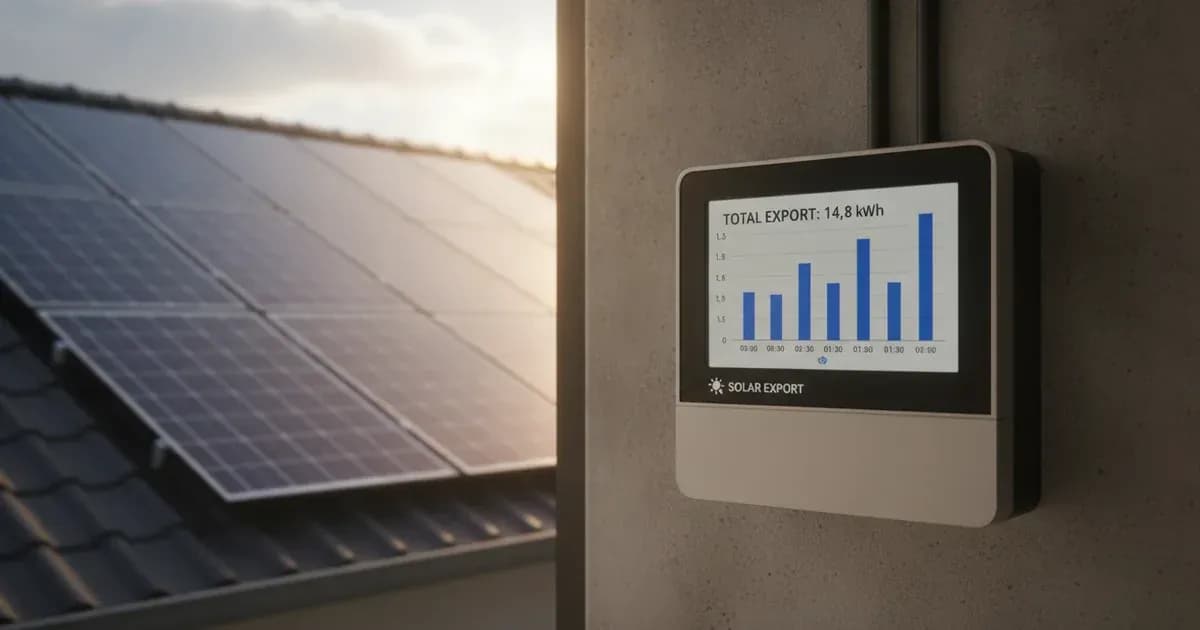
For solar generators, this means that the data used to calculate payments for exported electricity will become more granular. Instead of aggregated daily or monthly figures, your exports will be recorded and reported in 30-minute intervals. This level of detail can provide a more precise understanding of your system's contribution to the grid and how it aligns with market demand.
The Smart Export Guarantee (SEG) and Your Solar Exports
The Smart Export Guarantee (SEG) is a government-backed initiative that launched on 1 January 2020. Its purpose is to ensure that small-scale generators of low-carbon electricity in Great Britain receive payments for the electricity they export to the National Grid. Ofgem is the regulator responsible for the SEG.
To be eligible for SEG payments, your installation must meet specific criteria:
- Location: Installations must be located in Great Britain.
- Technology Types: Eligible low-carbon technologies include Solar photovoltaic (solar PV), Wind, Micro combined heat and power (micro-CHP), Hydro, and Anaerobic digestion (AD).
- Capacity: The total installed capacity (TIC) must be no more than 5MW, or no more than 50kW for micro-CHP.
SEG payments are calculated using export meter readings. You apply for a SEG tariff with a SEG licensee, which does not need to be your current energy supplier. SEG Licensees determine the rate, contract length, and other terms for these tariffs. While these rates must always be above zero, Ofgem does not set a specific export rate. You should check with individual SEG licensees for their current tariff offerings. Ofgem publishes a list of SEG licensees to help you find providers.
Metering Requirements for Exported Electricity
Accurate metering is fundamental for both the Smart Export Guarantee and the upcoming Market-Wide Half-Hourly Settlement. For any electricity supply where a customer is charged by quantity, the supply must be given through an appropriate meter. This applies equally to electricity exported from your solar system.
Here are the key requirements for meters used in Great Britain:
Aspect | Requirement |
|---|---|
Meter Provision | If your authorised supplier agrees, you may provide the meter. Otherwise, the authorised supplier must provide it. |
Meter Approval | No meter can be used to ascertain the quantity of electricity supplied unless it is of an approved pattern or construction, installed in an approved manner, and certified. |
Meter Certification | Meters must be certified by a meter examiner or an authorised person. Certification confirms the meter is of an approved pattern or construction and conforms to prescribed standards, including margins of error. |
These requirements ensure that the data used for calculating your SEG payments, and eventually for MHHS, is reliable and accurate. The shift to MHHS will rely heavily on these certified meters to provide the necessary half-hourly data.
What you can check yourself, and what you cannot
As a solar generator, you can take steps to understand your export metering and SEG arrangements, but you must not interfere with the meter itself.
What you can check yourself:
- Your SEG contract: Review the terms and conditions of your Smart Export Guarantee contract with your chosen SEG licensee. Understand how your payments are calculated and the frequency of payments.
- Your export meter readings: Learn how to read your export meter. Many modern smart meters provide digital displays that show both import and export figures. Regularly checking these readings can help you monitor your system's performance and verify your SEG statements.
- Ofgem's licensee list: Check Ofgem's website for the current list of SEG licensees. This can help you compare different tariff offerings if you are considering switching providers.
- Your energy bills and statements: Ensure that the export data on your statements aligns with your meter readings and the terms of your SEG contract.
What you cannot do yourself:
- Tamper with your meter: It is illegal and unsafe to attempt to modify, bypass, or interfere with your electricity meter. This includes both import and export meters.
- Install or replace your meter: Meter installation and replacement must be carried out by a qualified and authorised professional. Meters must be certified and installed in an approved manner.
- Change meter settings: Do not attempt to alter any settings on your meter. These are configured by your energy supplier or meter operator to ensure accurate measurement and compliance with network rules.
If you suspect an issue with your meter, or if you need clarification on your readings or SEG payments, contact your SEG licensee or energy supplier directly.
What the published sources do not tell you
While the Smart Export Guarantee (SEG) framework is well-defined, specific details regarding the implementation of Market-Wide Half-Hourly Settlement (MHHS) for small-scale solar generators are not fully detailed in the publicly available information.
The sources do not provide:
- Specific details on the implementation timeline for Market-Wide Half-Hourly Settlement (MHHS) as it applies directly to solar generators.
- How MHHS specifically impacts the calculation and payment of SEG tariffs beyond the general requirement for export meter readings.
- The precise role of Distribution Network Operators (DNOs) in MHHS for small-scale solar installations.
- Any specific technical requirements for solar installations to comply with MHHS for export data capture, beyond the general need for an approved and certified meter.
- Information on how balancing mechanisms will interact with half-hourly settled solar exports.
- Detailed content of "Standard Licence Condition 57" mentioned in the Smart Export Guarantee Order 2019.
These aspects are likely to be subject to ongoing industry development and regulatory guidance as the MHHS programme progresses. For the most up-to-date information on MHHS implementation, particularly for solar, you may need to consult industry bodies, energy suppliers, or Ofgem's dedicated MHHS programme updates.
Frequently asked questions
What is the Smart Export Guarantee (SEG)?
The Smart Export Guarantee (SEG) is a government-backed initiative launched on 1 January 2020. It requires certain electricity suppliers, known as SEG Licensees, to pay small-scale generators for low-carbon electricity exported to the National Grid.
How are SEG payments calculated?
SEG payments are calculated using export meter readings. These readings measure the quantity of electricity your eligible installation exports to the National Grid.
Who sets the SEG export rate?
SEG Licensees determine the rate, contract length, and other terms for export tariffs. Ofgem, the regulator, mandates that SEG tariff rates must always be above zero, but does not set a specific rate.
What is Market-Wide Half-Hourly Settlement (MHHS)?
Market-Wide Half-Hourly Settlement (MHHS) is an upcoming change in Great Britain's electricity market that will require all electricity consumption and generation to be settled based on half-hourly meter readings. This aims to improve billing accuracy and grid balancing.
Do I need a smart meter for SEG?
While the SEG does not explicitly mandate smart meters, payments are calculated using export meter readings. An appropriate meter, which is of an approved pattern or construction and certified, is required for ascertaining the quantity of electricity supplied or exported.
References
- Ofgem - Smart Export Guarantee (SEG) — accessed 26 August 2026
- Ofgem - Smart Export Guarantee (SEG) Generators — accessed 26 August 2026
- Legislation.gov.uk - Electricity Act 1989, Schedule 7 — accessed 26 August 2026
- Legislation.gov.uk - Smart Export Guarantee Order 2019 — accessed 26 August 2026
Related guides
More from what to buy — and how not to get cheated.