Growatt Error 300: AC Voltage Out of Range and Volt-Rise Fix
Updated 18 September 2026 · By SolarNevs Research Desk, Dealer surveys + verified sources · 2 sources · Method ↗
Key Takeaways
- Growatt Error 300 indicates that the AC line voltage at the inverter connection terminals has exceeded the permissible range defined by the active safety standard.
- The most frequent cause during sunny weather is volt-rise caused by high solar export pushing against AC cable impedance and an already elevated local grid voltage.
- Diagnosis requires measuring AC line voltage directly at the inverter terminals during the fault and comparing the reading against active grid standard thresholds.
- Resolving persistent overvoltage involves optimizing AC cabling, adjusting export limits, or escalating to the local Distribution Network Operator (DNO) to adjust substation transformers.
Why is my Growatt inverter showing Error 300?
When a Growatt solar inverter displays Error 300 on its screen or triggers an overvoltage alert in the monitoring app, it has detected alternating current grid voltage outside permissible statutory operating limits. To comply with mandatory network protection standards, the inverter instantly opens its grid synchronisation relays, halts generation, illuminates its fault LED, and enters a reconnection delay countdown.
In the UK, domestic distributed generation is governed by statutory voltage thresholds and grid connection engineering standards detailed in our micro-generator grid connection guide.
When the utility grid potential drifts outside allowable tolerances, or when the inverter own export current causes local voltage to rise too high along undersized cables, Error 300 trips the system. Understanding whether the problem is an external network surge or a localized cable impedance bottleneck is the key to achieving permanent resolution.
Root causes of Error 300 on UK solar installations
Growatt technical engineering documentation highlights three primary mechanisms responsible for AC voltage out of range alarms:
Root Cause Mechanism | Physical Condition | Operational Consequence | Corrective Action |
|---|---|---|---|
Utility Grid Voltage Surge | Local DNO network running at or above statutory ceiling | Inverter trips whenever local neighborhood demand falls | Wait for grid voltage stabilization; log data for DNO escalation |
Cable Impedance Volt-Rise | Voltage rise due to high export and AC cable impedance | Voltage climbs specifically at peak solar generation hours | Optimize AC cabling or reduce export if impedance-related |
Safety Configuration Error | Incorrect safety standard configuration programmed | Inverter applies inappropriate trip limits or timing curves | Adjust safety standard or voltage limits if allowed by regulations |
Grid Frequency Fluctuation | Error 304 AC F Outrange during national grid transient | Mains frequency deviates beyond generator tolerances | Restart the inverter after national grid frequency stabilizes |
For properties combining solar generation with battery energy storage or export tariff tracking, unmanaged overvoltage trips interrupt both battery charging cycles and revenue; see our battery storage fire safety guide and Smart Export Guarantee guide.
Step-by-step diagnostic workflow
To isolate the cause of Error 300, technicians execute a disciplined three-phase diagnostic investigation:
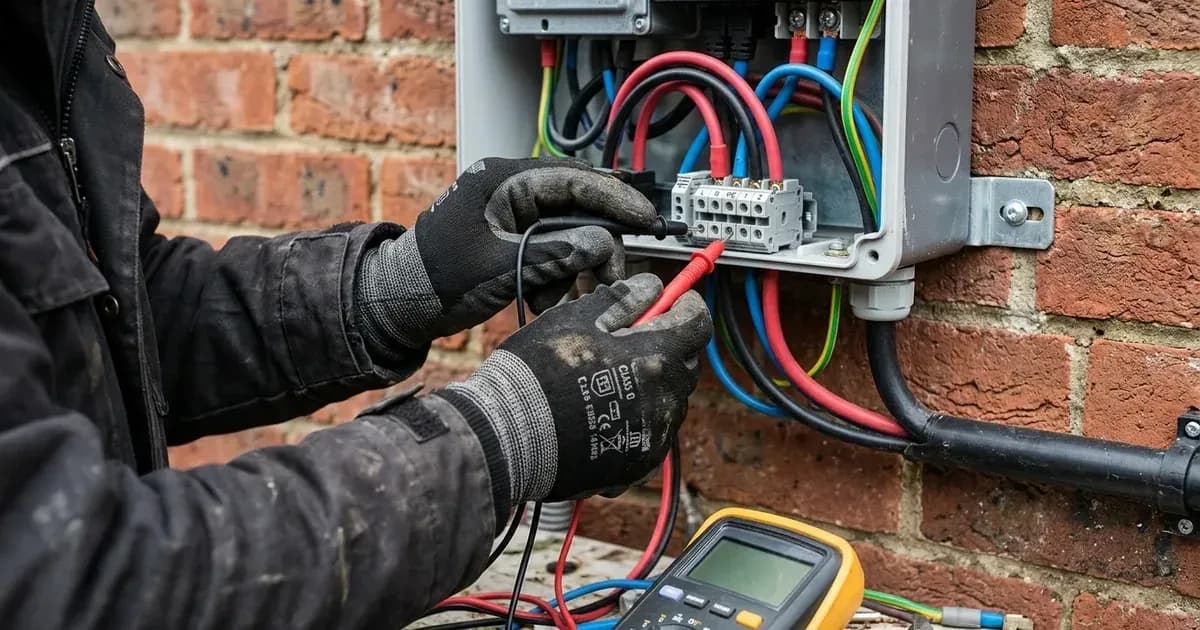
Step 1: Measure live line voltage at inverter terminals
During an active Error 300 event, an electrician must check the line voltage:
- Access the AC isolator or inverter terminal junction box.
- Measure AC voltage at inverter terminals during the fault with an approved multimeter.
- Record line-to-neutral, line-to-earth, and neutral-to-earth potentials.
- If line voltage is within the acceptable range, contact service@growatt.tech to report an internal voltage measurement calibration error.
Step 2: Compare against active safety standard parameters
Review the programmed safety country code within the inverter menu:
- Navigate to the inverter advanced configuration settings.
- Compare against limits of the active safety standard to confirm the unit is programmed for the correct UK grid code.
- Verify that an incorrect safety standard configuration is not imposing restrictive foreign voltage boundaries.
Step 3: Check for grid fluctuations and volt-rise impedance
Determine whether the voltage rise is localized or network-wide:
- Check for grid fluctuations or local impedance issues by measuring voltage at the main consumer unit simultaneously with the inverter terminals.
- If voltage at the inverter is significantly higher than at the consumer unit during peak generation, the cable run between them is dropping excessive potential due to undersized conductor cross-section.
- If voltage at the consumer unit is equally high even when solar generation is completely turned off, the root cause is external DNO network overvoltage.
Practical solutions for Error 300
Depending on the diagnostic findings, resolving Error 300 requires one of four targeted interventions:
1. Wait for grid voltage stabilization
If the trip occurred during an isolated utility network switching event or nearby lightning surge, wait for grid voltage stabilization. The inverter will complete its internal reconnection delay and resume power export automatically once line potential normalizes.
2. Optimize AC cabling to minimize volt-rise
When high cable impedance causes local volt-rise during maximum solar export, electricians must optimize AC cabling or reduce export if impedance-related. Replacing undersized AC wiring with larger cross-sectional copper conductors lowers loop impedance, keeping terminal voltage below the trip threshold. Detailed installation and cable sizing standards are set out in our UK solar electrical installation guide.
3. Implement export limitation
If re-cabling is physically constrained, configure dynamic export management via the inverter menu or external current sensor to cap peak generation during periods of maximum grid voltage.
4. Adjust regulated parameters or escalate to the DNO
Where grid code compliance allows, qualified installers can adjust safety standard or voltage limits if allowed by regulations. If the utility network supply voltage consistently exceeds statutory boundaries at the main meter, the homeowner must submit a formal voltage complaint to the local DNO requesting that substation transformer tap changers be adjusted down.
Safety: alternating current testing precautions
Working around live alternating current mains conductors involves serious electrical shock and arc flash risks:
- Approved test instruments: Voltage measurements must only be performed using calibrated digital meters or two-pole voltage indicators rated for category III or IV electrical environments.
- Proving dead before maintenance: Before performing any re-cabling or terminal tightening, isolate the AC circuit at the main consumer unit and confirm the circuit is dead with a proved voltage tester.
- Qualified personnel only: Maintenance and repair of PV systems, high-voltage DC, and AC components must only be performed by certified professionals with valid electrical qualifications.
When to contact an MCS-certified technician
Homeowners can monitor the inverter display and report error occurrences. However, physical multimeter measurements, cable replacement, and safety standard programming must be performed by an MCS-certified installer.
Escalate to a professional technician under the following circumstances:
- The error occurs daily during peak sunshine: Regular midday trips indicate severe cable volt-rise or elevated local grid voltage requiring formal electrical impedance testing.
- The inverter trips while line voltage is normal: If the measured grid voltage at the terminals is well within acceptable limits, the internal voltage sensing circuit is faulty.
- Frequency errors (Error 304) persist: Persistent frequency faults require verification of network stability.
In case of persistent hardware failure where field wiring and grid voltages are verified within specification, the only authorized path for repair is contacting the official Growatt Service Department at service@growatt.tech.
Frequently asked questions
What does Error 300 mean on a Growatt inverter?
Error 300 indicates that the utility grid voltage exceeds the permissible range defined by the active safety standard. When mains voltage rises above the statutory ceiling or drops below the lower boundary, the inverter halts export and enters reconnection delay.
Why does Error 300 occur during peak sunny afternoons?
Midday solar generation causes local volt-rise along the AC cable between the inverter and consumer unit. If cable impedance is high or the local grid substation is already operating near its upper threshold, high solar export pushes terminal voltage past the trip limit.
How do you test for Growatt Error 300?
A qualified technician measures the AC voltage directly at the inverter terminals during an active fault, compares the measured potential against the safety standard limits, and checks for local grid fluctuations or cable impedance issues.
What does Error 304 indicate on a Growatt inverter?
Error 304 indicates AC F Outrange, meaning the mains utility grid frequency has drifted outside permissible operating boundaries. The inverter disconnects and restarts once frequency stabilizes.
References
- Growatt Technical Support: Error 300 AC Voltage Out of Range Diagnostics — accessed 29 August 2026
- Growatt MOD XH BP Inverter Error Description and Triage Guide — accessed 29 August 2026
Related guides
More from inverter errors & fixes.