UK Solar Panel Payback Period: Regional Timelines & Economics
Updated 18 September 2026 · By SolarNevs Research Desk, Dealer surveys + verified sources · 1 source · Method ↗
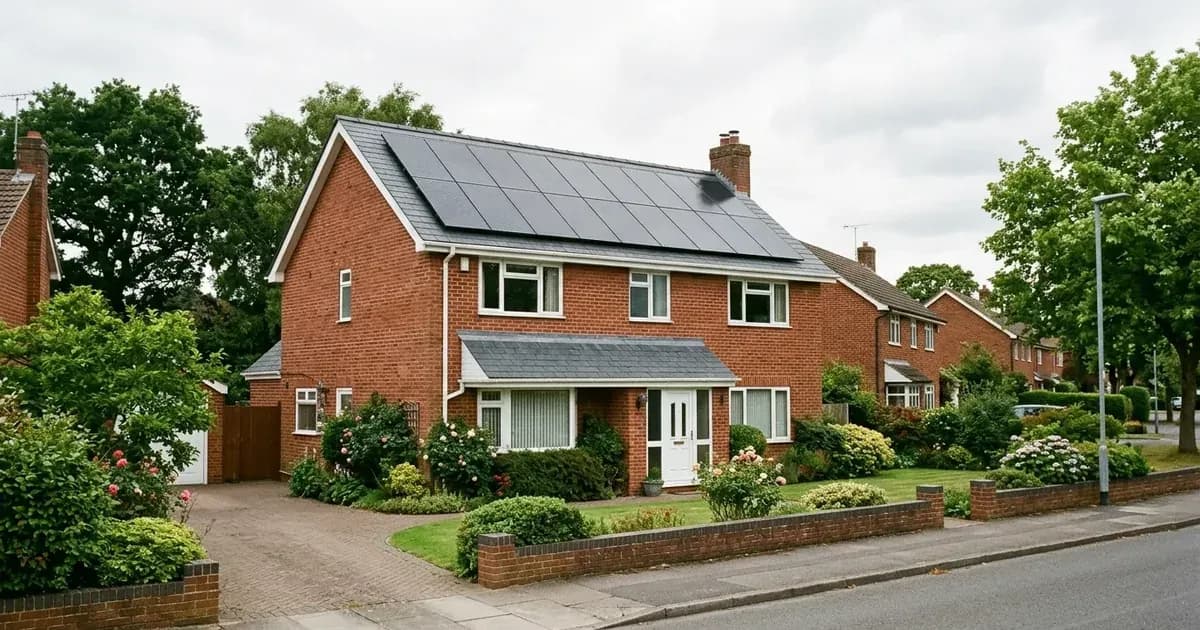
Assessing the financial viability of domestic photovoltaic systems requires an understanding of regional solar irradiation, initial capital outlay, and household electricity usage patterns. While promotional marketing often cites generalized returns, authoritative benchmarks from the Energy Saving Trust establish a verified payback envelope across England, Scotland, and Wales.
For a standard residential dwelling, an average home solar panel system costs around £7600 to install and delivers an average solar panel system capacity of around 4.5 kilowatt peak (kWp). This capital investment covers equipment procurement, scaffolding, electrical connection, and certification.
Architecturally, a 4.5kWp system typically covers between 20 to 30m 2 of roof surface area typically using around 12 panels. Understanding how this investment translates into bill reduction requires examining regional geography, export rates, and occupancy dynamics.
Geographic Irradiance and Orientation Factors
Solar generation across Great Britain varies primarily by latitude and orientation. Systems situated in the southern counties of England receive higher annual solar irradiation than properties situated in northern England or Scotland.
Roof orientation remains a critical operational determinant. While an unshaded south-facing pitch provides optimal yield, east- and west-facing arrays deliver functional generation throughout morning and afternoon hours. According to Energy Saving Trust modeling, a system facing east or west tends to get around 15-20% less energy than one facing directly south. Installations on north-facing pitches are systematically discouraged due to poor irradiance capture.
The widespread adoption of residential generation reflects these practical economics. According to UK government data there are nearly 1.7 million installations on homes across the UK. Homeowners deploying microgeneration benefit from immediate bill mitigation and environmental benefits. A typical home solar panel system could save around one tonne of carbon per year depending on where you live in the UK, representing an environmental offset equivalent to driving 3600 miles or traveling from London to Bristol 30 times.
Regional Payback Matrix Across the UK
The duration required for a solar panel system to offset its capital cost through energy savings and grid export depends heavily on household routine. Self-consuming electricity yields maximum financial benefit by displacing grid electricity purchased at regulated tariff prices, whereas unconsumed daytime power is channeled to the grid.
Exported electricity is remunerated through the Smart Export Guarantee (SEG). Under typical supplier arrangements, you will get around 12p for every unit that you do not use yourself through the smart export guarantee. Because retail import rates significantly exceed this credit, homes with higher daytime self-consumption experience shorter payback windows.
The following table summarizes the official Energy Saving Trust payback duration across representative UK geographic centers and household occupancy patterns:
Location | Home All Day | Home Half the Day | Out All Day |
|---|---|---|---|
London | 9 years | 9 years | 9 years |
Manchester | 10 years | 10 years | 11 years |
Aberystwyth | 9 years | 9 years | 10 years |
Stirling | 11 years | 11 years | 12 years |
These metrics represent a solar panel payback period with export payments, with figures based on fuel prices as of July 2026 across England, Scotland, and Wales.
In southern locations such as London, higher solar yields enable consistent amortisation within 9 years regardless of daytime occupancy. In northern latitudes such as Stirling, payback extends to 11 years for homes occupied throughout the day, and 12 years for households vacant during peak daylight hours where a greater proportion of generation is exported at the 12p rate.
System Longevity and Lifecycle Costs
Accurate payback calculations must account for the distinct operational lifespans of system components. While solar panels represent the primary asset, power conversion hardware operates under different mechanical and thermal stresses.
Your solar panels should last 25 years or more. Modern photovoltaic modules demonstrate minimal degradation over multiple decades of exposure. However, central string and hybrid inverters contain high-frequency switching electronics that bear continuous operational loads. Installers advise that if you have a solar inverter you need to replace this after around 12 years.
This mid-life inverter replacement must be factored into long-term financial modeling. When evaluating new installations, consumers should note that most inverters have warranties of five years as a minimum, with options to extend coverage up to 15 years. However, extended warranty contracts often approach the outright cost of a modern replacement unit, making careful evaluation essential.
System maintenance remains minimal over the asset lifecycle. In the UK rain will clean your panels if they are tilted at 15 degrees or more, ensuring that typical pitched roofs naturally wash away surface dust. By maintaining unobstructed solar arrays and pairing generation with smart tariffs, UK households achieve complete capital recovery well within the operating lifespan of the installation.
Frequently asked questions
How long does it take for solar panels to pay for themselves in the UK?
Based on Energy Saving Trust benchmarks using July 2026 fuel prices, typical domestic solar PV systems pay for themselves in 9 to 12 years depending on location and home occupancy.
What is the typical cost of an average UK domestic solar installation?
An average domestic solar panel system has a capacity of around 4.5 kWp (around 12 panels) and costs approximately £7,600 to install.
Does household daytime occupancy affect the solar payback period?
Yes, consuming solar power directly on-site displaces retail electricity imports, delivering faster financial returns than exporting surplus power at standard export rates.
References
- Energy Saving Trust Solar Panels Guide — accessed 29 August 2026
Related guides
More from schemes, subsidies & financing.