How Many Solar Panels Do I Need UK: Domestic Sizing Guide
Updated 18 September 2026 · By SolarNevs Research Desk, Dealer surveys + verified sources · 2 sources · Method ↗
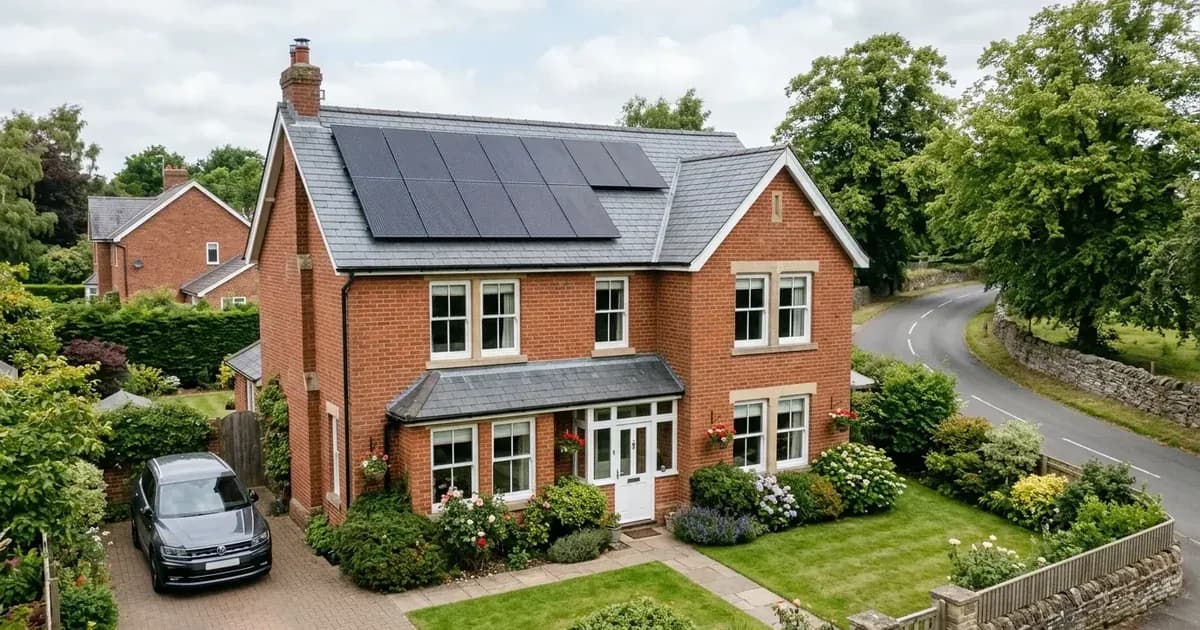
Determining the appropriate number of solar photovoltaic panels for a British residential property requires balancing household electricity demand, available roof geometry, orientation azimuth, and statutory grid connection thresholds. Installing too few panels leaves household appliances reliant on expensive grid imports during daylight hours, while oversizing an array beyond domestic consumption patterns without battery storage spills surplus energy onto the grid at lower export rates.
In the United Kingdom, residential solar engineering is governed by national standards published by the Microgeneration Certification Scheme (MCS) and empirical benchmarks compiled by the Energy Saving Trust (EST). By evaluating household load profiles against standard module specifications and regulatory export boundaries, homeowners can accurately calculate the optimal panel quantity for their dwelling.
<Callout type="info" title="Key Takeaways: UK Solar Panel Sizing">
- Benchmark Panel Quantity: An average UK residential installation utilizes around 12 panels to deliver a standard 4.5 kWp solar array.
- Roof Surface Area: Mounting a 12-panel system requires between 20 to 30m 2 of contiguous, unshaded pitched or flat roof space.
- Orientation Derating: Roofs facing east or west generate approximately 15-20% less annual energy than direct south-facing orientations.
- Statutory Installation Standard: Domestic design, sizing, and commissioning adhere to Microgeneration Installation Standard MIS 3002 ISSUE 6.0 (effective Date: 18/03/2026) up to a 50kWp maximum DC output.
- Grid Notification Boundary: Single-phase inverters up to and including 16 A per phase connect under EREC G98; setups exceeding 16 A require prior DNO approval under EREC G99.
- Transparent Self-Consumption: Installers must calculate self-consumption in accordance with MCS MGD 003 methodology, quoting figures for solar alone versus paired battery storage.
</Callout>
Benchmark Domestic Sizing: The 12-Panel 4.5 kWp Standard
For the vast majority of three- and four-bedroom detached and semi-detached properties in the UK, system sizing has converged around a well-defined technical baseline:
Domestic solar panel systems are around 4.5 kWp and cost around £7600*.
To achieve a 4.5 kWp nominal peak DC rating, modern installations deploy high-efficiency monocrystalline silicon modules. With current residential panels delivering between standard module wattages, an array requires approximately 12 panels arranged in one or two electrical series strings.
Spatial Footprint & Roof Sizing
Evaluating whether a dwelling has adequate physical capacity involves calculating contiguous roof dimensions:
- Aperture Requirements: An array of 12 panels typically occupies between 20 to 30m 2 of roof surface area. A standard domestic panel measures approximately 1.72 m in height by 1.13 m in width (roughly 1.95 square meters per panel). Allowing for boundary clearances from eaves, ridges, and verges, a roof face measuring at least 6 meters wide by 4 to 5 meters in rafter length is required.
- Flat Roof Mounting Architecture: Where properties feature flat dormers, garage roofs, or modern extensions, arrays cannot be mounted flush. Installers utilize aerodynamic mounting consoles where systems are weighted down rather than fixed through the roof covering. These ballast systems tilt panels at aerodynamic angles, requiring wider inter-row spacing to avoid row-to-row shading.
Sizing Parameter | Standard Value | Engineering Context |
|---|---|---|
Benchmark System Output | 4.5 kWp | Maximum DC rating at standard test conditions |
Typical Module Count | 12 panels | Standard monocrystalline residential modules |
Roof Surface Area | 20 to 30 m2 | Minimum contiguous clear roof area |
Standard Cost Benchmark | ~£7,600 | Complete turn-key domestic installation |
Micro-Generation Grid Threshold | 16 A per phase | Single-phase limit for EREC G98 connection |
Standard Scope Ceiling | 50 kWp | Maximum capacity governed by MIS 3002 Issue 6.0 |
Roof Orientation, Pitch & Shading Sizing Factors
A crucial step in calculating panel requirements is assessing the property's solar exposure. While roof pitch between 30 and 40 degrees is ideal across the UK, orientation significantly affects harvest yields.
Evaluating Compass Heading (Azimuth)
- South-Facing Elevation: Provides peak solar irradiance at solar noon, maximizing midday generation.
- East-West Elevations: Properties with pitched roofs running north-to-south split their panels across east and west roof planes. A system facing east or west tends to get around 15-20% less energy than one facing directly south. However, this configuration flattens the generation curve, producing power in the early morning and late afternoon when domestic demand peaks. To achieve the same annual kilowatt-hour yield as a south-facing array, homeowners with an east-west roof typically install 2 to 4 additional panels.
Shading Mitigation & String Architecture
Obstructions such as chimneys, neighbouring dormers, or mature deciduous trees cast localized shadows that can disproportionately reduce string output. Under MCS standards, installers must carry out an explicit shading analysis:
- DC Optimisers: Modern systems can minimise the impact of shading using ‘optimisers’. Fitting module-level power electronics allows unshaded panels to continue operating at maximum power point even if adjacent panels suffer partial shade.
```
ROOF ORIENTATION SIZING DYNAMICS
═══════════════════════════════════════════════
Direct South (Optimal): 100% Benchmark Yield
South-East / South-West: ~95% Benchmark Yield
East / West Split: 80% - 85% Benchmark Yield
(Requires 15-20% larger array to match annual output)
```
Regulatory Framework: MCS MIS 3002 Issue 6.0
Residential solar design and installation in the United Kingdom is governed by Microgeneration Installation Standard MIS 3002 ISSUE 6.0, formally enacted with document control Date: 18/03/2026.
Capacity Boundaries & Quality Mandates
The standard establishes the strict boundaries within which domestic contractors operate:
- System Capacity Limit: The standard applies to contractors undertaking the supply, design, installation, set to work, commissioning and handover of solar photovoltaic (PV) systems supplying permanent buildings and normally connected in parallel to the electricity distribution network up to a maximum DC output of 50kWp.
- Arc Fault Circuit Interruption: Fire safety rules dictate that 5.6.7 Where present, any arc fault detection function within the inverter shall be enabled, ensuring automated tripping if DC series arcing occurs.
Grid Connection Thresholds: EREC G98 vs EREC G99 Rules
A primary technical constraint when calculating how many panels to install is the capacity of the local electricity distribution network. In the UK, electrical connections are regulated by the Energy Networks Association (ENA):
Single-Phase 16A Threshold
- EREC G98 Notification: Under MIS 3002 rules, systems up to and including 16 A per phase shall connect under Engineering Recommendation EREC G98. On a standard domestic single-phase supply, this 16 A threshold establishes the simplified connection boundary. This connection route operates under "fit and inform," allowing the installer to commission the system and notify the Distribution Network Operator (DNO) following commissioning.
- EREC G99 Application: Engineering Recommendation EREC G99 applies to all systems exceeding 16 A per phase. Where a homeowner seeks to install an expanded residential array exceeding the standard microgeneration limit, formal permission must be granted by the DNO before commissioning.
Combined Solar PV & Battery Inverter Aggregation
Homeowners frequently pair solar panels with stationary battery storage. Sizing must account for combined theoretical output:
Where an inverter and battery storage system connected in parallel have a combined maximum theoretical output greater than 16 A, EREC G99 shall apply.
If a property installs an inverter alongside a separate AC-coupled battery inverter and their combined potential discharge exceeds 16 A, this automatically triggers EREC G99 connection procedures.
Consumer Quotation Transparency: MGD 003 Self-Consumption
To prevent misleading performance claims, MCS standards enforce rigorous pre-sale calculation methodologies:
- Mandatory MGD 003 Calculation: An estimate of self -consumption shall be calculated in accordance with MGD 003: ‘Determining the Electrical Self -Consumption of Domestic Solar Photovoltaic (PV). Contractors cannot rely on arbitrary self-consumption percentages; calculations must match household occupancy profiles and annual kilowatt-hour demand.
- Separate Storage Quoting: Installers must present transparent quotation splits, explicitly displaying Expected solar PV self-consumption (PV Only) kWh alongside paired battery performance estimates.
By calculating spatial roof constraints, orientation deratings, and EREC G98 grid thresholds against the benchmark 12-panel 4.5 kWp standard, UK homeowners can specify a solar PV system perfectly matched to domestic consumption requirements and regulatory compliance standards.
Frequently asked questions
How many solar panels does a typical UK house need?
An average UK domestic installation uses around 12 panels to construct a benchmark 4.5 kWp array, delivering substantial year-round clean energy.
How much roof space is needed for a domestic solar panel system?
A standard domestic system requires between 20 to 30m 2 of unshaded roof surface area to accommodate 12 modern photovoltaic panels.
What is the single-phase grid connection threshold for UK solar?
Installations up to and including 16 A per phase connect under simplified EREC G98 notification, while systems exceeding 16 A require prior EREC G99 approval.
How must contractors calculate expected solar self-consumption?
Under MCS MIS 3002, contractors must calculate self-consumption in accordance with methodology MGD 003, presenting separate estimates for PV alone and PV paired with battery storage.
References
- Energy Saving Trust Solar Panels Advice and Sizing Guide — accessed 29 August 2026
- MCS Microgeneration Installation Standard MIS 3002 Issue 6.0 — accessed 29 August 2026
Related guides
More from sizing, net billing & installation.