AC-Coupled vs DC-Coupled Solar Battery Storage Guide UK
Updated 18 September 2026 · By SolarNevs Research Desk, Dealer surveys + verified sources · 2 sources · Method ↗
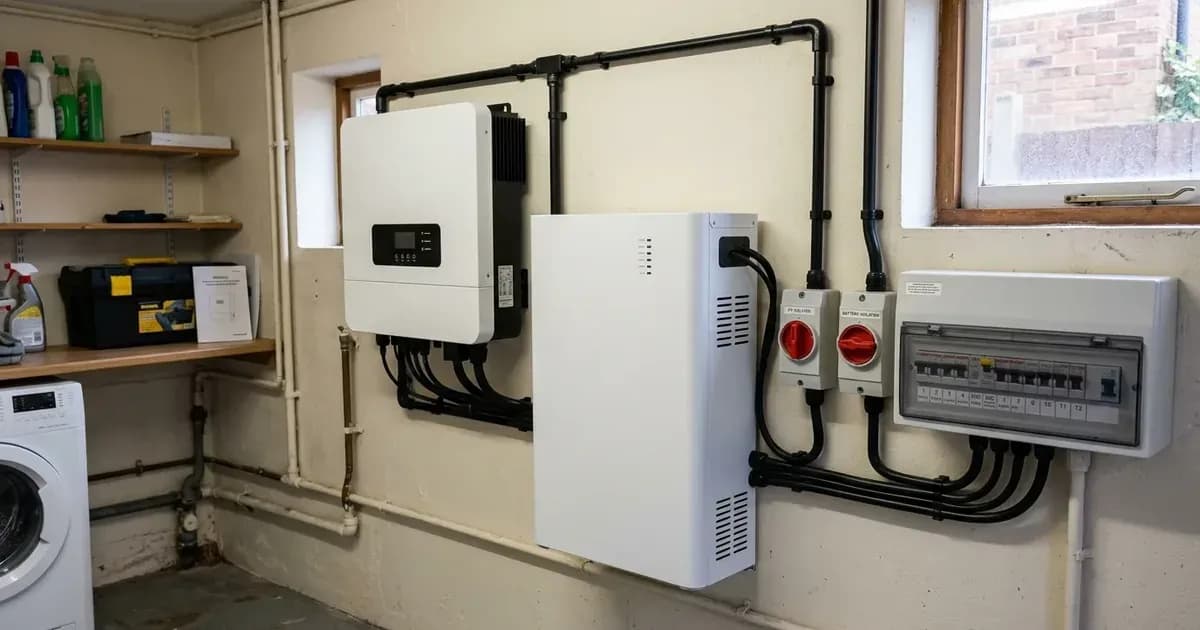
Key Takeaways
- AC-coupled battery storage systems act as an independent node between the household AC board and battery bank, making them the optimal retrofit solution for existing UK solar arrays.
- DC-coupled hybrid inverters integrate solar PV string conversion and battery management into a single chassis, delivering higher combined round-trip efficiency on new solar installations.
- Dedicated AC battery inverters (such as the GivEnergy AC-Coupled 3kW unit) utilize low-voltage battery architecture (45V - 58V range) with a 60A charge current and 96.5% European efficiency.
- Modern high-voltage hybrid inverters (such as the GivEnergy Gen 3) operate at 340VDC nominal battery voltage with up to 10000W continuous charge/discharge capability and 97.6% peak PV efficiency.
- Single-phase domestic installations in the UK must adhere to ENA connection rules: combined generation and battery export exceeding 3.68kW per phase requires prior DNO approval under G99 rather than standard G98 notification.
Architectural Fundamentals: AC Coupling vs DC Coupling
When installing residential energy storage in Great Britain, homeowners and installers face a foundational architectural choice: AC-coupled storage or DC-coupled hybrid systems. Understanding how power flows between photovoltaic modules, chemical battery cells, the domestic consumer unit, and the national grid is essential for optimizing system performance, capital expenditure, and regulatory compliance.
How AC-Coupled Battery Systems Operate
An AC-coupled storage system operates independently of the solar photovoltaic array. The existing solar panels connect to their own string inverter, which converts direct current (DC) into alternating current (AC) at 230V for consumption by household appliances.
The AC-coupled battery system connects directly to the domestic consumer unit through a dedicated AC circuit. According to official manufacturer specifications, an AC-coupled inverter functions by "acting as a node between your existing solar or AC supply and battery setup". When the home generates surplus solar electricity or accesses low-cost off-peak grid tariffs (such as overnight smart EV tariffs), the AC battery inverter draws AC power, rectifies it to DC, and stores it in the battery. GivEnergy notes that "this intelligent system is the key to lower bills, reduced grid reliance, and maximum energy efficiency." The hardware is "Solar, wind, hydro and grid compatible" with "Optimized Smart Energy Management". When household demand exceeds generation, the unit inverts stored DC back into 230V AC to supply domestic loads.
A prime UK engineering benchmark is the GivEnergy AC-Coupled Inverter:
- Continuous AC Output: 3kW Max AC output with 3kW Nominal AC Power rating.
- Apparent Power: 3.2kVA maximum apparent power rating.
- Current Handling: 13A Max output current under single-phase supply.
- Operating Voltage: 230V nominal operating voltage, accommodating a wide 202V - 262V range.
- Grid Frequency: 50Hz grid frequency with a (+-5Hz) operational window.
- Battery Voltage Window: Low-voltage DC operation across a 45V - 58V range.
- Current Flow: 60A maximum charging and discharging current to the battery bank.
- Efficiency: 96.5% European weighted efficiency rating.
- Physical Properties: IP65 ingress protection chassis weighing 22.4Kg, backed by a 12 Year Warranty.
How DC-Coupled Hybrid Systems Operate
By contrast, a DC-coupled hybrid inverter combines both functions in a single piece of power electronics. As documented by GivEnergy, "This model [ 10.0|8.0 ] is only compatible with the stackable battery." Furthermore, "Additionally, it will minimise import by discharging to meet demand in the property." The system delivers "Charge / Discharge Efficiency 96% / 96%" across high-voltage battery storage cycles.
In a hybrid configuration, DC electricity produced by rooftop solar panels enters the inverter and can flow directly into the battery bank across a shared DC bus without undergoing AC conversion. Power only converts from DC to AC once when serving household appliances or exporting to the grid. This direct DC-to-DC charging pathway reduces conversion losses.
Key engineering benchmarks for modern residential hybrid systems include:
- Photovoltaic Input: 600V maximum DC PV input voltage, an 80V start-up voltage, and up to 15000W maximum PV array DC input capacity across dual MPPT trackers.
- Battery Operating Voltage: High-voltage battery architecture with 340VDC nominal voltage.
- Power Capability: 10000W / 10500W maximum charge and discharge capability with 30A / 30A current limits.
- Inverter Efficiency: 97.6% maximum photovoltaic conversion efficiency, 97% European efficiency, and 99.9% MPPT tracking efficiency.
- Emergency Power: Integrated backup terminal providing 10ms automatic switchover during grid failure.
- Chassis & Safety: Integrated AFCI arc fault protection, 36kg unit weight, and compliance with G99 and G100 engineering recommendations.
Architectural Parameter | AC-Coupled Storage (e.g. GivEnergy 3kW) | DC-Coupled Hybrid (e.g. GivEnergy Gen 3) | UK Installation Consideration |
|---|---|---|---|
Inverter Configuration | Separate dedicated battery inverter | Integrated solar and battery unit | AC requires space for two inverters in retrofits |
Primary Application | Retrofit to existing MCS solar PV arrays | New installations or full inverter replacements | AC avoids disturbing existing FiT meters |
Nominal Battery Voltage | Low-voltage battery architecture (45V - 58V range) | High-voltage 340VDC nominal architecture | HV batteries require smaller cable cross-sections |
Continuous Power Output | 3kW AC continuous (3.2kVA apparent) | 10000W continuous AC output | 3kW fits within G98; 10kW requires G99 approval |
Max Battery Current | 60A continuous DC current | 30A / 30A continuous DC current | Higher current in low-voltage systems requires heavy-gauge cabling |
Peak PV Conversion Efficiency | N/A (coupled on AC busbar) | 97.6% maximum PV efficiency (97% Euro) | Hybrid achieves higher solar-to-battery yields |
Inverter Unit Weight | 22.4Kg compact chassis | 36kg integrated power electronics | Structural mounting assessment required |
Ingress Protection Class | IP65 outdoor/indoor rated | IP65 outdoor/indoor rated | Suitable for garage or exterior wall mounting |
Manufacturer Warranty | 12 Year Warranty | 12 Year Warranty | Long-term investment protection |
Efficiency Comparison: Round-Trip Conversion Pathways
The core operational distinction between AC-coupled and DC-coupled systems lies in the conversion steps required to store and use solar energy:
- DC-Coupled Solar Charging Pathway: Rooftop DC solar energy passes directly through the hybrid inverter's MPPT charge controller to charge the high-voltage battery. This DC-to-DC transition avoids AC inversion losses entirely. Power is converted from DC to AC only when discharged to power domestic appliances.
- AC-Coupled Solar Charging Pathway: Rooftop DC solar electricity is first converted to 230V AC by the existing solar string inverter. To store this surplus, the AC battery inverter draws 230V AC from the consumer unit, rectifies it to DC (operating at 96.5% European efficiency), and pushes up to 60A into the 45V - 58V battery bank. When discharging in the evening, the battery inverts DC back to 230V AC. This triple conversion incurs higher round-trip losses than direct DC hybrid storage.
- Grid Off-Peak Charging Comparison: When charging batteries overnight from low-cost off-peak tariffs, both systems perform identical single conversions: drawing 230V AC from the grid and converting it to DC for battery storage. In this operating mode, the efficiency difference between AC-coupled and hybrid hardware is negligible.
UK Grid Compliance: ENA G98 vs G99 and DNO Notification
In the United Kingdom, connecting any inverter-based generation or storage system to the distribution network is governed by Energy Networks Association (ENA) Engineering Recommendations:
- ENA EREC G98 Fast-Track: Domestic properties connecting generation equipment with an aggregate export capacity of up to 16A per phase (3.68kW at 230V) qualify for "Fit and Inform" under G98. An installer commissions the system and submits documentation to the District Network Operator (DNO) within 28 days without requiring prior engineering consent.
- The AC-Coupled Retrofit Trap: If a home already possesses an operational 3.68kW solar PV string inverter, adding a separate 3kW AC-coupled battery inverter increases total potential inverter capacity beyond standard single-phase limits. Even though the battery primarily charges during daylight, both inverters are physically capable of discharging to the grid simultaneously. Consequently, the addition of an AC battery inverter breaches the 3.68kW single-phase G98 threshold and requires formal prior application under ENA EREC G99.
- ENA EREC G100 Export Limitation: To prevent expensive network reinforcement charges or DNO connection refusals, installers deploy G100-certified export limitation schemes. By placing an external current transformer (CT) clamp on the incoming meter tails, the system monitors net grid exchange. If household export approaches the DNO-mandated ceiling (such as 3.68kW), the inverter dynamically curtails solar export or directs generation into battery storage within 5 seconds.
Sizing and Selection: Which System Should You Install?
Selecting between an AC-coupled and hybrid storage setup depends on your existing home infrastructure:
- Select AC-Coupling If You Have an Existing Solar Array: If your home already has solar panels installed under the Feed-in Tariff (FiT) or a recently installed MCS string inverter under warranty, retrofitting an AC-coupled unit (such as a 3kW / 3.2kVA system with a 45V - 58V battery) is the most cost-effective path. It avoids replacing a perfectly functional solar inverter, avoids disturbing MCS generation meter wiring, and enables independent system monitoring.
- Select DC-Coupled Hybrid If Installing Solar from Scratch: For new solar installations, a hybrid inverter is the superior engineering choice. Combining solar string MPPTs (supporting up to 600V array voltage) and battery storage in a single 36kg chassis eliminates redundant hardware, provides up to 97.6% PV efficiency, and delivers seamless 10ms emergency power supply during grid interruptions.
Frequently asked questions
What is the primary difference between AC-coupled and DC-coupled solar batteries?
An AC-coupled battery operates via a separate dedicated battery inverter connected to the household AC board, while a DC-coupled hybrid inverter combines solar PV and battery management within a single chassis.
Which battery configuration is best for retrofitting an existing UK solar array?
AC coupling is the standard choice for retrofits because it attaches directly to the domestic consumer unit without disturbing existing MCS-certified string inverters or FIT generation meters.
What is the typical battery voltage difference between AC and DC systems?
Traditional AC-coupled retrofit inverters utilize low-voltage batteries operating between 45V and 58V, whereas modern hybrid inverters utilize high-voltage batteries operating at 340VDC nominal.
How do conversion efficiencies compare between hybrid and AC-coupled inverters?
Hybrid inverters achieve up to 97.6% PV efficiency by routing DC solar directly to the battery, whereas AC systems undergo DC-AC-DC conversion cycles with around 96.5% European efficiency.
References
- GivEnergy AC-Coupled Inverter Datasheet & Product Specification — accessed 29 August 2026
- GivEnergy Hybrid Inverter Gen 3 Technical Specification — accessed 29 August 2026
Related guides
More from sizing, net billing & installation.