UK Solar Panel Low Pitch Roof Installation Guide: Down to 14 Degrees
Updated 18 September 2026 · By SolarNevs Research Desk, Dealer surveys + verified sources · 2 sources · Method ↗
Key Takeaways
- Specialist roofing membranes allow the installation of roof-integrated solar panels down to 14 degrees, well below the standard 20-degree MCS012 test threshold.
- Capillary action represents the primary water ingress threat on shallow pitches because surface tension pulls wind-driven rainwater upwards against gravity.
- Approved underlay membranes include Doerken Delta Exxtrem (with a 30-year guarantee) and DuPont Tyvek Supro (with a 15-year guarantee).
- Penetrations from batten nails and solar bracket screws must be fully sealed by installing membranes with a drape and applying proprietary butyl tape along rafters.
Can Solar Panels Be Installed on Low-Pitch Roofs in the UK?
Yes. Solar panels can be safely installed on low-pitch roofs across the United Kingdom, provided that specialized engineering details are implemented to safeguard against water ingress. Under standard building regulations and testing protocols, Clearline Fusion has been tested to and passed the water ingress test for MCS012 at a minimum pitch angle of 20 ° in accordance with PD CEN/TR 15601:2012. While traditional pitched roof arrays discussed in our UK domestic tiled roof solar mounting systems guide operate reliably at 30 to 45 degrees, modern residential extensions, rear additions, and dormers frequently feature shallow roof pitches between 14 and 19 degrees.
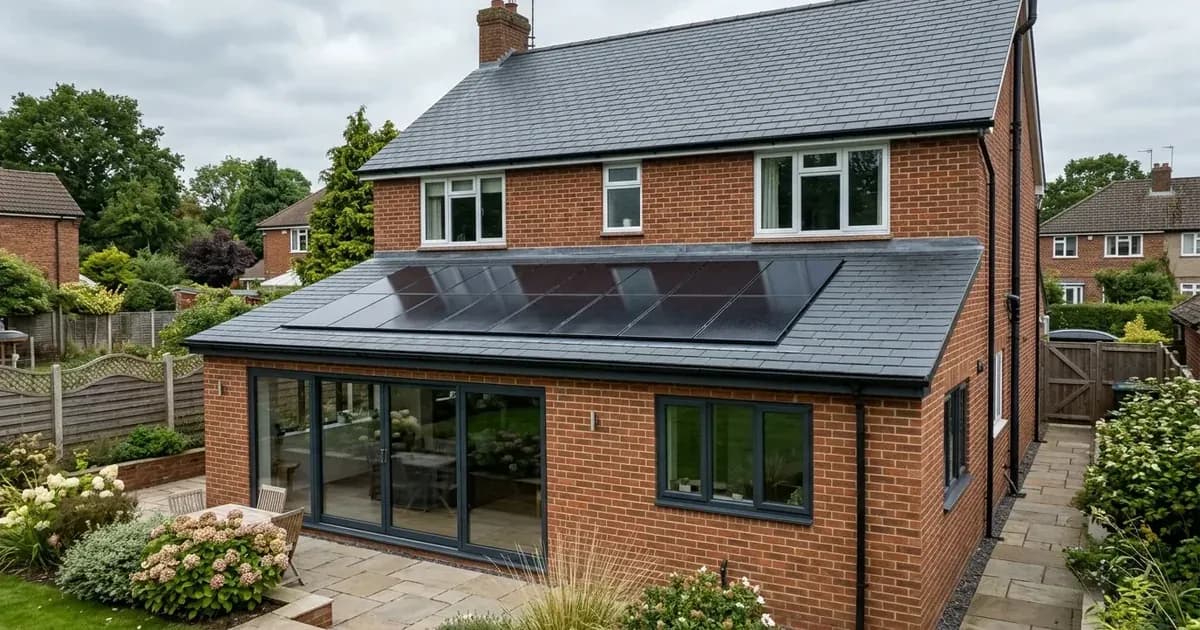
To address these architectural applications, Viridian Solar collaborated with specialist roofing membrane manufacturers to allow the installation of Clearline fusion roof integrated solar panels to roofs with pitch angles down to 14 degrees. Achieving weathertight reliability at shallow slopes requires replacing standard breathable underlay felts with high-performance membranes and applying dedicated rafter sealing details.
Understanding Capillary Action and Water Ingress on Shallow Pitches
On shallow roof slopes, rainwater drainage velocity decreases significantly. At low roof pitch angles capillary action increases the risk that flashing around roof integrated solar PV panels may leak. This structural risk is amplified in exposed geographical areas prone to extreme conditions of wind-driven rain, such as coastal regions in Western Scotland, Wales, and South West England.
Capillary action occurs when a liquid flows through a narrow space without any external force driving it, or against an external force holding it back, for example gravity. In building construction, this fluid dynamic is governed by surface tension acting between rainwater and adjacent roofing components:
- Reduced Gravity Resistance: Between lapped roofing elements, water can advance further against gravity because the accompanying height gain is lower than that for steeper roofs.
- Wind Pressure Head: Wind-driven rain drives moisture horizontally into microscopic gaps between side flashing channels, head flashings, and roofing tiles.
- Lapped Flashing Siphonage: Water drawn between overlapping metal flashing sheets travels upward until it bridges over the drainage upstand if secondary containment is inadequate.
Comprehensive details on standard in-roof flashing kits are documented in our UK in-roof solar mounting systems guide.
Specialist Low-Pitch Membrane Specifications: Delta Exxtrem vs Tyvek Supro
The core engineering solution for shallow pitches involves upgrading the secondary weatherproofing barrier. Replacing the standard roofing underlay with a specialist low pitch underlay provides protection against leakage at roof pitches below the standard minimum of 20 °. This detail may also be considered for roofs close to the minimum pitch (below 25°) and subject to additional risk factors such as a highly exposed location or older, uneven (non-planar) roofs.
Two specialist underlay products have been tested and approved for use with Clearline fusion roof integrated solar PV arrays:
Engineering Parameter | Doerken Delta Exxtrem | DuPont Tyvek Supro | Standard Roofing Felt |
|---|---|---|---|
Minimum Pitch Angle | Down to 14 degrees | Down to 15 degrees | 20 degrees |
Manufacturer | Doerken | DuPont | Generic suppliers |
Operational Temperature Range | -40ºC to +80ºC | -40ºC to +100ºC | -10ºC to +60ºC |
Short-Term Peak Temperature | 8 hour max 150ºC | Not specified | Heat degradation risk |
Reaction to Fire Rating (EN 13501-1) | Euroclass B-s1,d0 | Class E | Unrated or Class F |
Manufacturer Product Guarantee | 30 years | 15 years | 5 to 10 years |
Breathability Classification | Ventilation Class LR (Low Resistance) | Ventilation Class LR (Low Resistance) | Varies |
Doerken Delta Exxtrem represents the highest specification membrane, delivering an exceptional temperature withstand of 8 hour max 150ºC, Euroclass B-s1,d0 fire safety, and a 30-year manufacturer warranty. DuPont Tyvek Supro provides robust performance down to 15 degrees with an operating envelope of -40ºC to +100ºC backed by a 15-year guarantee.
Mechanical Rafter Sealing and Butyl Tape Installation
Even the most advanced membrane will fail if mechanical penetrations allow water to bypass the drainage plane. When installing roof-integrated solar arrays on low pitches, hundreds of mechanical fasteners penetrate the underlay to secure tile battens and panel mounting brackets.
To eliminate leak paths, the membrane should be installed in accordance with the manufacturer's instructions. These require that the membranes are installed with a drape and a proprietary butyl tape applied along the rafters to seal penetrations made when nailing the tile battens and fixing the Clearline fusion rafter brackets.
The execution workflow follows strict sequence:
- Lay the specialist underlay across rafters with a controlled drape between timbers to channel moisture away from batten fixings.
- Apply continuous strips of heavy-duty butyl sealing tape directly along the top center line of every timber rafter.
- Fix the PV16-445AG-M10 rafter mounting brackets directly through the butyl tape into the structural timbers. As the screws compress the bracket foot, the butyl compound self-heals around the fastener shank, forming an impermeable compression seal.
- Nail down horizontal tile battens through the butyl barrier to maintain sealed penetrations across the entire roof envelope.
Both approved specialist underlays satisfy Ventilation Class LR (Low Resistance), ensuring that indoor moisture vapor escapes freely into the batten cavity while liquid water is barred from entering the building fabric.
Hardware Selection and Flat Roof Alternatives
On pitched residential roofs, the Clearline Fusion platform utilizes the high-efficiency PV16-445AG-M10 monocrystalline module. The sleek all-black aesthetics integrate seamlessly with surrounding slate or concrete roof tiles, presenting a flush profile that minimizes wind turbulence across low-pitch roof planes.
When roof slopes fall below 14 degrees, in-roof BIPV integration is no longer permitted under UK building standards. For flat roofs and low-slope surfaces from zero to ten degrees, property owners must utilize ballasted aerodynamic framing or mechanical stanchions as outlined in our UK domestic flat roof solar mounting guide.
By coupling high-efficiency PV16-445AG-M10 modules with Doerken Delta Exxtrem or DuPont Tyvek Supro membranes and continuous rafter butyl sealing tapes, UK homeowners can safely convert shallow extensions into high-yield clean energy assets that remain completely watertight throughout decades of British weather.
Frequently asked questions
What is the minimum roof pitch for solar panels in the UK?
Standard in-roof solar systems require a minimum roof pitch of 20 degrees under standard MCS012 testing. However, specialist low-pitch roofing underlay membranes permit roof-integrated installations down to 14 degrees.
Why is water ingress a risk on low-pitch solar roofs?
At low pitch angles, capillary action pulls wind-driven rain upward between overlapping flashing sheets and tiles against gravity, significantly increasing the likelihood of roof leaks.
Which specialist roofing underlays are approved for low-pitch solar panels?
Doerken Delta Exxtrem is approved down to 14 degrees with a 30-year guarantee, while DuPont Tyvek Supro is approved down to 15 degrees with a 15-year guarantee.
How are screw and nail penetrations sealed on low-pitch solar roofs?
Installers must lay a continuous run of proprietary butyl tape along the top of every timber rafter prior to fixing tile battens and solar mounting brackets, sealing every puncture watertight.
References
- Viridian Solar Technical Note T013 Low Pitched Roof Solutions — accessed 29 August 2026
- Viridian Clearline Fusion PV16-445AG-M10 Datasheet — accessed 29 August 2026
Related guides
More from sizing, net billing & installation.