UK Domestic Slate Roof Solar Mounting Guide
Updated 18 September 2026 · By SolarNevs Research Desk, Dealer surveys + verified sources · 4 sources · Method ↗
Key Takeaways
- Installing solar PV on domestic slate roofs requires specialist bracket geometry and flashing systems to eliminate compressive point loads on fragile natural and manmade slates.
- Under Microgeneration Installation Standard MIS 3002, PV systems should not adversely affect the weather tightness or structural integrity of the roof covering.
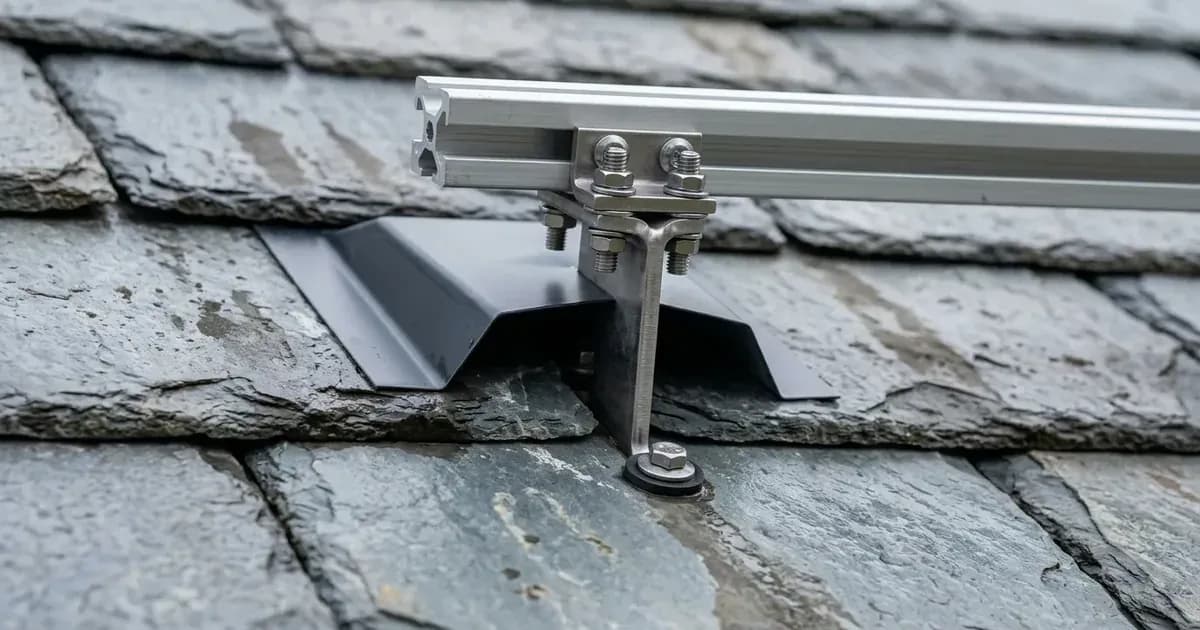
- The SolarFlash system provides a simple and effective waterproof solution to refitting roofing slates around a roof bracket when installing solar photovoltaic panels.
- The system accommodates a maximum slate length of 600mm (24 inches) on double-lap installations with head laps between 75mm and 100mm.
- When nail holes are covered by courses above, the patented Hallhook refit mechanism secures the replacement slate without visible or degrading lead tingles.
The Engineering Challenge of Domestic Slate Roofs
Natural slate—whether sourced from Welsh quarries (such as Penrhyn or Cwt-y-Bugail), Westmorland green slate, or imported Spanish varieties—is one of the most durable yet brittle roofing materials found on UK homes. Unlike interlocking concrete tiles, slates possess zero flexural tolerance. When an installer bolts a standard solar bracket over a slate or attempts to notch it with an angle grinder, the slate invariably cracks under wind loading or snow pressure.
Historically, retrofitting solar brackets to slate roofs involved crude lead soakers or mastic sealant. Over time, thermal cycling degrades sealant, leading to roof leaks, rotted roof battens, and damp ceilings. For commercial property scale penetrations, structural considerations are covered in our commercial slate and tile roof penetration guide. For residential dwellings, modern compliance demands purpose-built flashing solutions tested to MCS 012 weathertightness standards.
The SolarFlash system by Genius Roof Solutions solves this challenge. As certified in manufacturer documentation, "The SolarFlash system is a simple and effective waterproof solution to refitting roofing slates or tiles around a roof bracket when installing solar photovoltaic (or other) panels." It enables an installer to do a high-quality job and leave the roof tidy, reliable and weatherproof without relying on sealants.
SolarFlash Slate Refit vs New Build Specifications
The SolarFlash product line is tailored to two primary slate roofing applications: existing roof retrofits (Slate Refit Kit) and roof stripping/new construction (Slate New Build Kit).
Dimensional and Structural Engineering
The SolarFlash unit consists of a tough, UV-stabilized base plate integrated with a raised weatherproofing hood:
- Base Dimensions: The dimensions of the ‘Large’ SolarFlash are 365mm width/365mm length, engineered to provide complete weatherproofing coverage across double-lap slate courses.
- Hood Geometry: The hood is 50mm wide/140mm length/40mm depth, maintaining identical internal clearances across all SolarFlash models to accommodate standard stainless steel roof brackets.
- Slate Length Capacity: Designed for a maximum slate length of 600mm (24 inches). Slate sizes are marked on the SolarFlash which can be trimmed or nailed through to match the roof gauge.
- Head Lap Sizing: The length of the Large SolarFlash is based on slates being double lap (up to 100mm head lap).
- Driven Snow Seal: Each kit includes an engineered weather foam. The foam was designed with snow in mind to stop wind taking light snow into the roof void.
Component Parameter | SolarFlash Slate Refit Kit | SolarFlash Slate New Build Kit | Operational Significance |
|---|---|---|---|
Primary Application | Existing slate roofs (retrofit) | New build roofs or stripped roofs | Dedicated hardware for accessible vs blind nailing |
Supported Slate Types | Natural and manmade slate | Natural and manmade slate | Universal compatibility across slate materials |
Base Plate Dimensions | 365mm width by 365mm length | 365mm width by 365mm length | Double-lap weather protection barrier |
Integrated Hood Dimensions | 50mm wide / 140mm length / 40mm depth | 50mm wide / 140mm length / 40mm depth | Accommodates standard solar roof hooks |
Maximum Slate Length | Maximum slate length of 600mm | Maximum slate length of 600mm | Covers slates up to 600mm length |
Head Lap Operating Limits | Double lap slates up to 100mm head lap | Double lap slates up to 100mm head lap | Standard British slate laying geometry |
Included Alignment Hooks | Includes 3 x Compensation hooks | Standard fixing pack | Compensates for timber batten height steps |
Blind Nailing Hardware | Patented Hallhook and Hookpull included | Fixed directly through prepunched holes | Allows invisible slate refitting on existing roofs |
Refitting Slates with the Patented Hallhook Mechanism
The core obstacle when retrofitting solar brackets to an existing double-lap slate roof is the "blind nailing" dilemma. To fix the solar bracket to the underlying rafter, several courses of slates must be stripped using a slate ripper. Once the bracket is bolted to the rafter and the SolarFlash hood is positioned, the surrounding slates must be re-laid. However, the nail holes on the final course of slates are hidden beneath the overlapping upper courses.
Historically, roofers resorted to bending lead strips (tingles) over the bottom edge of the slate. Lead tingles are unsightly, deform under snow loads, and fail prematurely. The SolarFlash Slate Refit Kit resolves this using the patented Hallhook:
- Operating Mechanism: The patented Hallhook allows you to replace a slate when you cannot access the nail holes.
- Head Lap Range: The Hallhook only works on Hip holed slates and on head laps not less than 75mm and not greater than 100mm.
- Refit Hardware Contents: The refit kit includes 3 compensation hooks to ensure height alignment across the batten and bracket transition.
- Installation Action: The slate slides up under the overlapping course. The roofer engages the Hallhook with the accompanying Hookpull tool, securing the tail of the slate firmly against wind uplift without visible metal straps.
Regulatory and Installation Standards: MIS 3002 Compliance
Under Microgeneration Installation Standard MIS 3002 Issue 6.0:
- Solar PV installations must not compromise the building fabric. Specifically, "PV systems should not adversely affect the weather tightness or structural integrity of" the property.
- Contractors must ensure that fixings transfer wind uplift and snow down-force safely into the timber roof trusses without crushing slates.
- Rafter penetrations must be sealed to prevent water ingress into the loft space.
- Compliance with building energy standards should be maintained in accordance with our Building Regulations Part L guide and in-roof alternatives reviewed in our in-roof solar systems guide.
Step-by-Step Installation Best Practices
Executing a high-integrity slate solar installation requires strict adherence to roofing technique:
- Locate Rafter Positions: Measure rafter centers internally from the loft space or externally from the eaves. Never attempt to secure brackets into roofing battens alone.
- Slate Stripping: Use an approved steel slate ripper to slice through existing copper or galvanized nails cleanly without levering against the slate face. Remove slates to expose the rafter.
- Bracket Fixing: Position the stainless steel bracket over the rafter. Pre-drill pilot holes through the timber to prevent rafter splitting, and drive heavy-duty stainless timber screws with minimum embedment depth into solid wood.
- Flashing Placement: Slide the 365mm x 365mm SolarFlash base plate into position, seating the bracket neck through the 50mm x 140mm weatherproof hood. Ensure the hood foam insert is seated to prevent wind-blown snow ingress.
- Refit Slates: Position replacement slates, trimming where necessary along the marked guide lines. Engage the Hallhook mechanism to lock the final slate course permanently in place.
- Safety Precautions: Before commencing work on a slate roof, install full perimeter edge protection and access towers compliant with HSE working-at-height standards. Wet slate presents an extreme slip hazard. When testing DC array strings, isolate all circuits before making connections.
When to Call a Roofing Specialist
While electricians excel at inverter wiring, working on delicate slate roofs demands specialized roofing expertise. Homeowners should engage an MCS installer with proven slate roofing credentials if:
- The roof features historic or heritage hand-split Welsh slates where damage would require costly bespoke replacement.
- The roof head lap falls below 75mm or exceeds 100mm, requiring customized flashing adjustments.
- Rafter timbers exhibit signs of historical damp, rot, or deflection that require structural reinforcement before supporting the solar array.
Frequently asked questions
Can solar panels be mounted on a domestic slate roof without cracking slates?
Yes, by utilizing an engineered flashing system such as SolarFlash that replaces traditional lead slate patches and elevates the roof bracket, avoiding point compressive loads on fragile slates.
What maximum slate size does the SolarFlash slate refit system support?
The SolarFlash Slate Refit system is engineered for a maximum slate length of 600mm (24 inches) across natural Welsh, Cornish, and manmade synthetic slates.
How are replacement slates secured when nail holes are inaccessible?
Installers utilize the patented Hallhook device, which secures replacement slates on double-lap roofs with head laps between 75mm and 100mm without requiring external lead straps.
What weatherproofing standards apply to slate roof solar installations in the UK?
Under MCS MIS 3002 and MCS 012, solar installations must not compromise the weather tightness or structural integrity of the roof envelope.
References
- Genius Roof Solutions SolarFlash Slate Refit Kit Specification — accessed 16 September 2026
- Genius Roof Solutions SolarFlash Slate New Build Kit Specification — accessed 16 September 2026
- Genius Roof Solutions SolarFlash Waterproof Solutions Overview — accessed 16 September 2026
- MCS Microgeneration Installation Standard MIS 3002 Issue 6.0 — accessed 16 September 2026
Related guides
More from sizing, net billing & installation.