Domestic Solar Planning Permission & Permitted Development UK Guide
Updated 18 September 2026 · By SolarNevs Research Desk, Dealer surveys + verified sources · 1 source · Method ↗
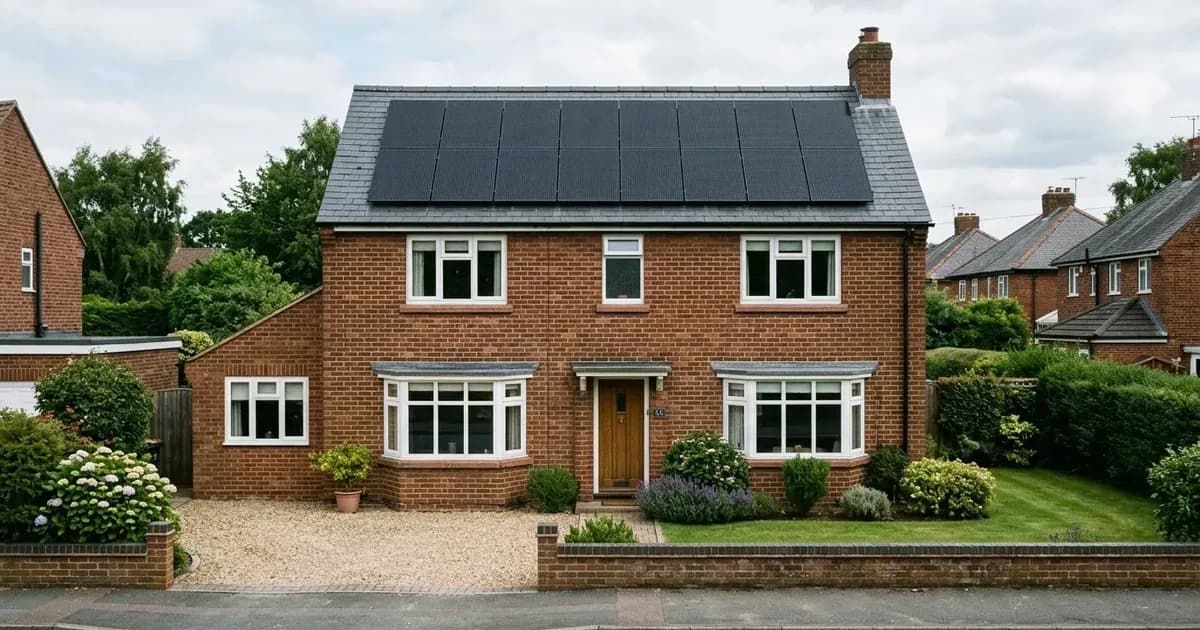
For the vast majority of homeowners in England, installing domestic rooftop solar panels does not require a formal planning application. The statutory planning system categorises domestic renewable microgeneration as "permitted development", granting automated planning consent provided installations comply with defined physical dimensions and locational conditions.
The primary legal authority governing these rights is the Town and Country Planning (General Permitted Development) (England) Order 2015 (Statutory Instrument 2015/596, known as GPDO 2015). Specifically, Schedule 2, Part 14 (Renewable energy) sets out the exact legal parameters under Class A (rooftop and wall installations) and Class B (stand-alone ground-mounted solar).
Understanding these statutory limits ensures installers and homeowners design systems that remain fully compliant without risking local planning authority enforcement action.
<Callout type="info" title="Key Statutory Limits: GPDO 2015 Part 14">
- Pitched Roof Protrusion: Equipment must not protrude more than 0.2 metres beyond the roof slope when measured from the perpendicular with the external surface.
- Apex Ridge Limit: The highest part of the equipment must not be higher than the highest part of the roof (excluding any chimney).
- Flat Roof Height Cap: On flat roofs, the installation must not result in the highest part being more than 0.6 metres higher than the highest part of the roof (excluding any chimney).
- Wall Mounting: Protrusion is capped at 0.2 metres if the wall abuts a highway, and 0.4 metres in any other wall case.
- Stand-Alone Solar (Class B): Strictly limited to 1 installation per curtilage, a maximum panel surface area of 9 square metres, and a 4 metres height limit.
- Class B Boundary Reductions: Maximum height is reduced to 2 metres within 5 metres of a boundary, and 1 metre if situated forward of the principal elevation.
- Listed Building Exclusion: Properties that are listed buildings are excluded from Class A and Class B permitted development.
</Callout>
Class A: Rooftop and Wall-Mounted Solar Microgeneration
Class A of Part 14 covers the installation, alteration or replacement of microgeneration solar PV or solar thermal equipment on:
- A dwellinghouse or a block of flats; or
- A building situated within the curtilage of a dwellinghouse or a block of flats (such as a detached domestic garage or outbuilding).
To qualify as permitted development under Class A, an installation must strictly adhere to the following development conditions:
1. Pitched Roof Protrusions and Height Ceilings
The solar PV equipment must not protrude more than 0.2 metres beyond the roof slope when measured from the perpendicular with the external surface of the pitched roof slope. Standard on-roof mounting rails and roof hooks typically keep panel clearance between 0.10 and 0.15 metres, satisfying this criterion comfortably.
Furthermore, the installation must not result in the highest part of the solar PV equipment being higher than the highest part of the roof (excluding any chimney). Arrays cannot project over the ridge line.
2. Flat Roof Height Restrictions
Flat roof mounting systems rely on angled ballast tubs or triangular A-frames (such as 10-degree or 15-degree configurations). Under Class A:
- It must not result in the highest part of the solar PV equipment being more than 0.6 metres higher than the highest part of the roof (excluding any chimney).
Installers deploying flat roof solar arrays must carefully verify panel tilt angles and ballast console heights to ensure the upper module edge remains within this 0.6 metres ceiling.
3. Wall Protrusions and Highway Facades
Where solar equipment is installed on external building walls:
- Where the wall abuts on a highway, the equipment must not protrude more than 0.2 metres beyond the plane of the wall.
- In any other case, the equipment must not protrude more than 0.4 metres beyond the plane of the wall.
Installation Location | Statutory Protrusion / Height Limit | Legal Clause (GPDO 2015 Part 14) |
|---|---|---|
Pitched Roof Slope | Max 0.2 metres perpendicular protrusion | Class A.1(b) |
Roof Ridge Line | Cannot exceed highest part of roof (excluding chimney) | Class A.1(c) |
Flat Roof Structure | Max 0.6 metres above highest part of roof (excluding chimney) | Class A.1(d) |
Wall Abutting Highway | Max 0.2 metres protrusion beyond wall plane | Class A.1(e)(i) |
Wall (Other Locations) | Max 0.4 metres protrusion beyond wall plane | Class A.1(e)(ii) |
Stand-Alone Ground Array | Max 4 metres height; max 9 square metres surface area | Class B.1(b) & Class B.1(c) |
Designated Areas and Heritage Exclusions
Permitted development rights are subject to statutory restrictions in environmentally sensitive and historic locations.
Conservation Areas and World Heritage Sites
Within land designated as a conservation area or a World Heritage Site, Class A permitted development rights do not apply if the solar PV equipment would be installed on a wall which fronts a highway.
Rooftop solar installations visible from the highway in conservation areas may still proceed under permitted development provided they are sited to minimise visual impact, but wall-mounted panels facing public thoroughfares require full planning consent.
Listed Buildings and Scheduled Monuments
The statutory exclusion for historic structures is absolute:
- The installation is not permitted development if the solar PV equipment would be installed on a dwellinghouse, or on a building within the curtilage of a dwellinghouse, if the dwellinghouse is a listed building.
Owners of Grade I, Grade II*, or Grade II listed buildings must apply for formal planning permission and Listed Building Consent (LBC) through their local planning authority before proceeding with any solar installation.
Class B: Stand-Alone Ground-Mounted Solar Arrays
Where roof space is unviable, overshadowed, or structurally unsuitable, domestic microgeneration can be deployed as ground-mounted arrays within gardens or grounds under Class B.
Class B permits the installation, alteration or replacement of stand-alone solar for microgeneration within the curtilage of a dwellinghouse or a block of flats. However, Class B is subject to strict dimensional and density caps:
- Quantity Limit: Development is not permitted if it would result in the presence within the curtilage of more than 1 stand-alone solar installation. Multiple detached ground arrays require full planning permission.
- Surface Area Limit: The surface area of the solar panels forming part of the stand-alone solar must not exceed 9 square metres. In domestic terms, this typically accommodates approximately four to five standard domestic solar modules.
- Maximum Height: The installation must not exceed 4 metres in height.
- Boundary Setbacks:
- If any part of the stand-alone solar is installed within 5 metres of the boundary of the curtilage, its maximum height is capped at 2 metres.
- If installed within 5 metres of the boundary and situated on land forward of a wall forming part of the principal elevation of the dwellinghouse, the maximum height is capped at 1 metre.
Mandatory Conditions and Decommissioning Rules
Under GPDO 2015 Part 14, all permitted development solar installations (both Class A and Class B) are subject to statutory operational conditions:
- Minimising Visual Impact: Solar equipment must, so far as practicable, be sited so as to minimise its effect on the external appearance of the building and the amenity of the area.
- Decommissioning Mandate: Solar PV or solar thermal equipment is removed as soon as reasonably practicable when no longer needed.
When solar equipment reaches end-of-life or ceases generating microgeneration power, property owners are legally required to remove the panels and restore the building or land.
Frequently asked questions
Do I need planning permission to install solar panels on a house in England?
In most cases, no. Under Schedule 2, Part 14, Class A of the GPDO 2015, domestic rooftop solar installations are permitted development provided they meet specific height, protrusion, and boundary conditions.
How far can solar panels protrude from a pitched roof under permitted development?
Under Class A rules, solar PV equipment must not protrude more than 0.2 metres beyond the roof slope when measured perpendicular from the external surface.
Can I install stand-alone ground-mounted solar under permitted development?
Yes, under Class B. However, only 1 stand-alone solar installation is permitted per curtilage, total panel surface area cannot exceed 9 square metres, and maximum height is capped at 4 metres (or 2 metres within 5 metres of a boundary).
Are listed buildings covered by permitted development for solar panels?
No. Solar installations on listed buildings or on buildings within the curtilage of a listed dwellinghouse are excluded from Class A and Class B permitted development and require formal planning permission and listed building consent.
References
- GPDO 2015 Part 14 Renewable Energy — accessed 16 September 2026
Related guides
More from sizing, net billing & installation.