Domestic Solar PV System Sizing Guide UK
Updated 18 September 2026 · By SolarNevs Research Desk, Dealer surveys + verified sources · 5 sources · Method ↗
Key Takeaways
- Domestic solar photovoltaic system sizing requires balancing household annual electricity demand against the strict electrical voltage and current envelopes of the solar inverter.
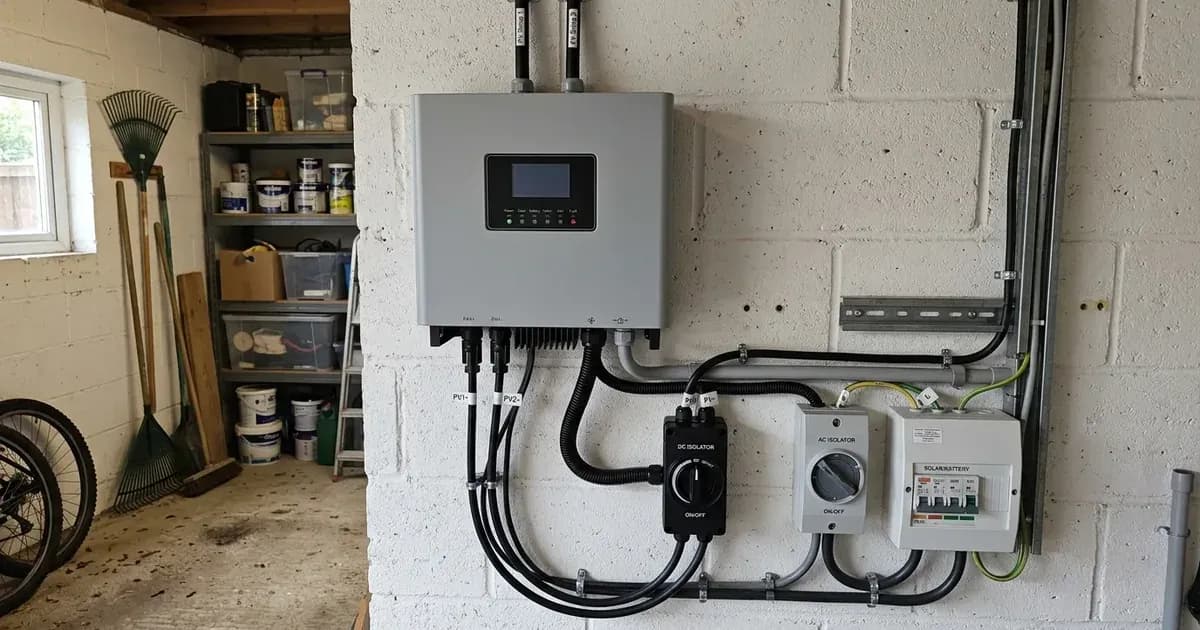
- Single-phase hybrid inverters combine solar photovoltaic conversion and battery energy management into a single wall-mounted chassis weighing 36kg.
- Key DC electrical limits govern array layout: a minimum MPPT activation threshold of 80V, a maximum array open-circuit limit of 600V, and a generous DC input ceiling of 15000W.
- Dual maximum power point tracking (MPPT) architecture supports up to 30A continuous input current and 38A short-circuit tolerance per channel, enabling split-roof installations across east and west orientations.
- The inverter delivers up to 10000W nominal continuous AC output with a maximum current export limit of 46A, achieving 97.6% peak photovoltaic efficiency and 99.9% MPPT efficiency.
- Single-phase systems exceeding 3.68kW (16A) export to the distribution grid require formal prior approval under Engineering Recommendation G99 and certified export management under standard G100.
Engineering Principles of Domestic Solar Sizing in the UK
Designing a high-performance residential solar photovoltaic (PV) installation in Great Britain requires moving beyond basic roof area estimates. True engineering optimization matches the property's annual electrical load curve to the precise electrical capabilities and statutory connection constraints of modern power electronics.
Historically, domestic solar installations were treated as isolated generation assets with string inverters designed solely to export unconsumed power back to the grid. In modern residential design, solar generation operates in synergy with chemical storage. It can be coupled directly with solar panels to generate usable electricity in the property as well as store any excess energy for later use in a battery. The Hybrid Inverter aims to minimise export by storing excess energy in the battery during generation hours.
To engineer a resilient system, installers must evaluate four core parameters:
- Inverter Electrical Boundaries: Voltage windows (start-up and maximum open-circuit DC voltage) and string current capacities (continuous and short-circuit).
- Conversion Efficiency Profiles: Peak solar conversion efficiency, weighted European operational efficiency, and MPPT tracking accuracy.
- Domestic Consumption Benchmarks: Statutory electricity baselines established by Ofgem across single-rate and multi-rate consumer profiles.
- Distribution Network Compliance: Statutory export limitations and regulatory approvals required by regional distribution network operators (DNOs).
Inverter Electrical Boundaries and Array Design
The physical solar array must be engineered within the safe electrical operating window of the inverter. Exceeding voltage thresholds can permanently destroy power semiconductor components, while failing to reach minimum voltage thresholds prevents the inverter from waking up during overcast British weather.
Using the GivEnergy Hybrid Inverter Gen 3 as a reference single-phase domestic platform, system designers operate within clearly defined electrical limits:
DC Voltage Boundaries: Start-Up vs Maximum Input
- Minimum MPPT Start-Up Voltage (80V): The inverter requires a minimum threshold of 80V DC across the solar string before its power electronics engage. This low start-up voltage ensures the system begins harvesting daylight early in the morning and continues generating power during dim, cloudy conditions typical of British winters.
- Maximum Array DC Input Voltage (600V): The absolute maximum open-circuit voltage (Voc) of any photovoltaic string must never exceed 600V under any operating condition. Because photovoltaic semiconductor cells exhibit a negative temperature coefficient (generating significantly higher voltages at sub-zero winter temperatures), string design must calculate open-circuit voltage at coldest expected ambient temperatures to guarantee the string remains safely below 600V.
Current Limits and Maximum DC Input Power
- Maximum Solar DC Input Power (15000W): The inverter accommodates an extensive solar array with up to 15000W of total DC module capacity. This high input ceiling allows substantial DC oversizing (installing more panel wattage than the inverter's AC nominal rating), ensuring strong generation during autumn, winter, and shoulder daylight hours.
- Dual MPPT Tracker Channels (30A / 30A): The inverter incorporates dual independent maximum power point tracking channels, each rated for 30A continuous input current. This high current capacity enables installers to connect high-current modern photovoltaic modules or parallel multiple strings per tracker without encountering thermal clipping.
- Short-Circuit Current Protection (38A / 38A): Each MPPT tracker channel is engineered to withstand up to 38A maximum short-circuit current, providing a robust engineering safety margin against transient electrical faults.
AC Power Delivery and Continuous Output
- Maximum Continuous AC Power (10000W): The single-phase inverter section delivers up to 10000W nominal continuous AC power into the domestic consumer unit or the wider electrical grid.
- Maximum AC Current (46A): The inverter is rated for a maximum continuous AC current of 46A, providing abundant power throughput to supply heavy domestic loads (such as heat pump compressors and electric cooking appliances) simultaneously.
- Mechanical Chassis and Siting (36kg): The entire hybrid inverter is packaged within a single wall-mountable enclosure weighing 36kg, enabling neat installation within domestic garages or utility areas.
Solar Module Electrical Matching and Roof Integration
Matching solar modules to the hybrid inverter requires evaluating individual panel specifications under standardised laboratory ratings and actual environmental loads. Taking the Viridian Solar Clearline Fusion PV16-445AG-M10 in-roof panel as an industry benchmark:
- Standard Test Conditions and Output: Electrical specification measured under standard test conditions: Irradiation 1 kW/m2 with light spectrum AM 1.5 and a cell temperature of 25°C. Under these conditions, the module delivers 445 Wp (catalogued as 445) rated peak power, with individual panel power Subject to a manufacturing tolerance of +/- 5 %.
- Voltage Characteristics (Vmpp and Voc): Each panel operates with a maximum power voltage (Vmpp) of 33.02 V (catalogued as 33.02) and an open-circuit voltage (Voc) of 39.90 V (catalogued as 39.90). Sizing a domestic string requires connecting enough modules in series to comfortably exceed the inverter's 80V start-up threshold, while ensuring total string Voc remains well under the 600V ceiling at freezing winter conditions.
- Electrical Connectivity and Safety: Strings are interconnected using Electrical Connectors Genuine Stäubli MC4 PV-KST4, PV-KBT4, ensuring low-resistance contacts and long-term protection against DC arc faults.
- Structural and Mechanical Durability: The panels are engineered for simple roof integration with clean, low-profile aesthetic for new build and retrofit, offering Structural Durability Equivalent to roof structure. Fitted during the normal roofing programme, enabling clarity of responsibility and safe working practices, the assembly ensures design resistance to ultimate loads includes a partial material safety factor of 1.0, backed by certifications under IEC61215, 61730, TUV, MCS05 , MCS12.
Hybrid Inverter Technical Electrical Matrix
Electrical Parameter | Technical Rating | Operational Significance for Array Sizing |
|---|---|---|
Inverter Architecture | Single-phase hybrid solar & battery | Eliminates redundant conversion stages; routes solar DC directly to battery storage. |
Minimum MPPT Activation Voltage | 80V | Low wake-up voltage ensures early morning generation and overcast daylight capture. |
Maximum DC String Voltage | 600V | String length ceiling; open-circuit calculations at sub-zero temperatures must not exceed 600V. |
Maximum Solar DC Input Power | 15000W | Allows extensive DC array oversizing to maximize winter and shoulder-season yields. |
Continuous MPPT Current Rating | 30A / 30A | Accommodates high-current modern monocrystalline cells across dual independent trackers. |
Maximum Short-Circuit Current | 38A / 38A | Provides robust electrical protection against string short-circuit conditions. |
Nominal Continuous AC Output | 10000W | High continuous output easily powers multiple high-draw domestic electrical circuits. |
Maximum AC Continuous Current | 46A | Supports large single-phase domestic electrical service installations. |
Peak Photovoltaic Efficiency | 97.6% | Maximizes energy transfer from rooftop solar cells into domestic AC electricity. |
European Weighted Efficiency | 97% | Delivers sustained efficiency across fluctuating British cloud cover and variable irradiance. |
MPPT Tracking Efficiency | 99.9% | Ensures dynamic impedance matching to lock onto maximum power points in real time. |
Unit Physical Weight | 36kg | Compact wall-mounted chassis suitable for garage or domestic utility mounting. |
Sizing Against Ofgem Consumption Baselines and Energy Costs
To determine how many solar panels a domestic property requires, installers must evaluate household electricity usage against official benchmarks. Ofgem establishes Typical Domestic Consumption Values (TDCVs) for Great Britain, defining standard single-rate and multi-rate consumption tiers.
Furthermore, under Ofgem's price cap methodology, the benchmark annual dual-fuel energy bill for a typical domestic customer paying by Direct Debit stands at £1,723 per year. Offsetting this substantial baseline expenditure represents the primary economic driver for residential solar installations. When projecting financial yields, an estimate of self -consumption shall be calculated in accordance with MGD 003: ‘Determining the Electrical Self -Consumption of Domestic Solar Photovoltaic (PV) to establish accurate domestic energy savings.
Single-Rate Domestic Profiles (Profile Class 1)
For properties on standard single-rate electricity tariffs, Ofgem establishes three statutory annual consumption tiers:
- Low Consumption: 1,800 kWh annually. Suitable for 1-2 person apartments or smaller terraced homes with modest appliance loads.
- Medium Consumption: 2,700 kWh annually. The standard national benchmark for 2-3 bedroom semi-detached houses.
- High Consumption: 4,100 kWh annually. Representative of 4-5 bedroom detached homes with high occupancy, electric home offices, and intensive appliance use.
Multi-Rate Domestic Profiles (Profile Class 2)
For homes utilizing time-of-use tariffs or dual-rate metering:
- Low Consumption: 2,200 kWh annually.
- Medium Consumption: 3,900 kWh annually.
- High Consumption: 6,700 kWh annually.
Sizing Strategy by Consumption Class
Domestic Demand Profile | Ofgem Benchmark | Design and Sizing Strategy |
|---|---|---|
Profile Class 1 (Single-Rate) | Low: 1,800 kWh | Compact array layout; single string operating comfortably above 80V start-up threshold. |
Profile Class 1 (Single-Rate) | Medium: 2,700 kWh | Balanced domestic array; dual-orientation strings taking advantage of 30A dual MPPT trackers. |
Profile Class 1 (Single-Rate) | High: 4,100 kWh | Full roof utilization; high string voltages approaching 600V limit to minimize cable losses. |
Profile Class 2 (Multi-Rate) | Low: 2,200 kWh | Sized to cover daytime baseload while pairing with battery storage for overnight tariff charging. |
Profile Class 2 (Multi-Rate) | Medium: 3,900 kWh | Dual string configuration; maximizes self-consumption against £1,723 price cap baseline. |
Profile Class 2 (Multi-Rate) | High: 6,700 kWh | Extensive DC oversizing approaching 15000W DC input to supply heat pumps and domestic loads. |
Network Compliance: Navigating G99 and G100 Regulations
In Great Britain, connecting a solar generation system to the electricity distribution grid is strictly regulated by the Energy Networks Association (ENA). Installers must ensure equipment is fully certified and follows statutory connection pathways:
Standard G98 vs G99 Connection Pathways
- Fast-Track G98 Notification (3.68kW per Phase): Under ENA Engineering Recommendation G98, small-scale embedded generators can connect under a simplified "fit and inform" procedure, provided total export capacity does not exceed 3.68kW per phase (corresponding to a 16A current limit). Installers simply commission the equipment and notify the regional DNO within 28 days.
- Prior Approval under G99: Systems with inverters capable of delivering up to 10000W continuous output (such as the Gen 3 hybrid unit) exceed the 3.68kW threshold. Connecting such systems requires submitting a formal application to the regional DNO under Engineering Recommendation G99 prior to installation and receiving a formal grid connection offer.
Statutory Export Management under Standard G100
To overcome DNO export restrictions in areas with constrained local network infrastructure, modern hybrid inverters incorporate certified export limitation schemes compliant with standard G100:
- Failsafe Curtailment: A G100-compliant installation continuously measures real-time domestic demand via an approved energy meter. If household demand drops and potential grid export threatens to exceed the DNO's agreed limit (for instance, 3.68kW), the inverter automatically curtails solar generation or diverts excess DC power into battery storage within seconds.
- Maximizing Generation Without Network Upgrades: By deploying certified G100 export limitation, homeowners can install large rooftop arrays (up to 15000W DC input) to achieve maximum self-consumption during winter and shoulder months, without being blocked by regional grid export caps.
Practical Design Considerations: Roof Geometry and Shading
Achieving optimal system performance requires accounting for practical site conditions:
- Azimuth and Pitch Optimization: In the UK, rooftop pitches between 30° and 40° facing true south yield optimal annual solar radiation. However, with dual 30A MPPT trackers, modern systems excel on split east-west roofs. An east-west array produces a wider daily generation curve, generating power earlier in the morning and later into the evening, matching typical domestic consumption patterns.
- DC String Voltage Calculations: Installers must calculate string open-circuit voltage at minimum design temperatures (-10°C) to ensure the 600V maximum DC input is never breached, while maintaining string operational voltages safely above the 80V start-up threshold even under high summer cell temperatures.
- High-Efficiency Inversion: Operating with a peak photovoltaic efficiency of 97.6%, a weighted European efficiency of 97%, and 99.9% MPPT accuracy ensures that available rooftop solar irradiance is converted into usable household electricity with minimal thermal loss.
Frequently asked questions
What inverter electrical ratings dictate domestic solar array sizing?
Array sizing is bounded by inverter voltage and current parameters, including an 80V start-up threshold, a 600V maximum DC input voltage, and a 30A input current per MPPT channel.
How much solar DC input power can a single-phase hybrid inverter handle?
Modern single-phase hybrid inverters accommodate up to 15000W of DC solar input, converting up to 10000W into continuous AC domestic power.
How does domestic solar sizing align with Ofgem electricity consumption baselines?
System sizing correlates with Profile Class 1 single-rate demand benchmarks: Low at 1,800 kWh, Medium at 2,700 kWh, and High at 4,100 kWh annually.
When does a domestic solar installation require formal DNO approval under G99?
Installations exceeding the standard 3.68kW (16A) single-phase export threshold require prior G99 approval and may utilize G100 statutory export limitation.
References
- GivEnergy Hybrid Inverter Gen 3 Technical Specification — accessed 29 August 2026
- Ofgem Decision on Typical Domestic Consumption Values 2023 — accessed 29 August 2026
- Ofgem Energy Price Cap October to December 2026 Determination — accessed 29 August 2026
- Viridian Solar Clearline Fusion PV16 Data Sheet — accessed 29 August 2026
- Microgeneration Installation Standard MIS 3002 Issue 6.0 — accessed 29 August 2026
Related guides
More from sizing, net billing & installation.