Can You Charge an EV in the Rain? Snow? A Car Wash?
Updated 6 September 2026 · By SolarNevs Research Desk, Dealer surveys + verified sources · 1 source · Method ↗
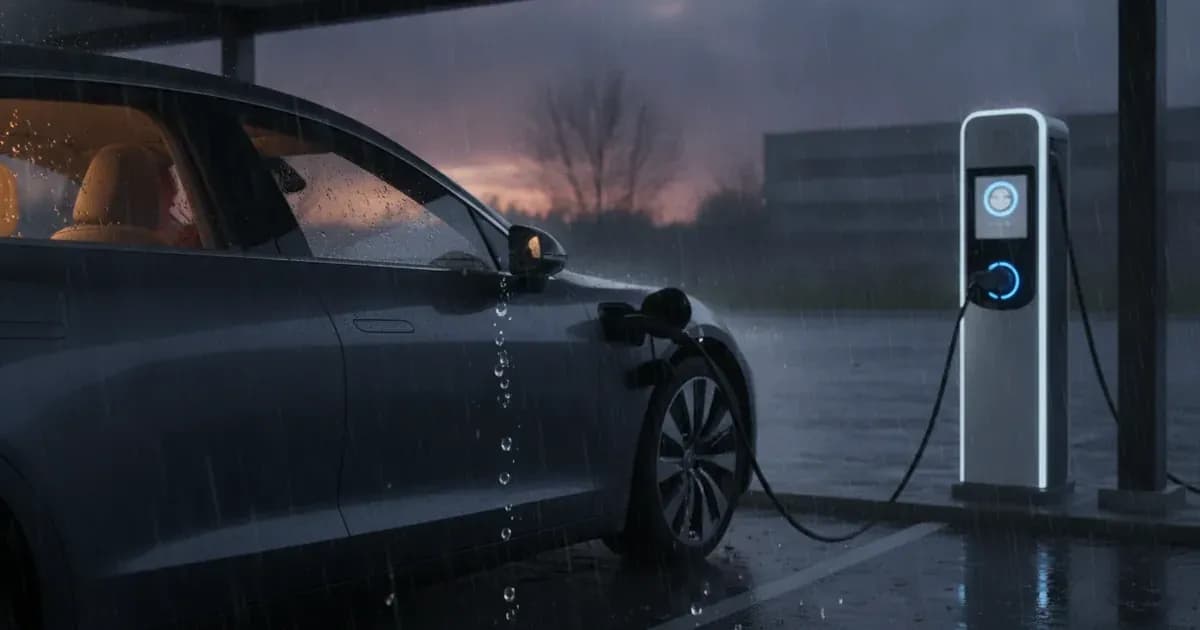
Key Takeaways
- Yes — wet-weather charging is routine by design: sealed connectors, and no live power until the plug locks and the safety handshake completes.
- The fear imports a gasoline-era intuition (liquids + energy = danger) into a system engineered specifically against it.
- Snow, drizzle, downpours: all fine. The real rules are about damage, flooding, and proper installation, not weather.
- Millions of outdoor charging sessions happen in rain daily across every climate the US owns — the experiment has run.
Why the plug in the rain isn't the hazard it looks like
The image triggers every childhood warning: electricity, water, an exposed connector. The engineering answer is that the connector is never what it looks like. Charging pins are de-energized until connected: the plug seats into the port, physically locks, and only then do the car and charger negotiate — verifying the circuit, the insulation, the ground — before any current flows. Yank test, drop it in a puddle, plug it in soaked: the exposed state carries no power to meet the water.
Around that logic sits physical sealing — connectors and ports are built to automotive weather-exposure standards, the same discipline that lets every other high-voltage component on the car live in rain, spray, and slush for decades. Public chargers stand uncovered in Seattle drizzle and Florida thunderstorms as their permanent job description. DOE safety guidance treats outdoor charging as the default case it is.
The weather edge cases, answered
Scenario | Verdict | The nuance |
|---|---|---|
Rain, any intensity | ✅ Routine | This is the design case |
Snow and ice | ✅ Routine | Clear the port of packed ice for a clean seat |
Thunderstorm | ✅ Equipment-wise | The caution is you outdoors, not the charger |
Car wash | ✅ (not while charging) | Cars are wash-rated; unplug first, obviously |
Flooded charge port / standing water | ❌ Stop | Damage territory — inspect before use |
Visibly damaged cable or connector | ❌ Stop | The one genuine electrical hazard here |
Per DOE safety framing and universal manufacturer guidance.
The pattern in the table: weather never disqualifies charging — condition does. A cracked connector housing or a port that's been submerged is an equipment problem that happens to involve water, and the response is inspection, not weather anxiety.
Home-charging's version of the question
Outdoor home chargers are a normal, code-compliant installation — the requirements are the boring ones: an outdoor-rated unit, a properly permitted circuit with the protection modern code requires, and mounting per the manufacturer. Handled by any competent electrician, the driveway charger is as weatherproof as the porch light. What this question is actually asking, often, is "should I be nervous about the whole system?" — and the honest answer is that the charging chain (charger, cable, connector, port, onboard electronics) is among the most safety-engineered consumer electrical systems ever deployed, precisely because it was designed knowing it would live outdoors in the rain, be handled by wet hands, and get dropped on driveways for twenty years.
Charge in the rain. The car was built for the world it lives in — a standard the folklore has been slower to meet than the hardware.
Keep reading: EV charging times · charging levels · the cost to charge an EV.
Frequently asked questions
Can you charge an electric car in the rain?
Yes, completely routinely. Charging connectors and ports are engineered for outdoor weather — sealed against ingress, and designed so no power flows until the plug is locked in and the car and charger complete their safety handshake.
How is a soaked charging plug safe?
The pins aren't live when exposed: current flows only after the connector seats, locks, and the vehicle-charger electronics verify the circuit. Rain on the outside never meets electricity on the inside.
Can you charge in snow or a thunderstorm?
Snow, yes — same engineering. Thunderstorms: charging is fine as far as the equipment is concerned; lightning caution is about being outside at all, and a home charger on a properly wired circuit is as protected as any appliance.
What water rules do exist for EVs?
Common-sense ones: don't charge through visible connector damage or a flooded port, keep home charging equipment properly installed and rated for outdoor use if mounted outside, and follow the manual after deep-water events.
References
- US DOE AFDC – Maintenance and safety of electric vehicles — accessed 5 August 2026
Related guides
More from going electric in pakistan.