Can You Jump-Start an EV? And Can It Jump Your Gas Car?
Updated 6 September 2026 · By SolarNevs Research Desk, Dealer surveys + verified sources · 1 source · Method ↗
Key Takeaways
- Yes, you can jump an EV — you're jumping its ordinary 12-volt battery, the same way and for the same reason as any car.
- The paradox to internalize: a dead 12-volt strands a full pack — the big battery can't connect itself without the little one's electronics.
- Direction matters: EV receiving a jump is routine; EV giving one to a gas car is prohibited by most manuals — starter motors draw too much.
- The unglamorous best practice: a $60-class lithium booster pack in the frunk retires the whole topic.
The two-battery secret every EV owner learns eventually
Every EV carries two electrical systems. The high-voltage pack — the hundreds-of-volts, tens-of-kWh battery this site's charging guides revolve around — moves the car. And a plain 12-volt battery, cousin to the one in any gas car, runs everything that must work before the big pack connects: computers, locks, screens, and critically the contactors — heavy relays that physically bridge the high-voltage pack to the car.
That architecture creates the signature EV failure: 12-volt dies, contactors can't close, and a car with 250 miles of range sits as inert as any dead sedan. It isn't rare — the humble 12-volt is among the most common EV roadside calls, per the pattern DOE maintenance guidance and every owner forum echo. The high-voltage pack does recharge the 12-volt in normal operation, but leave the car parked long enough, or let an aging 12-volt fade, and the little battery loses the race.
Jumping an EV: the routine direction
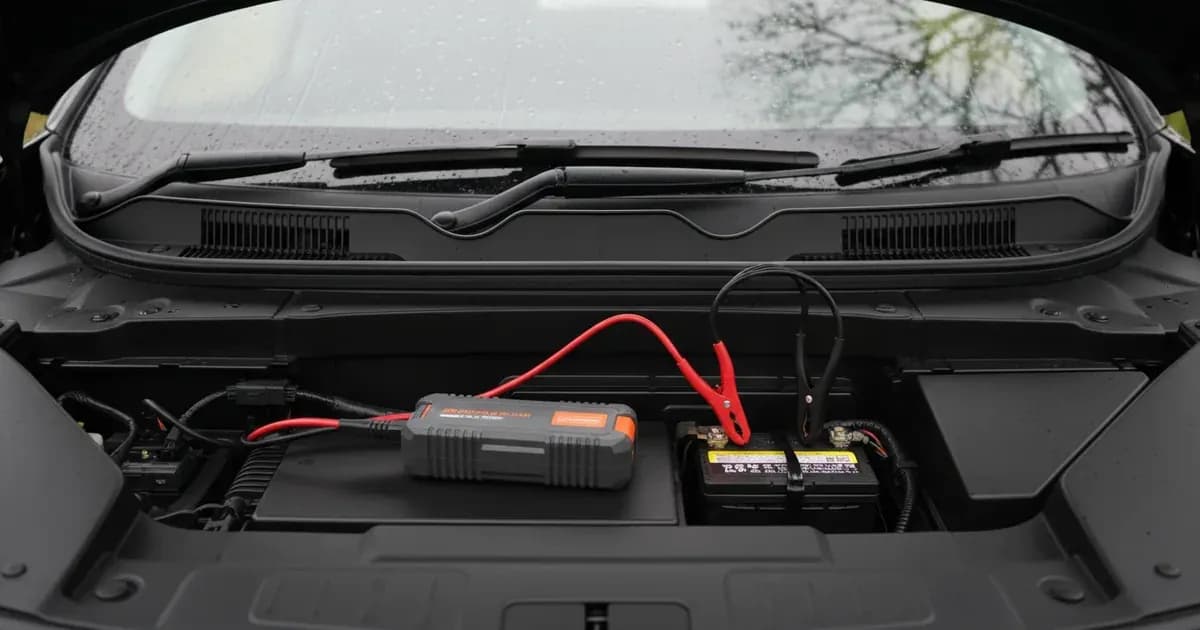
The procedure is deliberately familiar: locate the 12-volt terminals (often in the frunk area, sometimes remote posts because the battery hides elsewhere), connect a booster pack or donor car's cables positive-to-positive and negative-to-ground, wait a moment, and the car boots — screens light, contactors clunk, and you're driving on the big pack while it replenishes the small one. Three EV-specific footnotes:
- Manual first, cables second. Jump points and sequences vary more between EVs than between gas cars; some hide terminals in unintuitive places.
- Never touch anything orange. Orange cabling is the high-voltage system — no jump procedure involves it, and nothing about a 12-volt jump requires going near it.
- Investigate repeat offenders. A 12-volt that dies twice is aging or being drained (aftermarket accessories are classic culprits); replacement is cheap and proactive replacement at the first warning is cheaper than the second stranding.
Donating jumps: the direction most manuals forbid
Using your EV to rescue a gas car seems neighborly and symmetrical. It isn't: a combustion starter motor gulps hundreds of amps, and an EV's 12-volt system — sized to run electronics, not crank engines — can be damaged sourcing that surge. Multiple manufacturers explicitly prohibit it in their manuals, and "the manual says no" is the whole answer on warranty grounds alone. (V2L-equipped models that offer household outlets are powering appliances through proper inverters — a different, sanctioned trick; see our bidirectional-charging guide.)
The right tool for both directions of this problem is the same: a compact lithium booster pack. It jumps your EV's 12-volt without a donor, jumps strangers' gas cars without risking your car, and lives in the frunk costing nothing until the night it's everything.
Scenario | Verdict |
|---|---|
Jump an EV's 12-volt (booster or donor car) | ✅ Routine — manual for jump points |
EV jump-starts a gas car | ❌ Most manuals prohibit — starter draw |
Anything involving the high-voltage pack | ❌ Never part of any jump procedure |
Booster pack in the frunk | ✅ The category-killer answer |
Per DOE guidance and prevailing manufacturer manual language; your manual governs your car.
The takeaway has a pleasing shape: the EV's most futuristic battery almost never strands you — its most ordinary one occasionally does, and a tool the size of a paperback solves it. File under the growing genre this cluster keeps finding: EV problems that are smaller, cheaper, and more boring than the folklore.
Keep reading: the oil-change question · EV gears · EV tires.
Frequently asked questions
Can you jump-start an electric car?
Yes — EVs carry a conventional 12-volt battery that runs computers, locks, and contactors, and when it dies the car won't 'boot.' Jumping that 12-volt with a booster pack or donor car wakes the EV; the high-voltage pack is never involved.
Why won't my EV turn on with a full main battery?
Because the 12-volt is the ignition system: it powers the electronics that connect the high-voltage pack. A dead 12-volt strands hundreds of miles of range behind a relay that can't close — the most common EV roadside call.
Can I use my EV to jump-start a gas car?
Most manufacturers say no. A gas starter motor's massive current draw can damage the EV's modest 12-volt system, and several manuals explicitly prohibit donating jumps. Carry a booster pack instead.
Where are the jump points on an EV?
Often behind a panel in the frunk or engine-bay area, sometimes with remote terminals because the battery itself is buried. Your manual shows the exact points — worth finding before the rainy night.
References
- US DOE AFDC – Maintenance and safety of electric vehicles — accessed 5 August 2026
Related guides
More from going electric in pakistan.