Do Electric Cars Have Transmissions? Gears, Explained
Updated 6 September 2026 · By SolarNevs Research Desk, Dealer surveys + verified sources · 1 source · Method ↗
Key Takeaways
- EVs have a single-speed reduction gear, not a transmission as gas cars mean it — one fixed ratio, zero shifting, nothing to service.
- The reason is the motor: full torque from zero RPM across an enormous speed range makes gear-swapping pointless.
- Exceptions exist as garnish — a couple of performance EVs run two speeds for top-end bragging rights.
- Your selector's P-R-N-D and paddles are software: direction, drive modes, and regen strength — not gears.
What's actually between an EV's motor and wheels
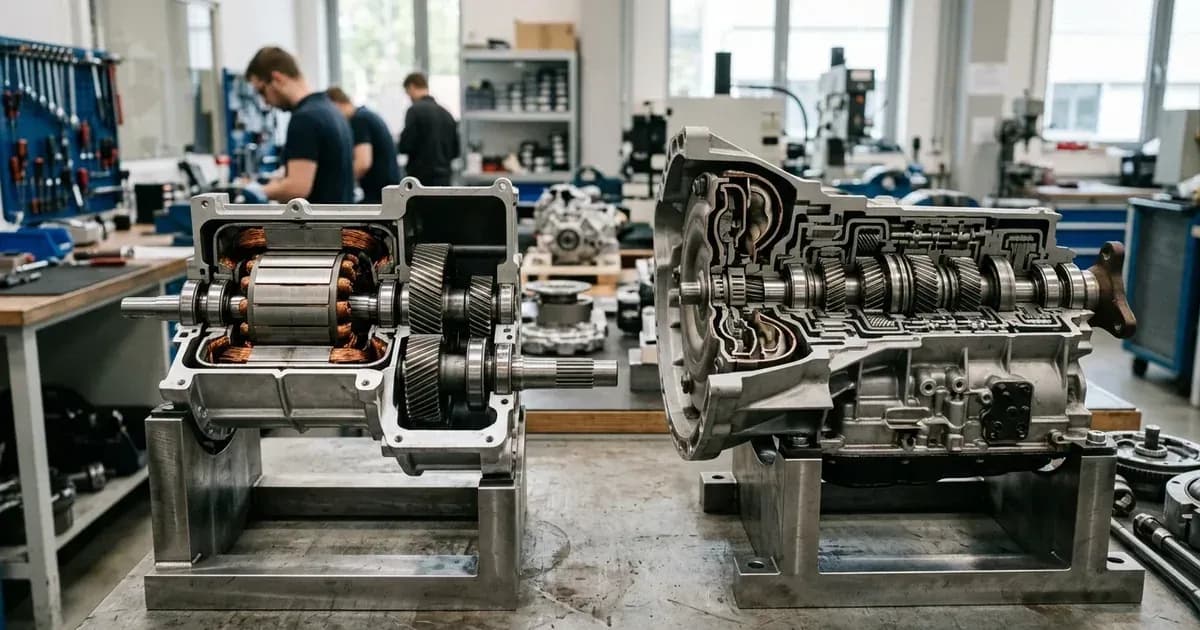
Open an EV's drivetrain and the "transmission" is almost comically simple: a single-speed reduction gearbox — a fixed pair (or planetary set) of gears that steps the motor's fast rotation down to wheel speeds and multiplies torque by the same fixed ratio. The DOE's drivetrain explainers label it exactly that. No clutch, no torque converter, no valve body, no bands, no shifting — and no transmission-service line on the maintenance schedule, just a sealed lubricant that most manufacturers never ask you to touch.
Gas cars carry six-to-ten-speed transmissions because combustion engines are prima donnas: they produce usable torque only within a narrow RPM band and must be kept there by constant ratio-swapping. The transmission is a workaround for the engine's limitations. Remove the limitations and the workaround follows.
Feature | Traditional Combustion Transmission | Mainstream EV Reduction Gear |
|---|---|---|
Gears & Ratios | 6 to 10 selectable speeds | Single fixed reduction ratio (or planetary set) |
Torque Delivery | Narrow RPM band requiring constant shifting | Maximum torque at zero RPM across a wide operating range |
Internal Components | Clutch, torque converter, valve body, and bands | Fixed gear pair; no clutch or torque converter |
Reverse Operation | Mechanical reverse gear | Electronic direction control (motor spins backward) |
Routine Maintenance | Scheduled transmission fluid and filter servicing | Sealed lubricant with no transmission-service schedule |
Moving Parts | Hundreds of moving mechanical components | Dozens of moving powertrain components |
Why one gear is enough
An electric motor's characteristics read like the wishlist gears were invented to fake:
- Maximum torque at zero RPM — the launch gear's job, built in. It's why modest EVs embarrass sports cars off the line.
- A usable band tens of thousands of RPM wide — one ratio covers parking-lot creep to interstate speeds without strain.
- Efficiency that stays high across the band — where a gas engine's efficiency island is small enough to need constant chasing.
- Instant, precise control — "shift quality" becomes a software constant: there are no shifts.
The driving texture people notice first in an EV — the uninterrupted, seamless surge — is the absence of gear changes, experienced viscerally.
The exceptions and the fake gears
A small club of performance EVs runs a two-speed gearbox — a short launch ratio plus a long top-speed ratio — solving a problem that exists mainly above legal speeds; the mainstream hasn't followed because one ratio genuinely suffices. Meanwhile everything gear-shaped in your EV's cabin is electronic theater: R spins the motor backward (there is no reverse gear), P engages a parking pawl, drive modes remap the accelerator, and the paddles that look like shifters on many models adjust regenerative braking strength — how aggressively lifting off harvests energy — which is the closest thing EVs have to a gear-change sensation, and it's braking, not gearing.
Why this matters beyond trivia
The missing transmission is a load-bearing absence. It's a chunk of why EV maintenance lists are short (see our oil-change explainer — the two questions share an answer: less machinery, less service), why the drivetrain's moving-parts count collapses from hundreds to dozens, and why powertrain longevity conversations center on the battery rather than mechanical wear. For the total-cost math this site runs — fuel from your roof, maintenance from a short list — the single-speed gearbox is one more subsystem that simply stopped being a cost center. The gearhead's lament is the owner's savings.
Keep reading: jump-starting an EV · EV tires · the EV maintenance list.
Frequently asked questions
Do electric cars have transmissions?
Not in the multi-gear sense. Nearly all EVs use a single-speed reduction gearbox — a fixed gear ratio between motor and wheels. There's no shifting, no clutch, no torque converter, and no transmission service.
Why don't EVs need multiple gears?
Electric motors deliver strong torque from zero RPM and stay efficient across a huge speed range — the exact weaknesses gears were invented to patch in combustion engines don't exist.
Do any EVs have more than one gear?
A handful of performance cars use a two-speed unit to combine launch acceleration with high top speed — engineering garnish on exotic machines, not a direction the mainstream needs.
What do the drive modes and 'gears' on my EV's selector do?
P-R-N-D on an EV selects direction and modes electronically — reverse is the motor spinning backward, not a reverse gear. Paddle 'shifts' on many EVs adjust regenerative braking strength, not ratios.
What do the drive modes and "gears" on my EV's selector do?
P-R-N-D on an EV selects direction and modes electronically — reverse is the motor spinning backward, not a reverse gear. Paddle "shifts" on many EVs adjust regenerative braking strength, not ratios.
References
- US DOE – How do all-electric cars work? — accessed 5 August 2026
Related guides
More from going electric in pakistan.