Can Electric Cars Tow? Yes — Now Let's Talk About the Range
Updated 6 September 2026 · By SolarNevs Research Desk, Dealer surveys + verified sources · 2 sources · Method ↗
Key Takeaways
- Yes, and electric trucks tow exceptionally well — instant torque, no gear hunting on grades, superb low-speed control.
- The penalty is range: roughly 40–60% loss in real-world testing, and toward 70% with tall trailers at highway speed.
- Aerodynamics beat weight: a boxy camper costs far more range than a low, open utility trailer of the same mass.
- The real friction isn't the truck — it's charging logistics, since most fast-charging sites aren't built for a vehicle with a trailer attached.
Why the driving experience is genuinely better
Start with the good news, because it's substantial and under-reported. An electric truck delivers maximum torque from zero rpm, which is exactly what a loaded trailer wants off the line and up a grade. There is no downshift hunting, no turbo lag, no gear searching on a long climb — the transmission that isn't there can't hunt. Weight sits low, which helps stability. Regenerative braking holds speed on descent without cooking the friction brakes, doing the job engine braking does badly.
Anyone who has towed with both will tell you the electric truck is the calmer machine. The capability question is answered: rated tow capacities on current electric pickups are competitive with combustion equivalents. The question is what happens to range.
The number you have to plan around
Real-world testing converges on a 40–60% range loss for typical setups, and the worst cases go further — heavy, tall trailers at 70 mph have pushed tested range toward a third of the unladen figure. Manufacturers themselves have guided to roughly a 50% reduction with mid-weight trailers.
What you're towing | Expected hit |
|---|---|
Low, open utility trailer | Toward the mild end of the band |
Boat on a trailer | Middling — depends on hull height |
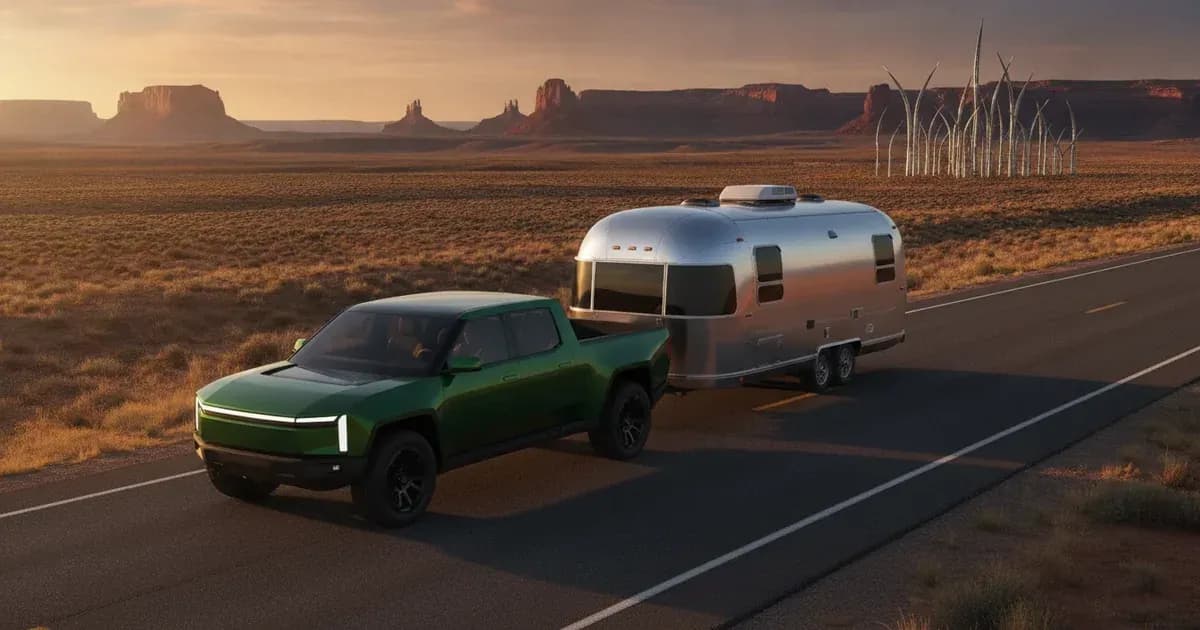
Tall enclosed / travel trailer | Toward the severe end — frontal area rules |
Near max capacity at 70+ mph | Worst case — plan for roughly a third of rated range |
Real-world test range 40–70% loss depending on trailer profile, speed, weather and load; treat your first trip as the measurement.
The physics explains the ranking. Aerodynamic drag scales with frontal area and with the square of speed, so a tall box behind you at 70 mph is a vastly bigger tax than the same mass in a low trailer at 60. This is why the single most effective towing tactic in an EV is the least popular one: slow down. Dropping from 70 to 60 mph recovers a disproportionate share of the loss.
Cold compounds it — winter range loss stacks on top of the towing penalty rather than overlapping with it, which is how a 300-mile truck ends a January morning showing under 100 miles with a trailer.
The logistics problem nobody warns you about
Here's the part that decides whether EV towing works for you, and it has nothing to do with the truck. Fast-charging sites are laid out for cars. Pull-through stalls that accommodate a trailer exist but aren't the norm, which means unhitching in a parking lot — repeatedly, on a long trip, in whatever weather you have.
Combined with a charging stop roughly every 100–150 towing miles, a long haul becomes an exercise in route research. Road-trip planning is already a charging-curve discipline in an EV; add a trailer and it becomes the trip's main organizing constraint. Network coverage matters more here than anywhere else in EV ownership.
So the honest recommendation splits cleanly. If you tow occasionally and locally — a boat to the lake, a utility trailer across town, a camper a couple of hours out — an electric truck is very likely better at the job than what you're driving now, and the ordinary running-cost advantage applies to the other 95% of your miles. If you tow heavy, far, and often, the charging logistics are a genuine ongoing cost, and clear-eyed planning or a combustion option is the fair answer in 2026.
One consolation worth noting for the occasional tower: the truck that hauls your trailer six weekends a year spends the other fifty-something charging in your driveway — and if that driveway power comes off your roof, the fuel bill for everything except the towing has effectively gone away.
Frequently asked questions
Can electric cars tow a trailer?
Yes, and electric trucks tow unusually well — instant torque, no downshifting on grades, and strong low-speed control. The constraint isn't capability, it's range: expect to lose roughly 40–60% of normal range while towing.
How much range do you lose towing with an EV?
Real-world testing clusters in the 40–60% band, with heavy, boxy trailers at highway speed pushing toward 70%. Aerodynamics matter more than weight — a tall camper hurts far more than a low, open utility trailer of similar mass.
Are electric trucks good for towing?
Mechanically, excellent — torque delivery and stability are genuine advantages over combustion trucks. Logistically, harder: charging stops are more frequent, and most fast-charging sites aren't laid out for a vehicle with a trailer attached.
Should I buy an EV if I tow often?
If you tow long distances regularly, the charging logistics are still a real cost — plan carefully or keep a combustion option. If you tow occasionally and locally, an electric truck is likely better at the job than what you have now.
References
- US DOE AFDC – Electric vehicle benefits and considerations — accessed 5 August 2026
- FuelEconomy.gov – EV efficiency and range factors — accessed 5 August 2026
Related guides
More from going electric in pakistan.